JERUSALEM JERUSALEM!

My month in Palestine is nearing an end. It flew by as I knew it would. The last few days have been jam packed with must-dos. On Friday, I went into Jerusalem to meet with a lawyer from the human rights organization Diakonia. You can read about them here. http://www.diakonia.se/en/Where-we-work/Middle-EastNorth-Africa/ He was a young, very bright Italian chap named Alessandro. He’s been working for them for a couple of years and prior to that worked for the Palestinian advocacy group, Al Haq, which you can read about here. http://www.alhaq.org/ We met in a nice little book store in East Jerusalem, the focus of which was Palestine. I ordered a grapefruit juice and got an eye-poppingly huge tumbler full of fresh squeezed juice. There must have been 3 grapefruits in it. It was delicious. I’m proud to say I drank every last drop,too.

IMG_1296

Here is Alessandro. We compared notes on our work and he gave me a lot of good ideas. I hope our paths will cross again (I’ve been saying that a lot lately!). Inshallah.

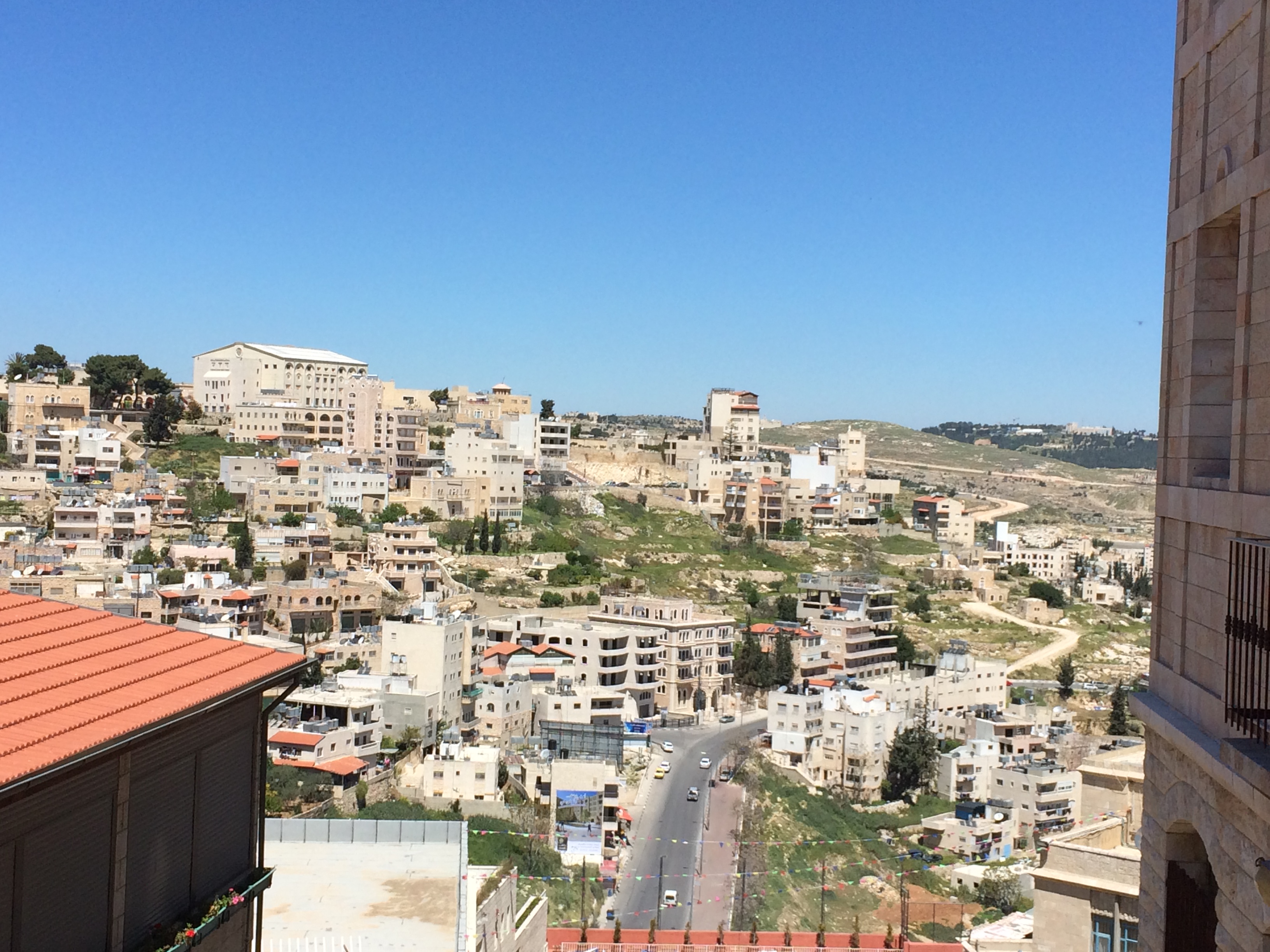
Before sharing lovely pictures of Jerusalem, I  am compelled to talk about the trip into Jerusalem. Bethlehem and Jerusalem are very close to each other, but you would never know that anymore because of Israel’s slow, deliberate attempt to sequester all of Jerusalem and its surrounds. I’ve shown a picture of the separation wall in Bethlehem where people would pass from one city to the other.
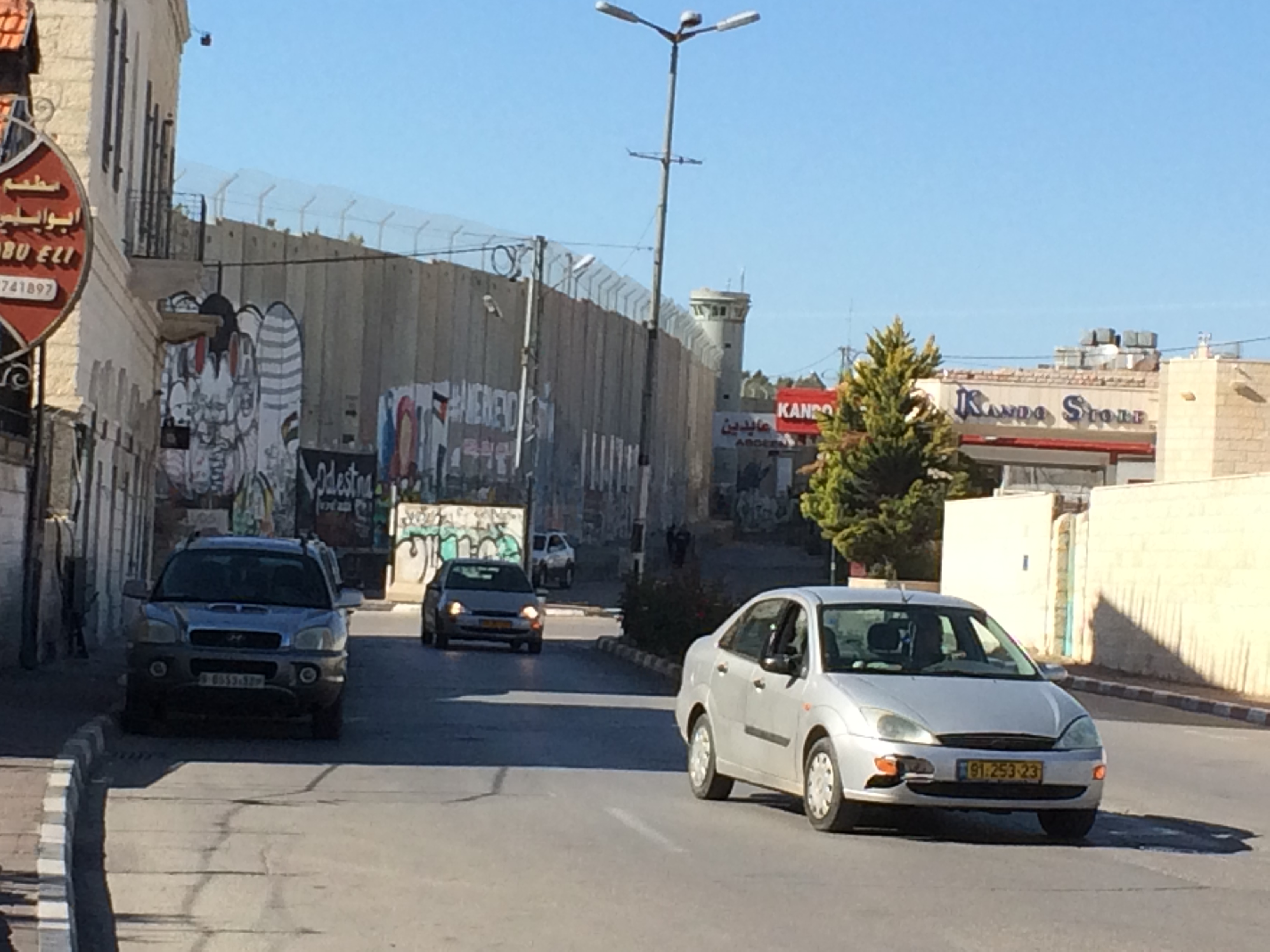
IMG_1350

Here is it is again – on the Bethlehem side.
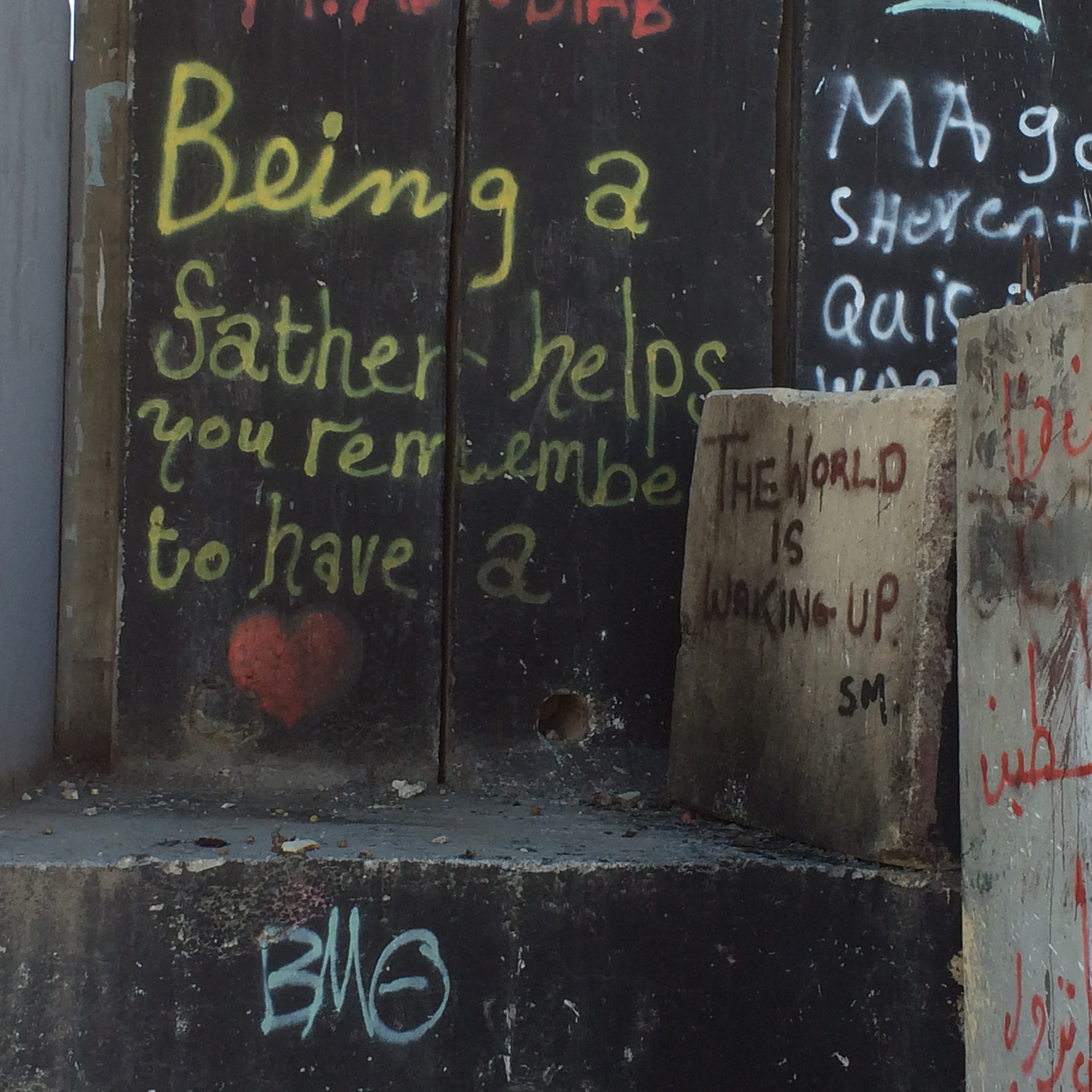
IMG_1361

And a detail of graffiti on the wall from the same area. There are so many good ones, but this one really spoke to me.

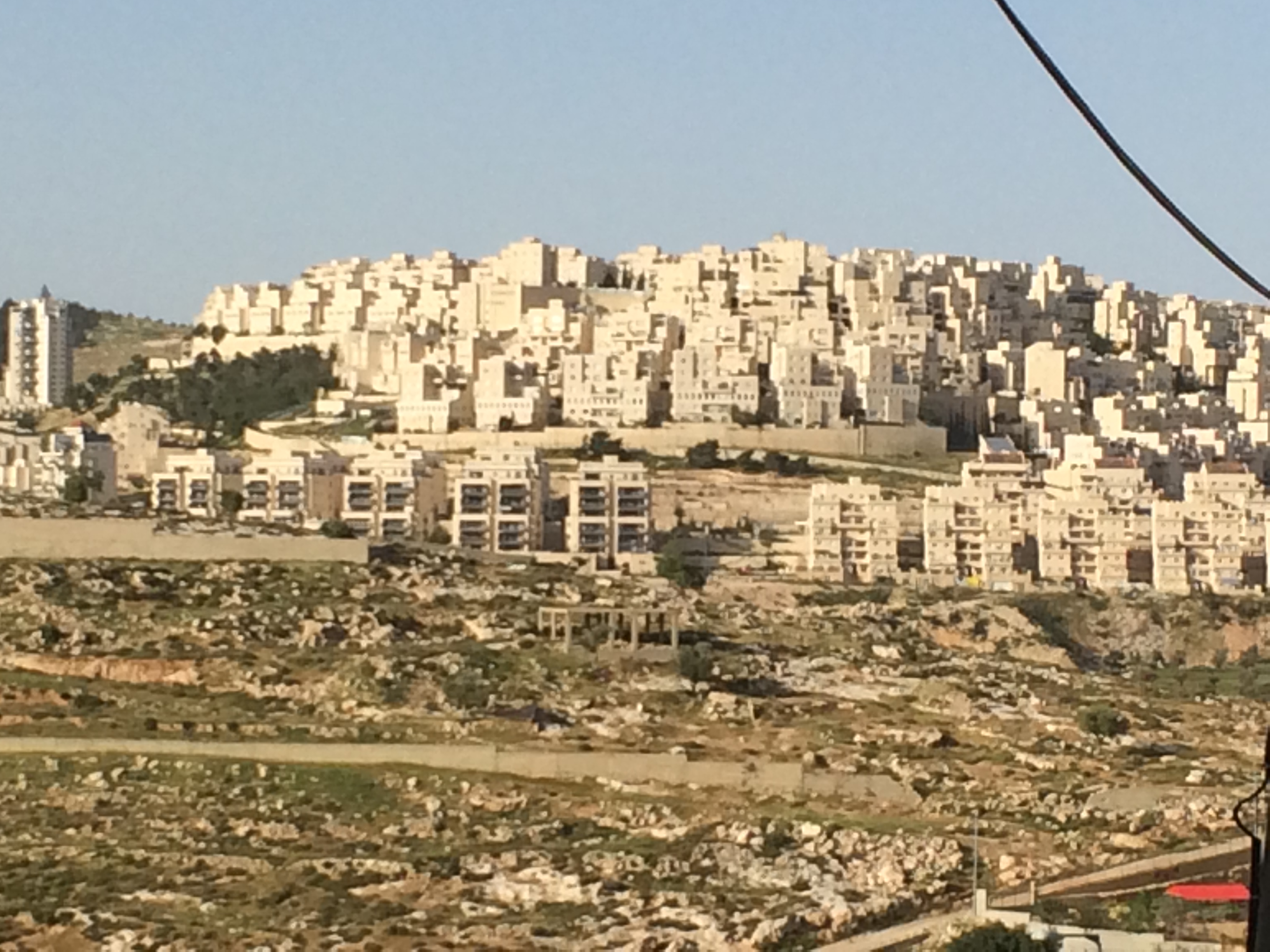
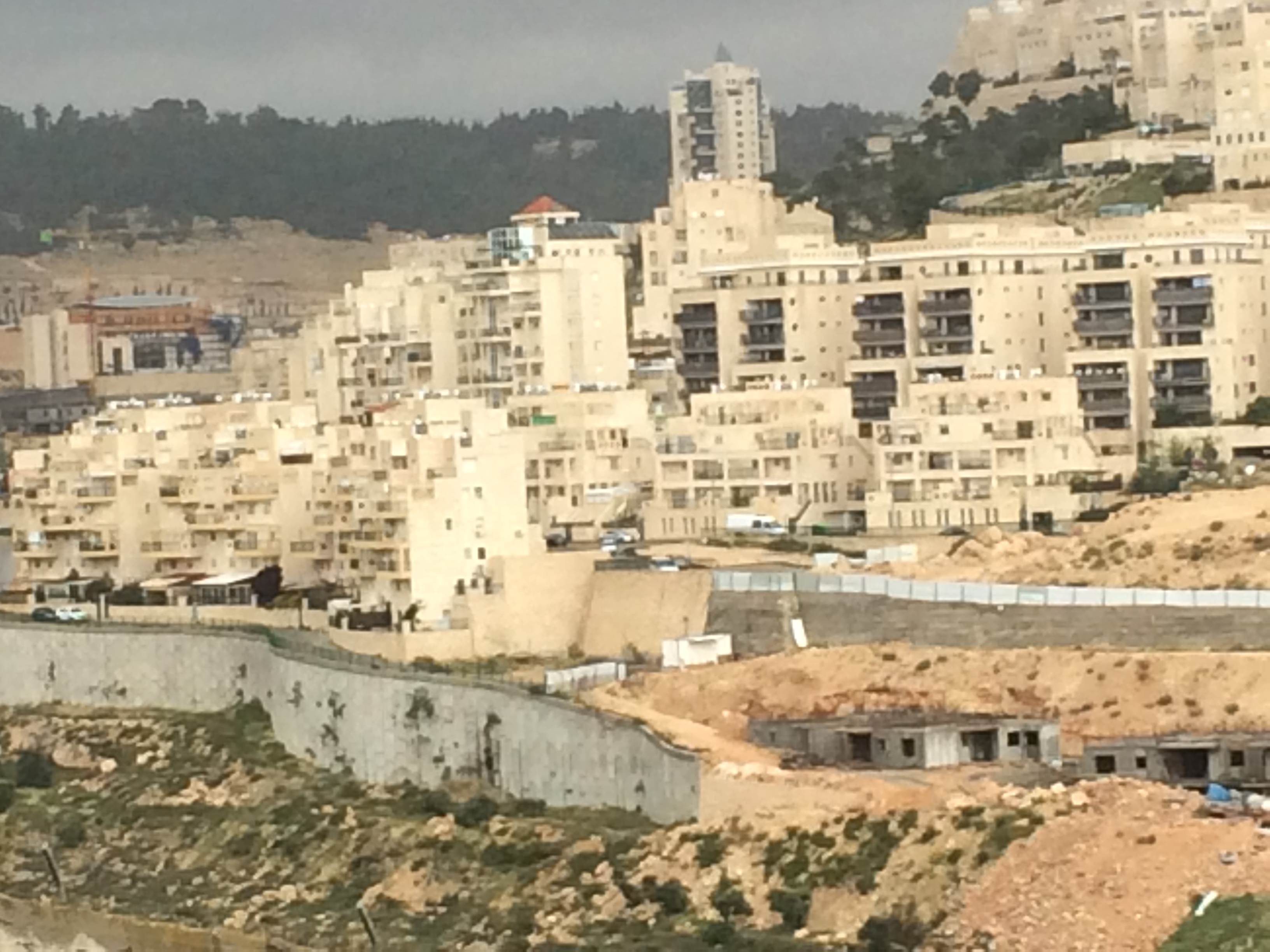
But, that’s not all. There are three large settlements that surround Bethlehem and are further encroaching on it. I have shown pictures of Har Homa which overlooks my neighborhood. They always build the settlements on high hills, giving them the advantage of being able to look down on the Palestinians in a siege sort of mentality. Imagine the feeling of the Palestinians having to constantly look up at them. These modern metropolises that are so out of place in the environment, secured by tall cement fences and with roads on which only Israelis are allowed, dissecting farms and villages.

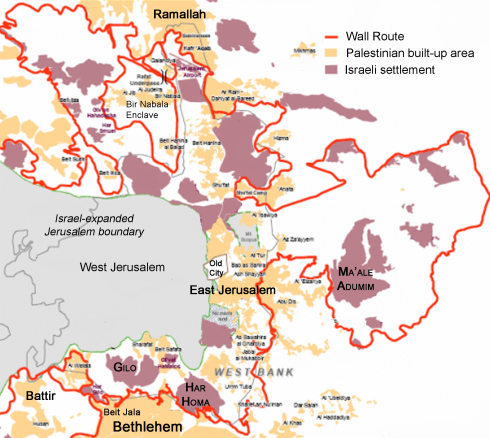
I had spoken in a previous post about the ridiculous road that Palestinians must now take traveling north-south around Jerusalem. Ramallah used to be a 20 minute or so trip from Bethlehem. It now take 1 ½ hours or more. Here’s why.
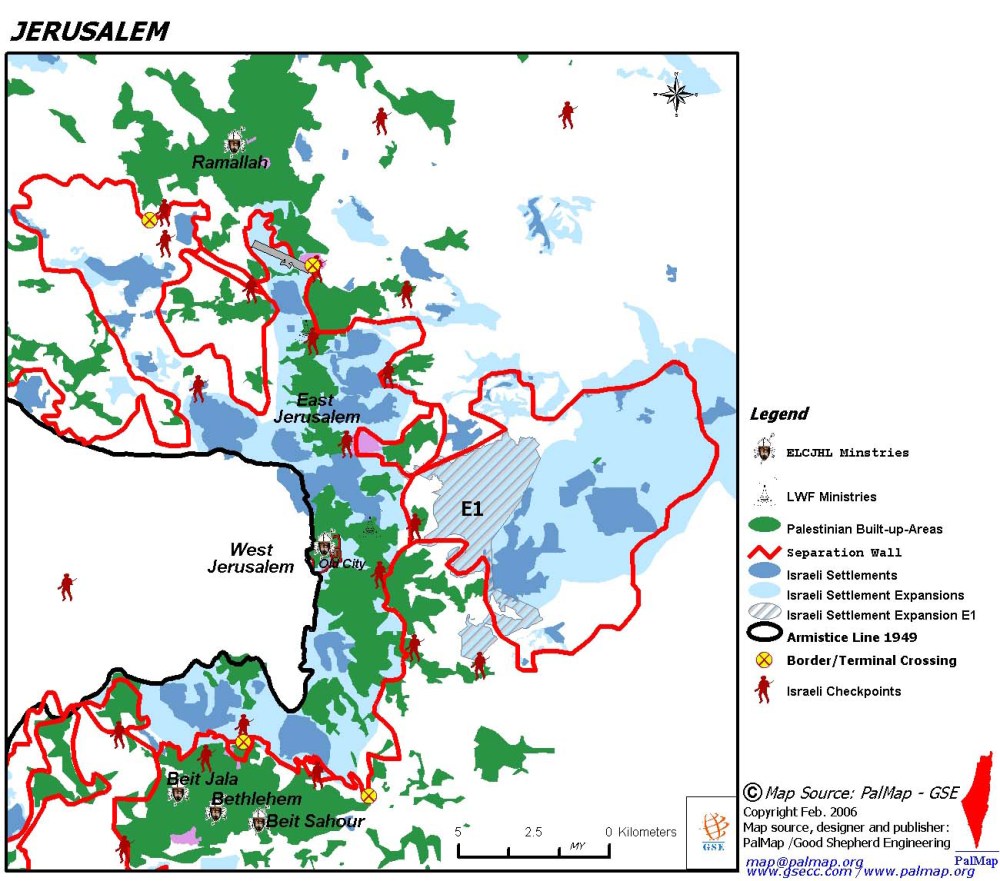
jerusalem-www-elcjhl-org-resources-maps


05d-map5

If you look at the map, draw an imaginary line going north and south through Jerusalem.  That would be Route 60, the major throughway going  directly through Jerusalem. This route is open to Israelis but no longer to Palestinians. BIn the name of security (the excuse for the whole occupation and all of the land grabs), this road has been closed off to Palestinians who get the special road from hell, (euphemistically referred by Israel to as part of the Fabric of Life roads). Its purpose is to bypass not only Jerusalem, but also the several, huge illegal settlements that have spilled well over the green line into the West Bank. So, the Palestininan route roughly follows those red lines which demarcate the wall. The irony is that Uncle Sam financed the road from hell through US Aid dollars – Israel couldn’t even foot the bill to keep Palestinians off of the good roads.
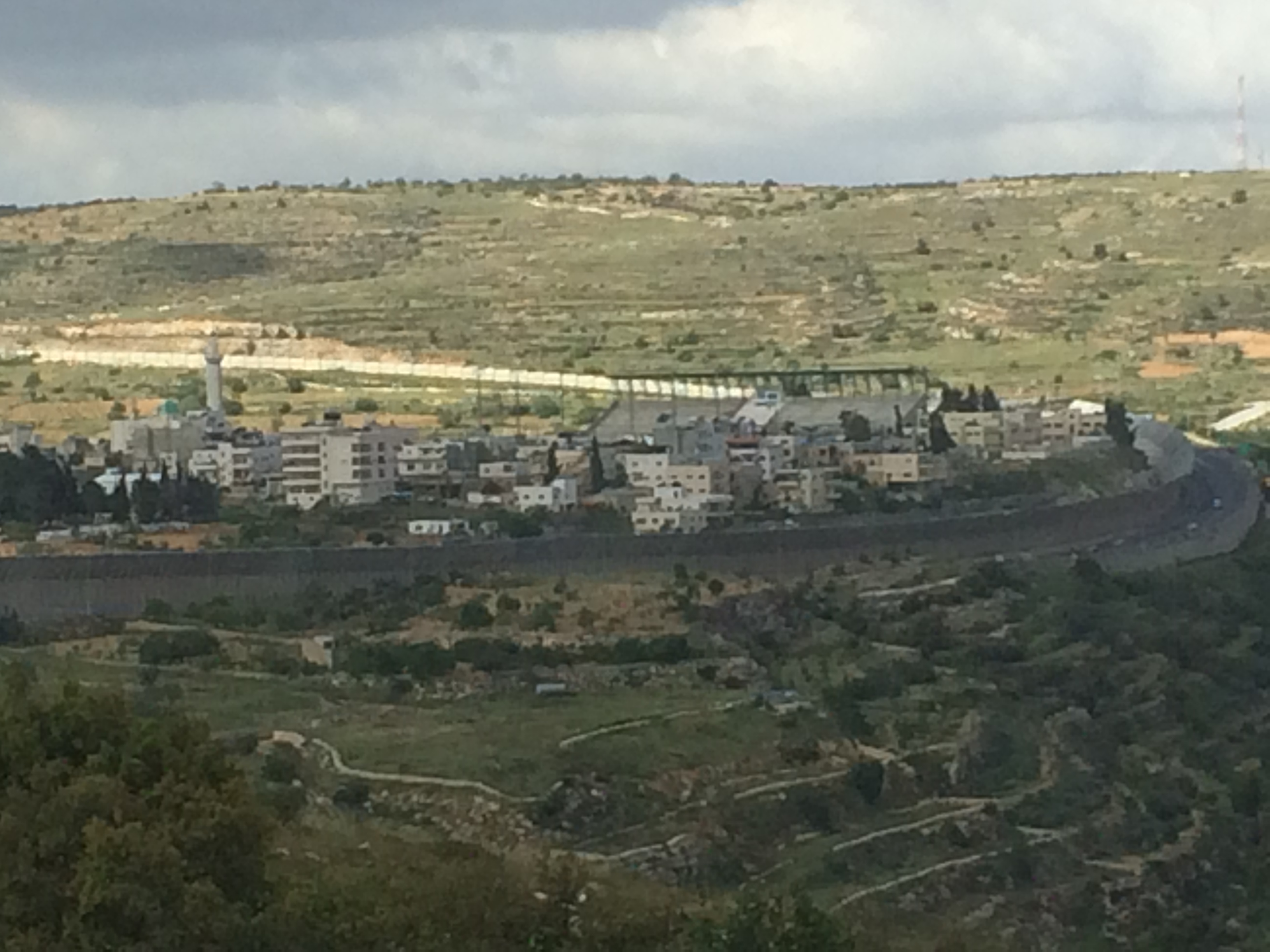
IMG_1268 IMG_1275

Here  are a couple of  views of the wall snaking around Jerusalem that I took on the bus on my trip in.

I caught the bus at the main station in Bethlehem. It was quite full of people when we left. The trip itself was maybe a half hour. Again, you can’t go directly to Jerusalem, you have to snake around the city. But, all in all, it was maybe ½ hour or less. The aparatheid system was readily apparent when we arrived at the checkpoint. All of the Palestinians or the ones without dual citizenship had to leave the bus. We privileged persons got to stay on.
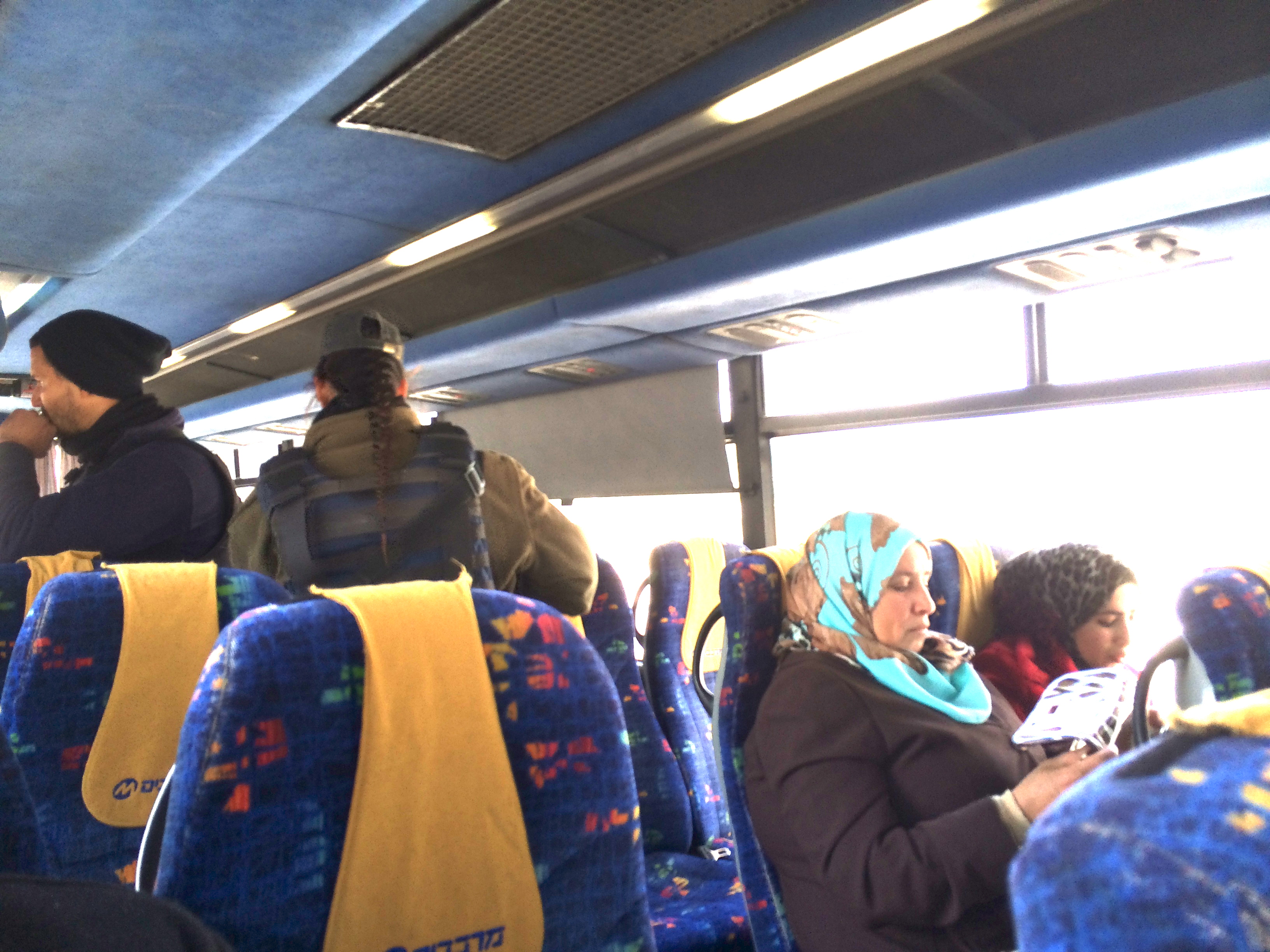
IMG_1278

Two armed border police came on the bus to check our passports . . .
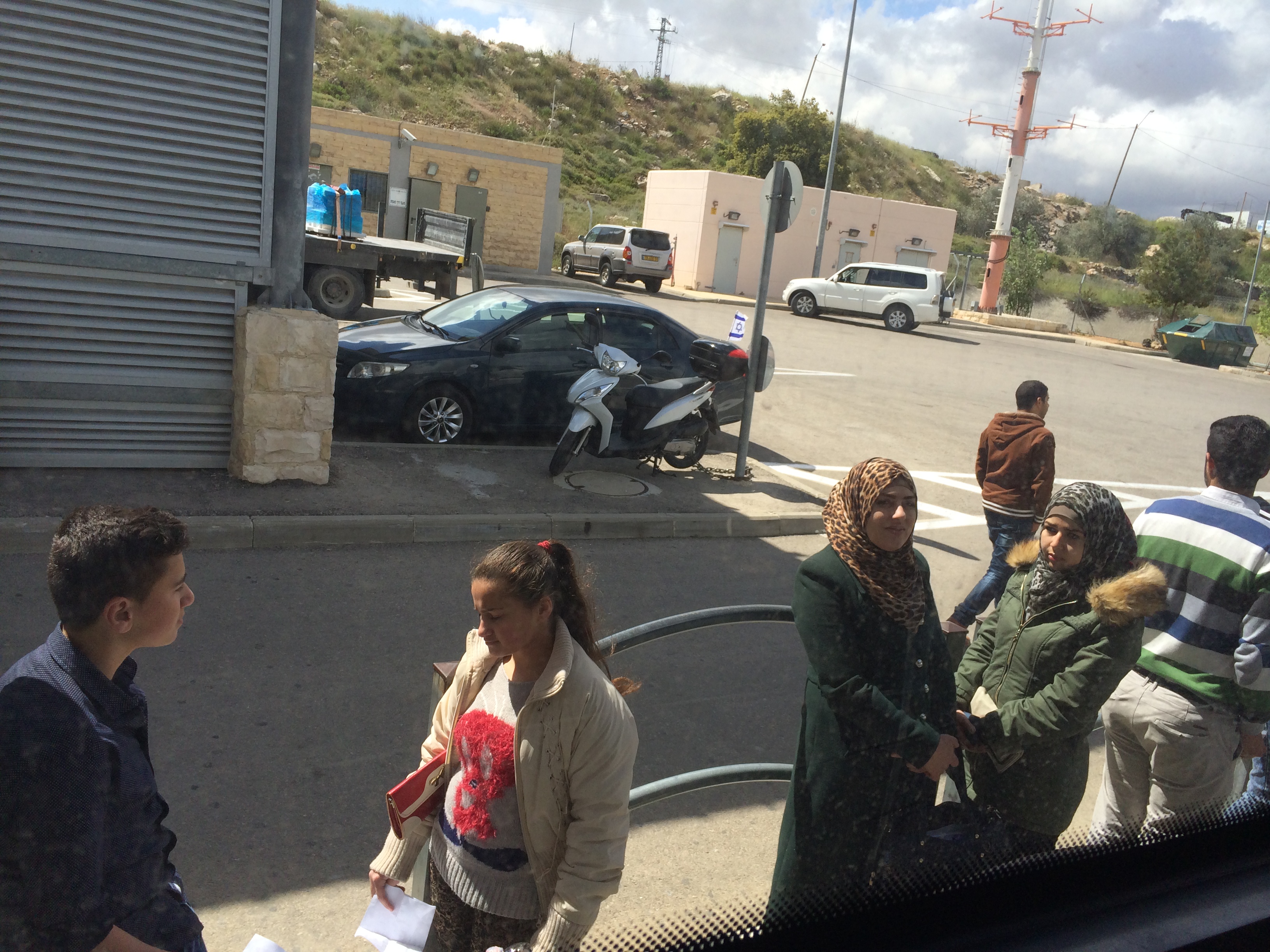
IMG_1276

. . . while the Palestinians were herded into a queue outside to wait to be checked. They also spent quite a bit of time grilling our bus driver and on the telephone dealing with him for God knows what reason.

IMG_1283

So that was the checkpoint, and by many accounts these days, very uneventful.

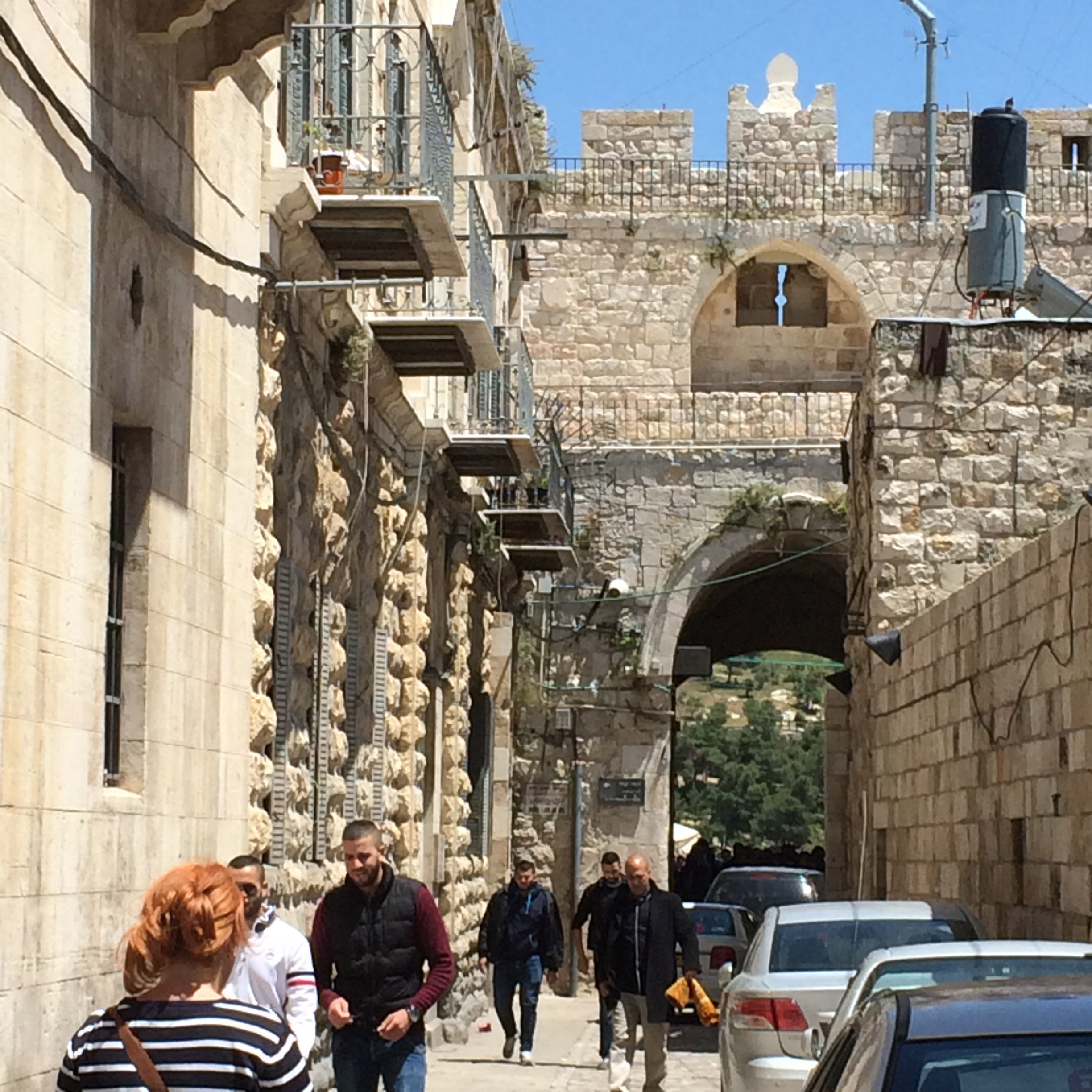
To counter the tragedy, I need to share a little bit about Jerusalem. After my meeting with Alessandro, I wandered the city a bit. Since it was Friday, there were droves of Muslims headed toward the Al Aqsa Mosque (the 4th holiest Muslim site in the world and site of huge controversy because it is on the Dome of the Rock aka Temple Mount, which was the site of the Jewish Temple that was destroyed over 2,000 years ago). A couple of times, not really knowing where I was going, I got caught in the crowd, and being a fast walker, was snaking through. At one point, a man politely chastised me telling me that I couldn’t take cuts. Without realizing it, I was in the midst of the throng on the way to the Mosque. At another point, I was stopped by an Israeli police indicating that I was going into an area restricted to Muslims. Once I got out of the way of the Muslim worshippers, I was able to see parts of Jerusalem I hadn’t seen during last year’s trip. It’s such a beautiful, ancient city. Everywhere you turn, these is something fascinating or awe inspiring.

The photo at the beginning of this post is the Damascus Gate. It is near the bus stop and this is the entrance through the ancient city wall  to the Muslim quarter of  old Jerusalem.
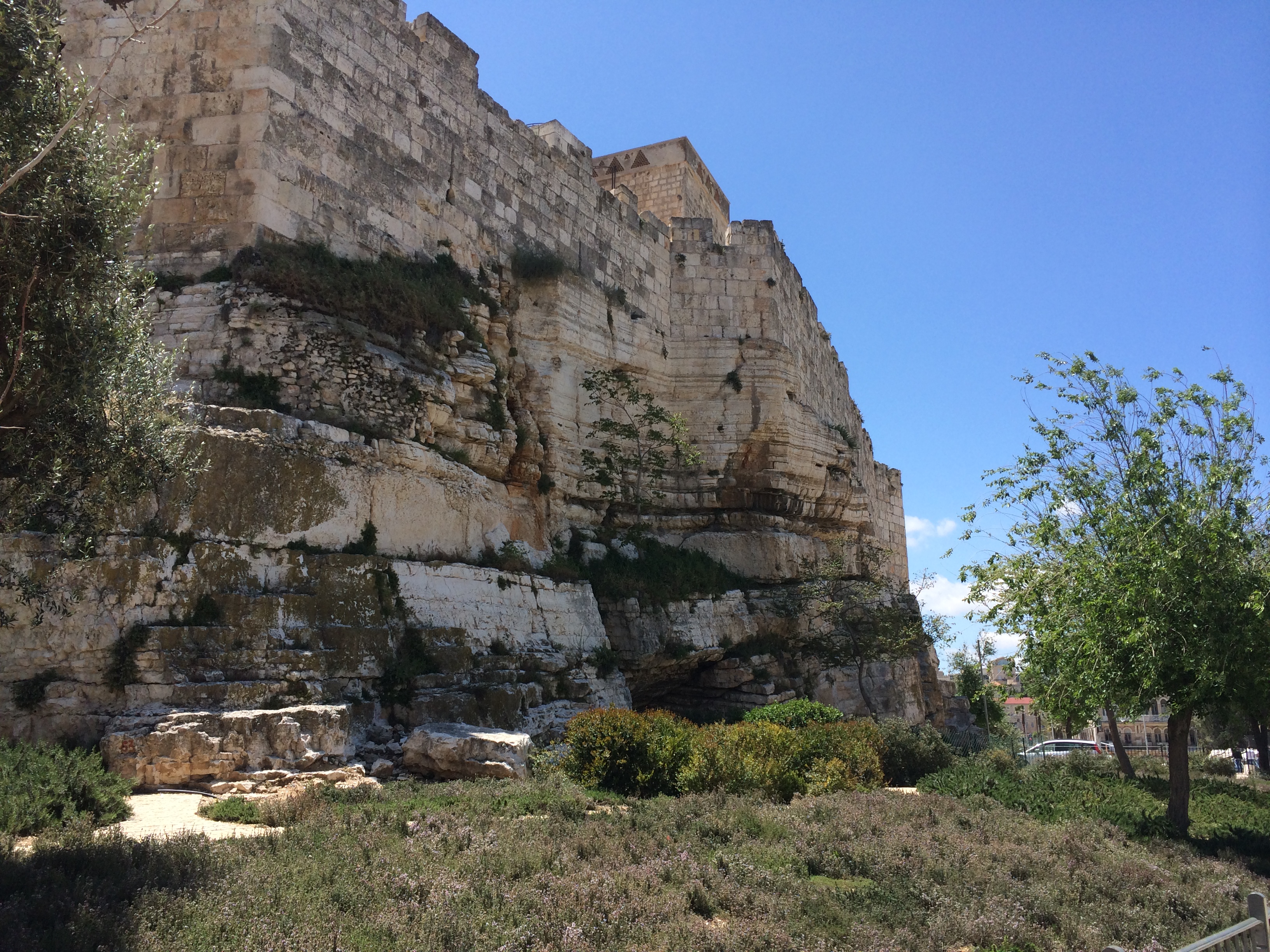
IMG_1300

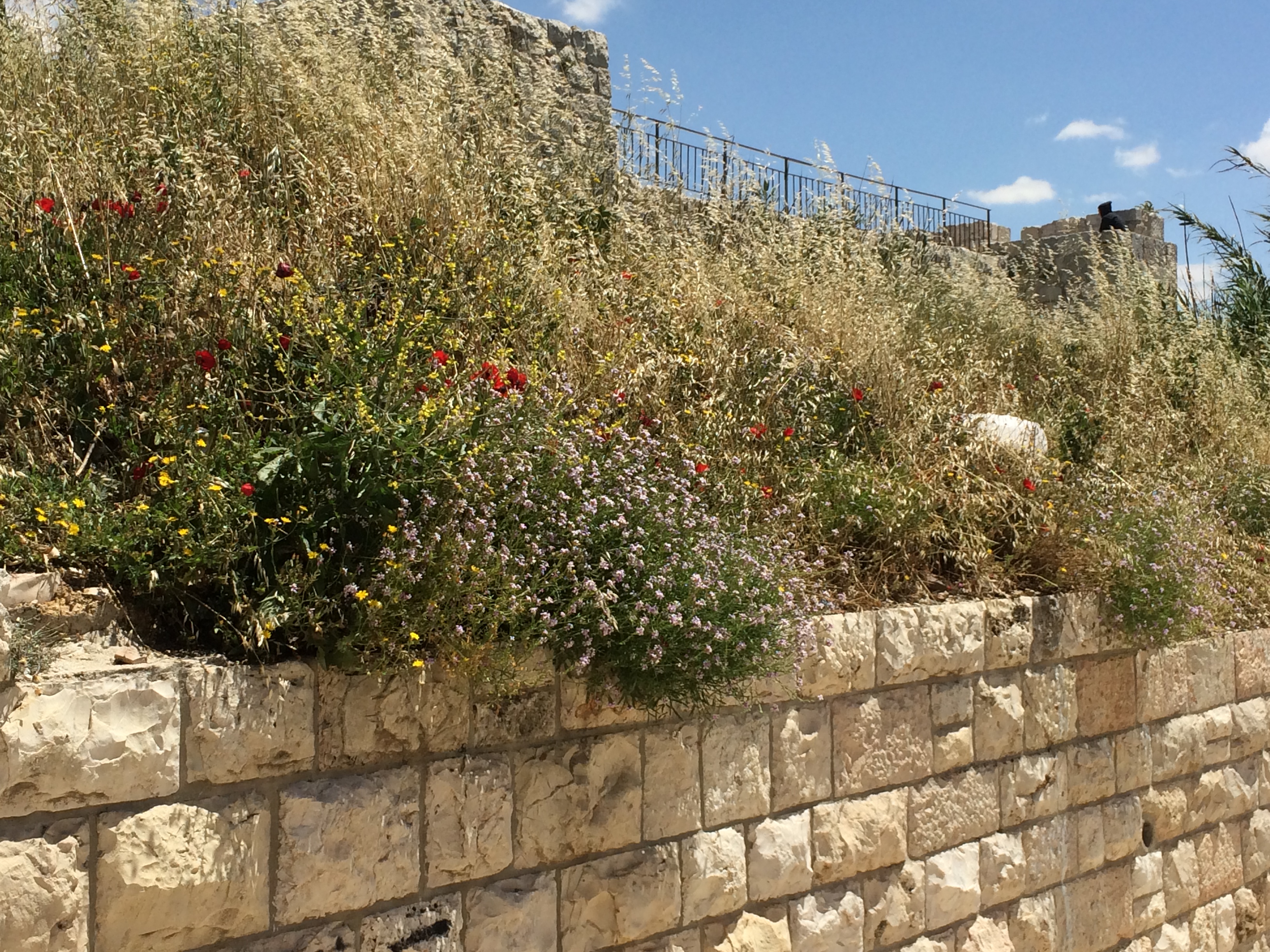
This is a little section of the wall near the Damascus Gate. It’s so beautiful how the wall is built into the natural rock.
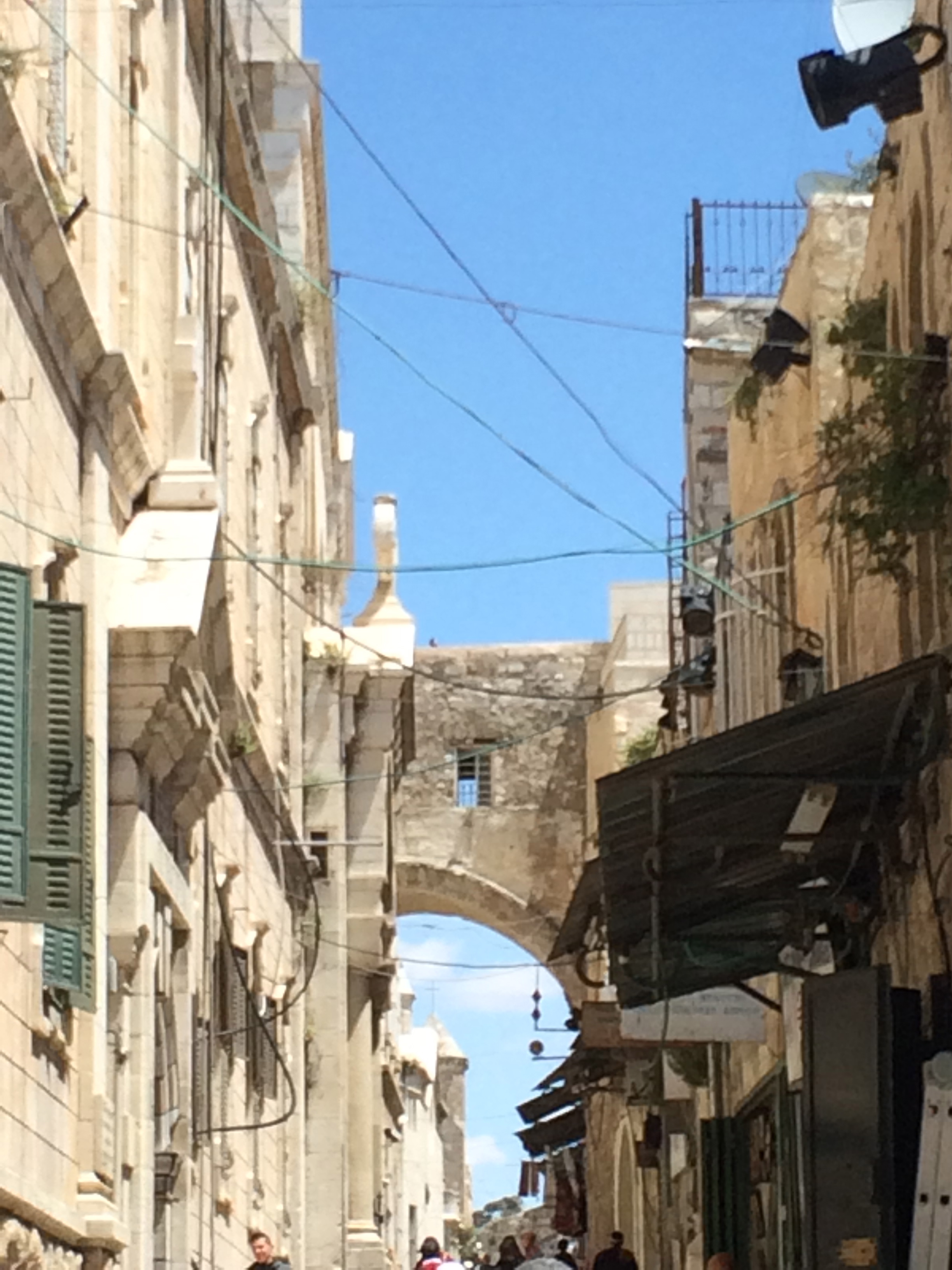
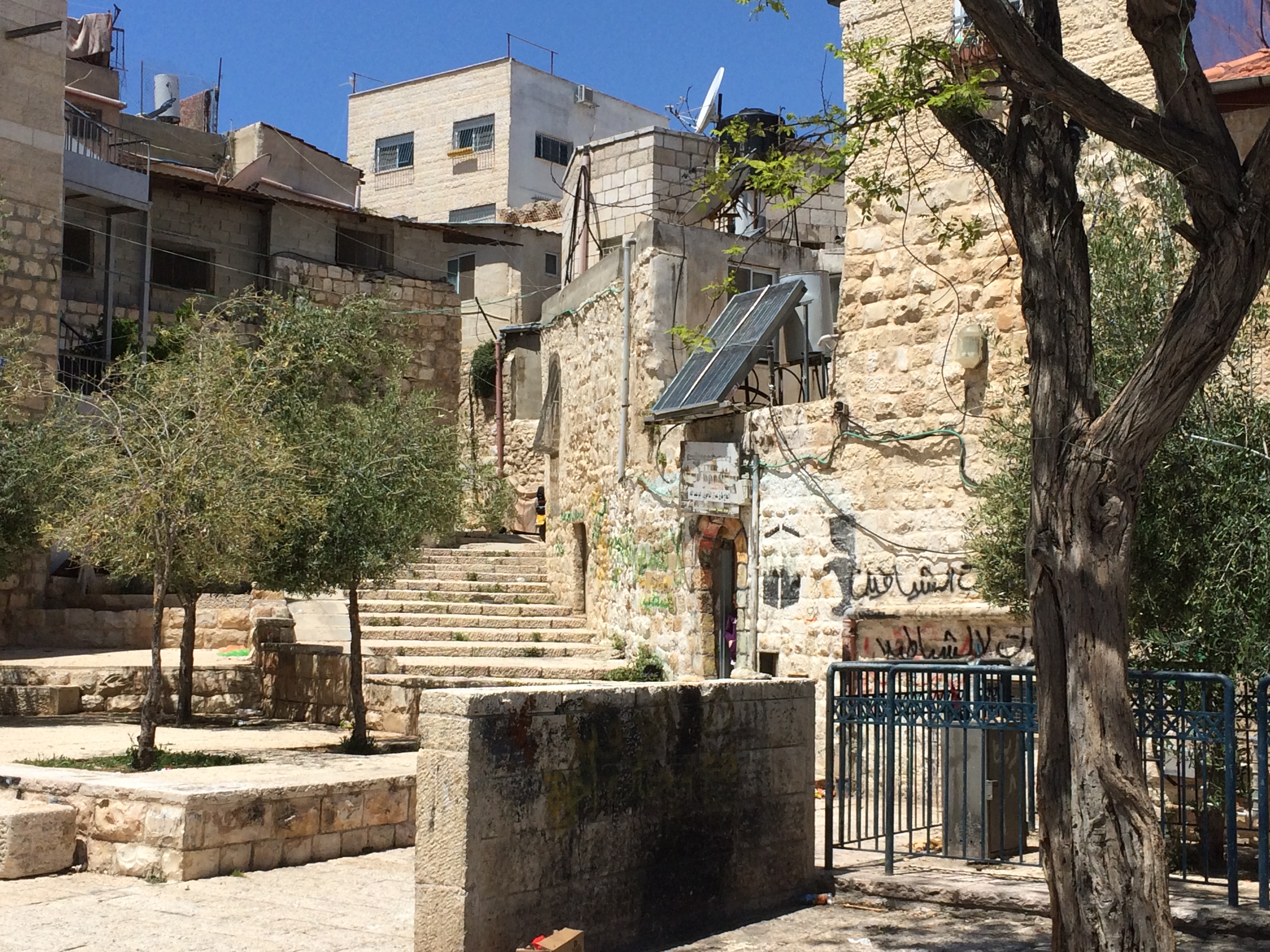
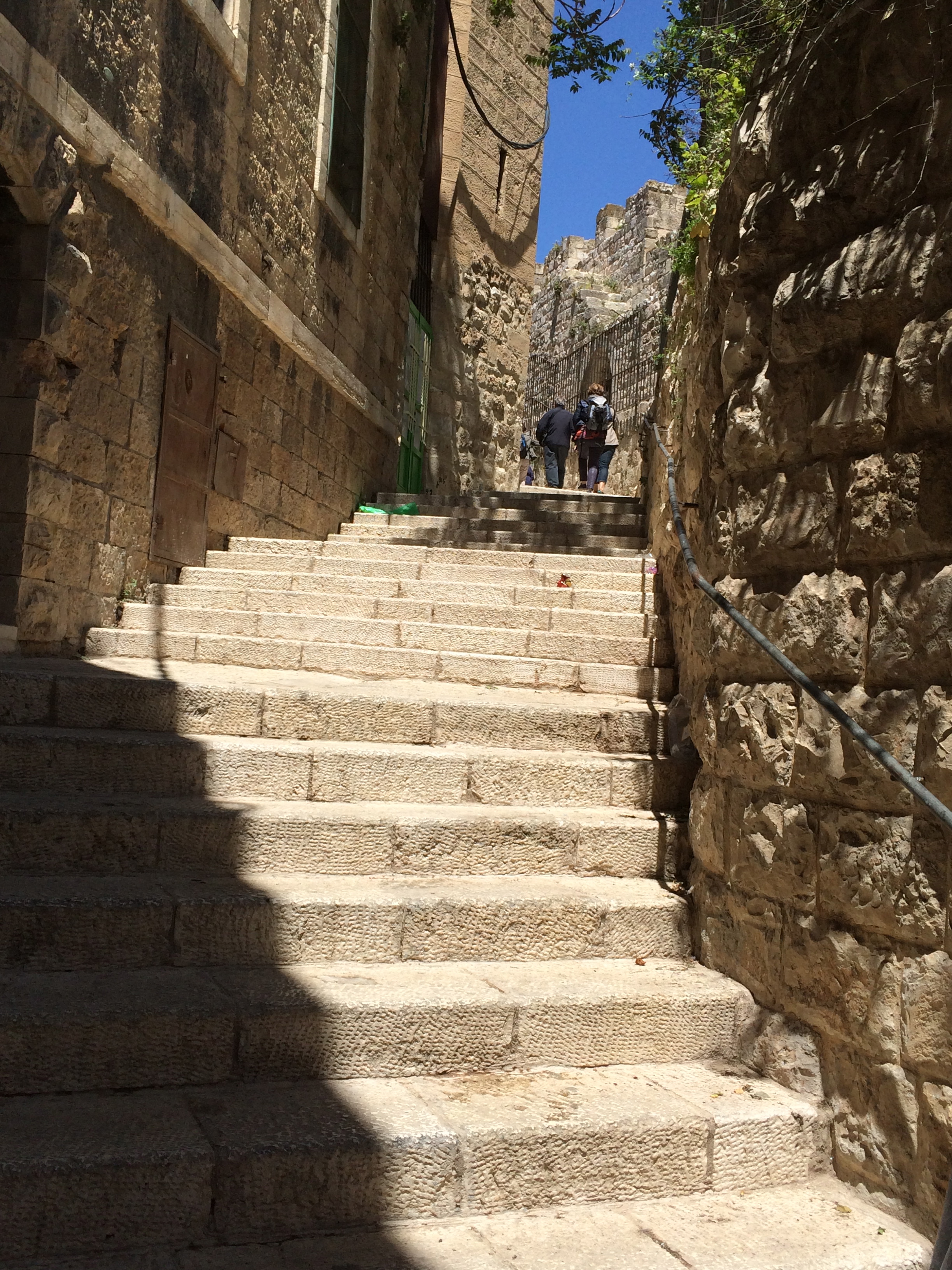
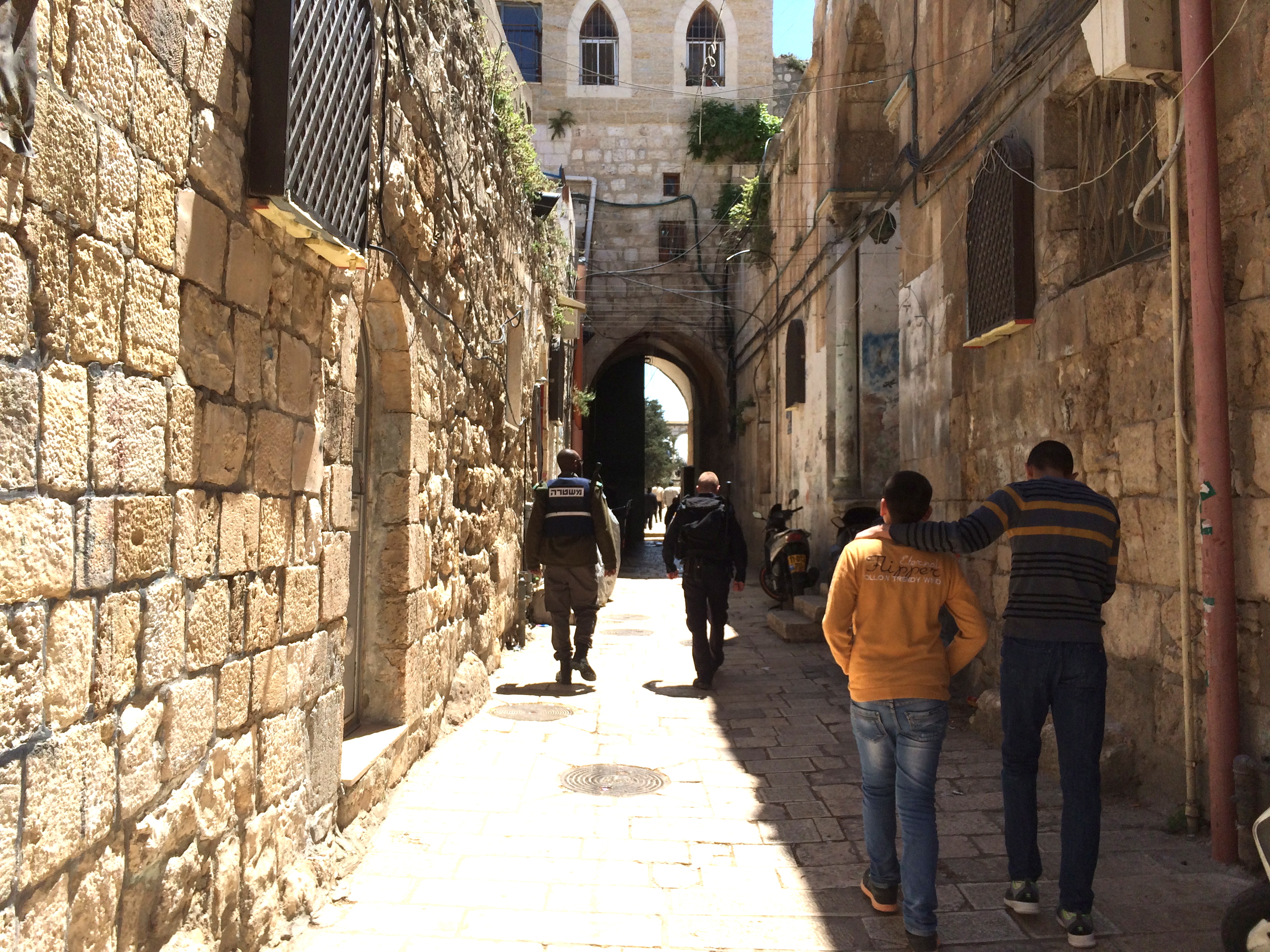
IMG_1304 IMG_1307 IMG_1311 IMG_1315 IMG_1318 IMG_1319 IMG_1322 IMG_1325 IMG_1341

And just a few random shots from around the old city.
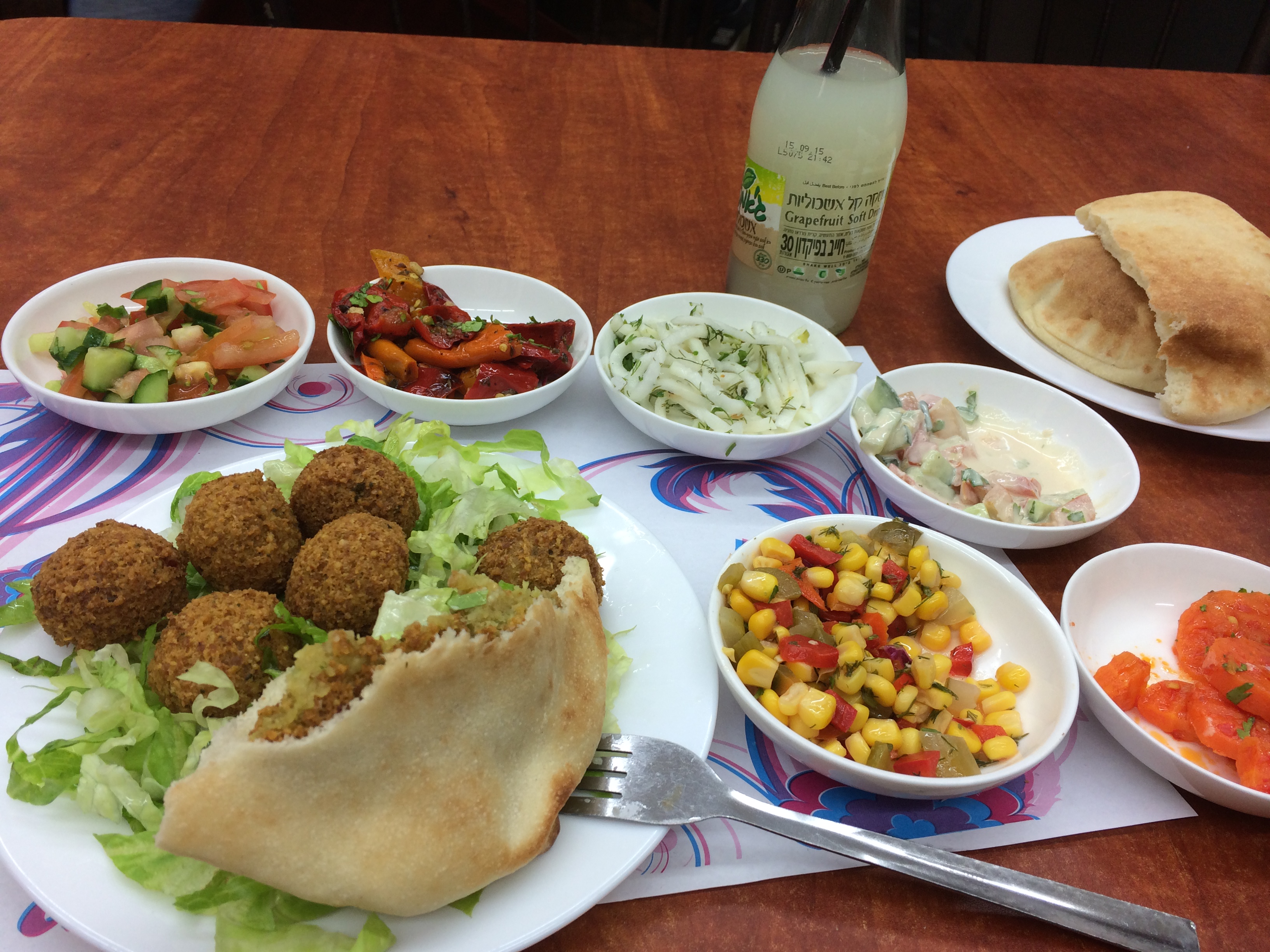
IMG_1330

Oh, and the amazing falafel plate I had for lunch along the Via Dolorosa.

https://www.youtube.com/watch?v=fUf939_mxgU

To end this, I need to share a song that popped up on Facebook a couple of days ago , from the group Kairos Palestine, coinciding with my trip to Jerusalem – another little piece of serendipity. It’s a little sappy, but the words are poignant. I hope you’ll take a listen, because the message is so important.

Also, Kairos Palestine is an ecumenical group that stands in solidarity for the liberation of Palestine.   You can read about it here. http://www.kairospalestine.ps/

WHISTLE WHILE YOU WORK

I’ve talked about Laila in a couple of posts, the lovely woman in the Hebron Souq (market) who sells beautiful hand made items from the nearby women’s cooperative. I finally was able to get out there with her help to see how it is all done. The Women in Hebron Cooperative is actually located in a village about 10 kilometers outside of Hebron call Idna. A young man and friend of Laila’s escorted me to the Service (Serveese) station to find one that would take me there.  As I’ve explained earlier, these are the yellow vans that hold 7 passengers and are a cross between a taxi and a bus.

It was another one of those situations where I just put my faith in the goodness of the people around me and  Allah that things would work out. I always thought that I was a fast walker, but this fellow was a challenge to keep up with, weaving between parked and oncoming cars and heavy foot traffic through the busy market streets of Hebron for ½ mile or so until we got to the station which is a multiple story parking garage pack-jammed with identical yellow. vans. The young man pointed me to an older gent who was apparently going to be getting on the Idna van as well. At that point, he pulled a bunch of Palestine trinkets out of his pocket. So, I realize, okay, this is the part where I pay you, I asked him how much one of the plastic bracelets are, and he tells me 10 shekels. Wait a minute! I paid the guy in Tel Rumeida 4 shekels for an identical one. Sigh. I gave him 10 shekels knowing that it was worth no more than 4, but he was a good chap in dropping what he was doing to get me on the right Serveese and a guy has to earn a buck.

The man I followed into the Service was heading home to Idna.  So, out of the hands of  bracelet boy, and into the hands of a stranger from Idna. We spoke falteringly with his limited English. At one point he handed me a handful of little slightly fuzzy, green pods that I have seen overflowing in barrels in the market recently, and had wondered about. I thought maybe they were fresh, unhusked almonds. I asked him how to eat it and he demonstrated by biting right into it and eating the whole thing. It was not a nut after all. It was a sour, green-applish tasting thing. I can’t say I really liked them, but they weren’t bad either. I need to figure out what in the world they were. When we arrive din Idna, he pointed me in the direction of the cooperative and as soon as I walked through the door I was greeted by Laila’s daughter, Maysa. She showed me around the workshop a bit.

IMG_1188

This lady, Aisha was teaching a younger woman how to make rugs. Aisha agreed to the photo but her apprentice declined.

IMG_1209

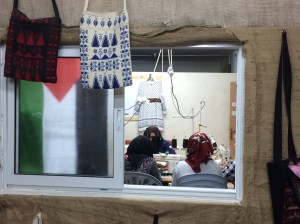
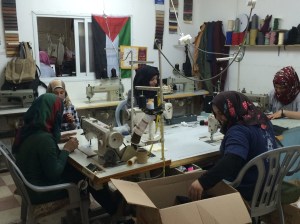
Here as a peek from Maysa’s office into the area where the women work. IMG_1211 IMG_1210

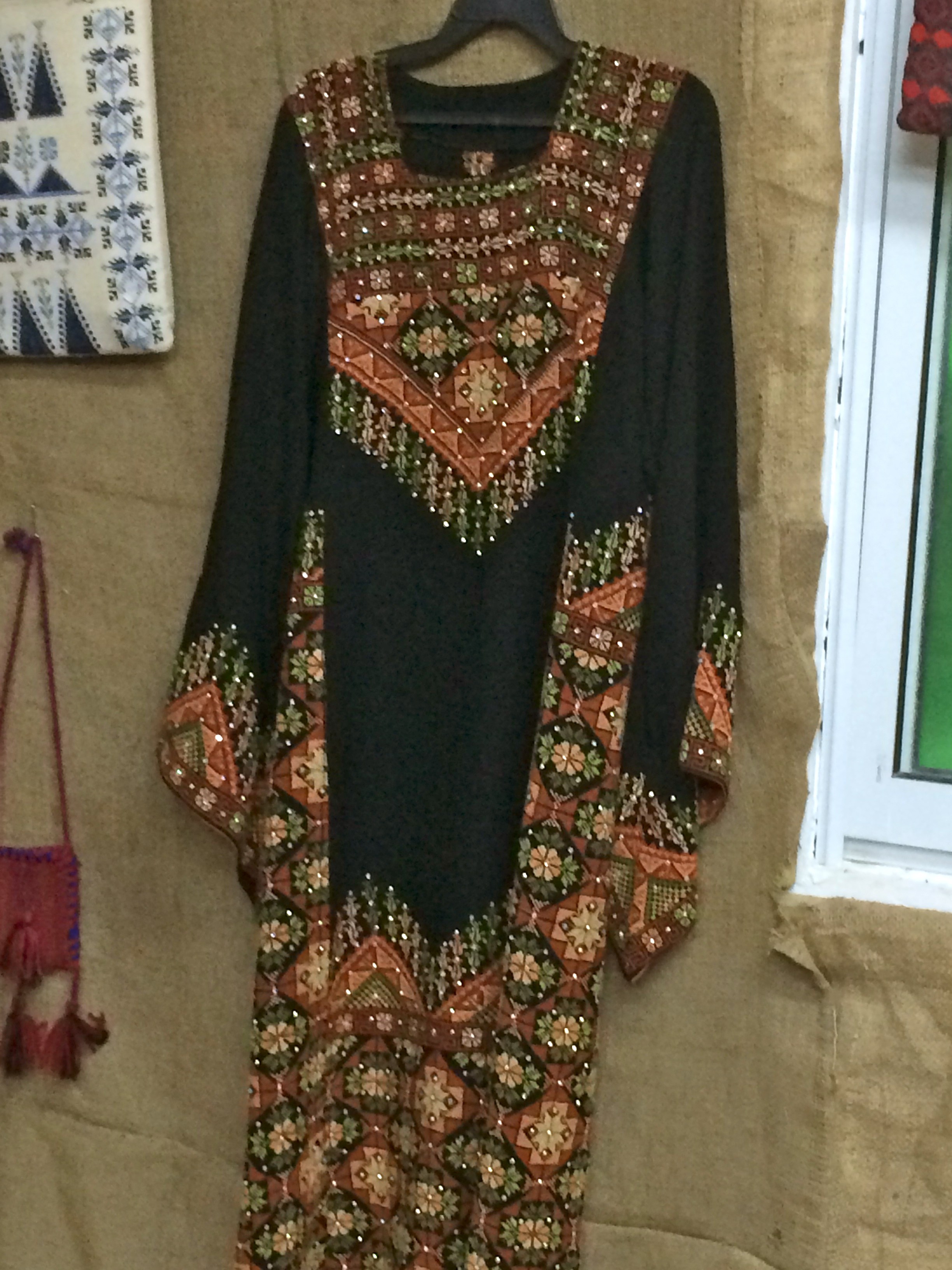
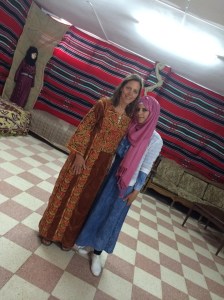
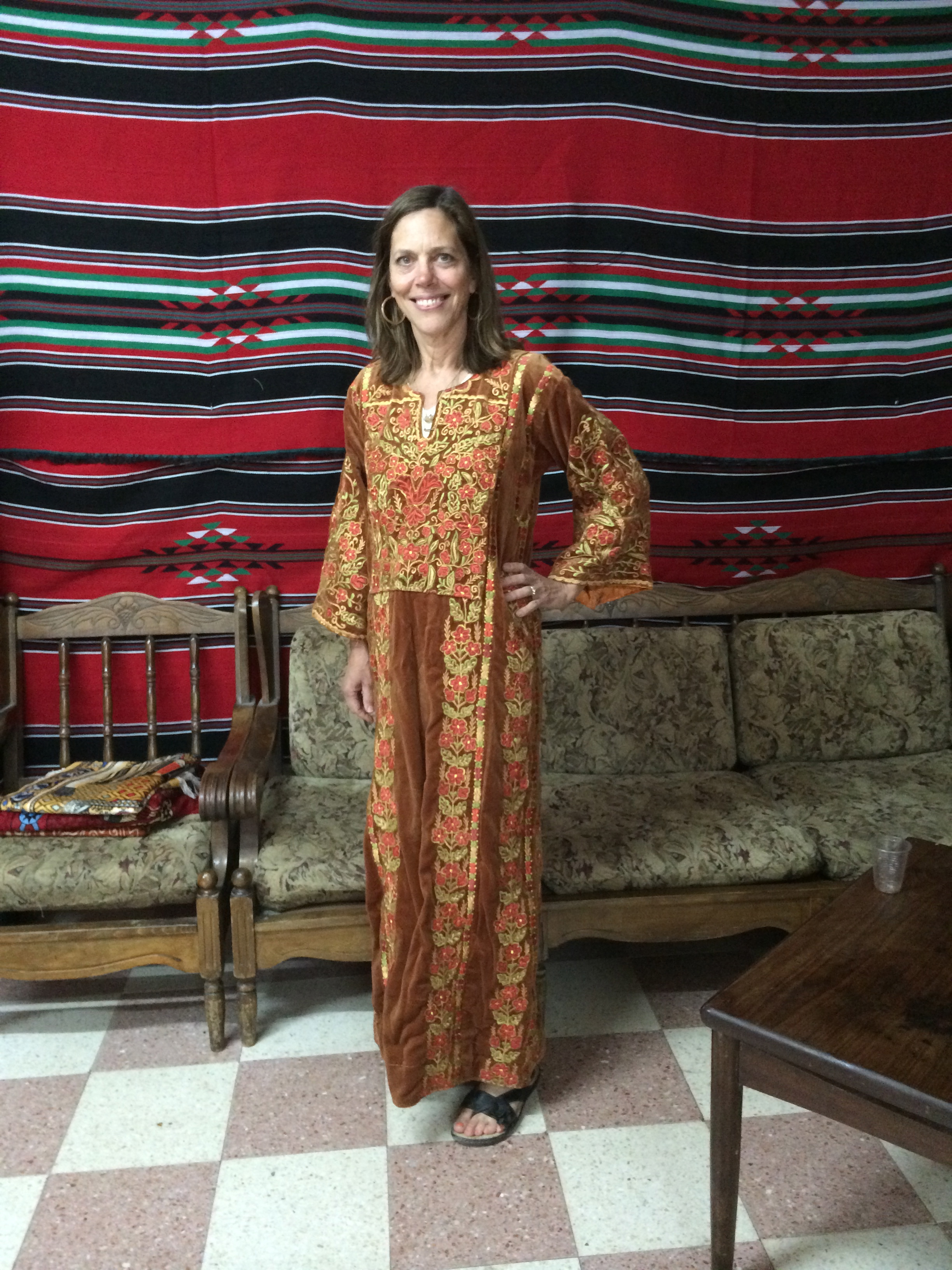
These are examples of some of the dresses the women make and embroider. These two are both wedding dresses. Maysa took me to a stack of folded dresses and told me to pick one out to try on.

IMG_1203

IMG_1199

This one actually fit quite perfectly. It was made from thick, lush velvet.

She then brought in lunch of chicken and rice and tomato salad that we ate with Aisha.After that, she took me into the workshop, and this is where the real fun began.

IMG_1198

IMG_1212IMG_1192

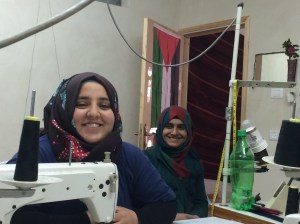
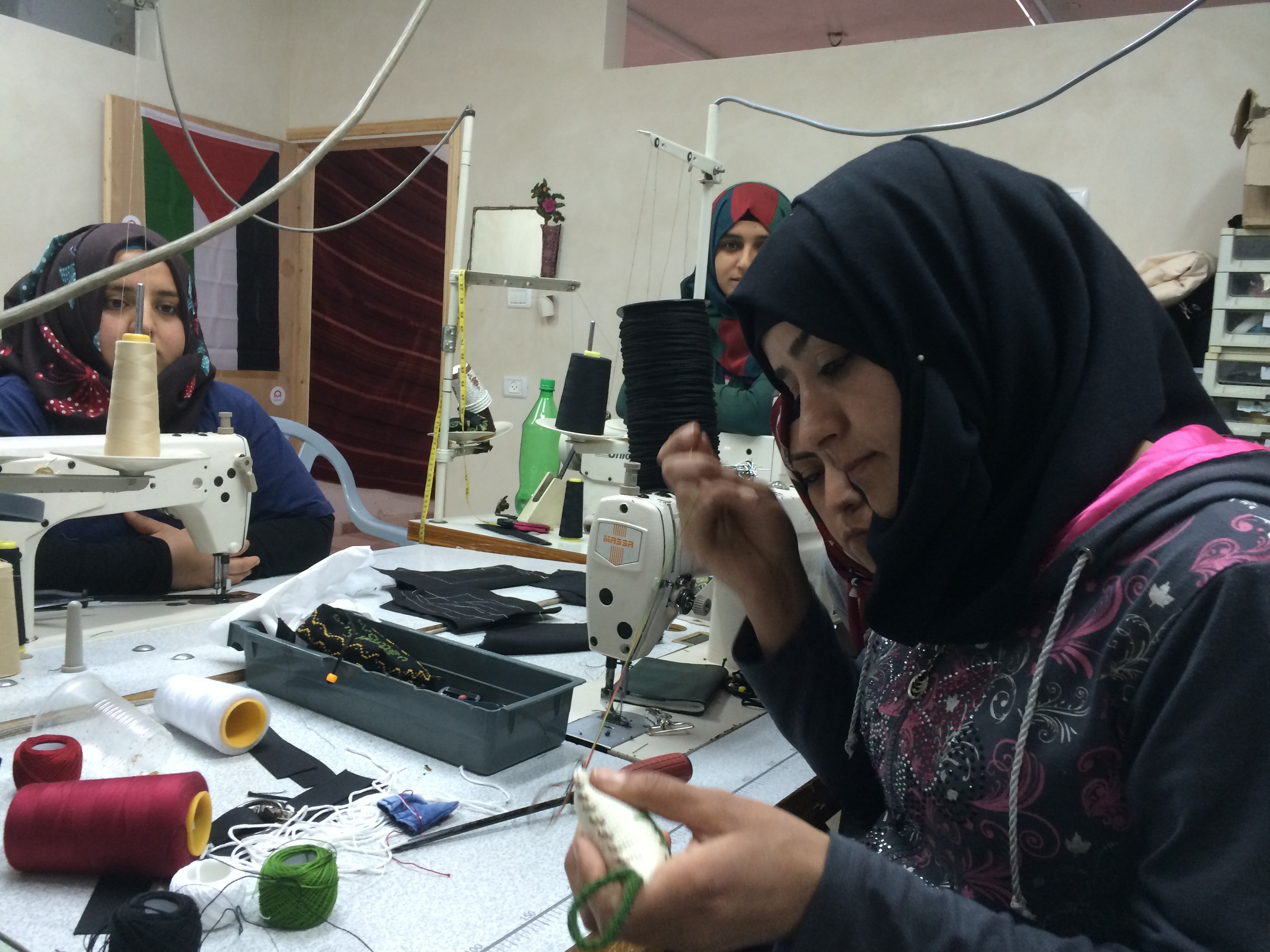
There were five  young women working on the sewing machines. They were stitching together pieces that had been embroidered into little zippered pouches, cases and bracelets. There are over 125 women employed through the cooperative, many of whom work at home doing the embroidery.

IMG_1214

They made a place for me next to one woman (I need to get her name) who proceeded to teach me how to do the cross stitching that is emblematic of Palestinian stitchery. She asked me to write down my name, I thought, so that she could remember it. Well, the little sampling she had me working on turned out to be my name. I would slowly do three or four stitches, and then she would whip out the rest of a letter and start the next one, and so it went until it was done. Then, however, came the surprise. She handed the piece across the table to girl at a sewing machine and she in very quick order turned it into a bracelet by stitching a backing onto it with cords for ties. The whole time, the girls were laughing, occasionally asking me a question in faltering English, me sometimes trying to answer in even more faltering Arabic. At times they were probably laughing at me, but it was all in good fun, and I couldn’t help but to laugh along with them.

At one point they seated me at a sewing machine and let me have a go at it. I thought, “no sweat. I’ve been sewing all my life”, but these machines are heavy duty and it was sort of like learning to drive a stick shift car.  Every time I pressed the pedal, it roared out of control. The girls had a good laugh over that.

I had brought in a box of candy, and that got passed around and heightened the joviality. This was an aspect of Palestinian life I had experienced for the first time –  this girls only, letting loose atmosphere. It was so fun and joyful and productive, all at once. Maybe not whistling while they worked, but certainly a lot of giggling.

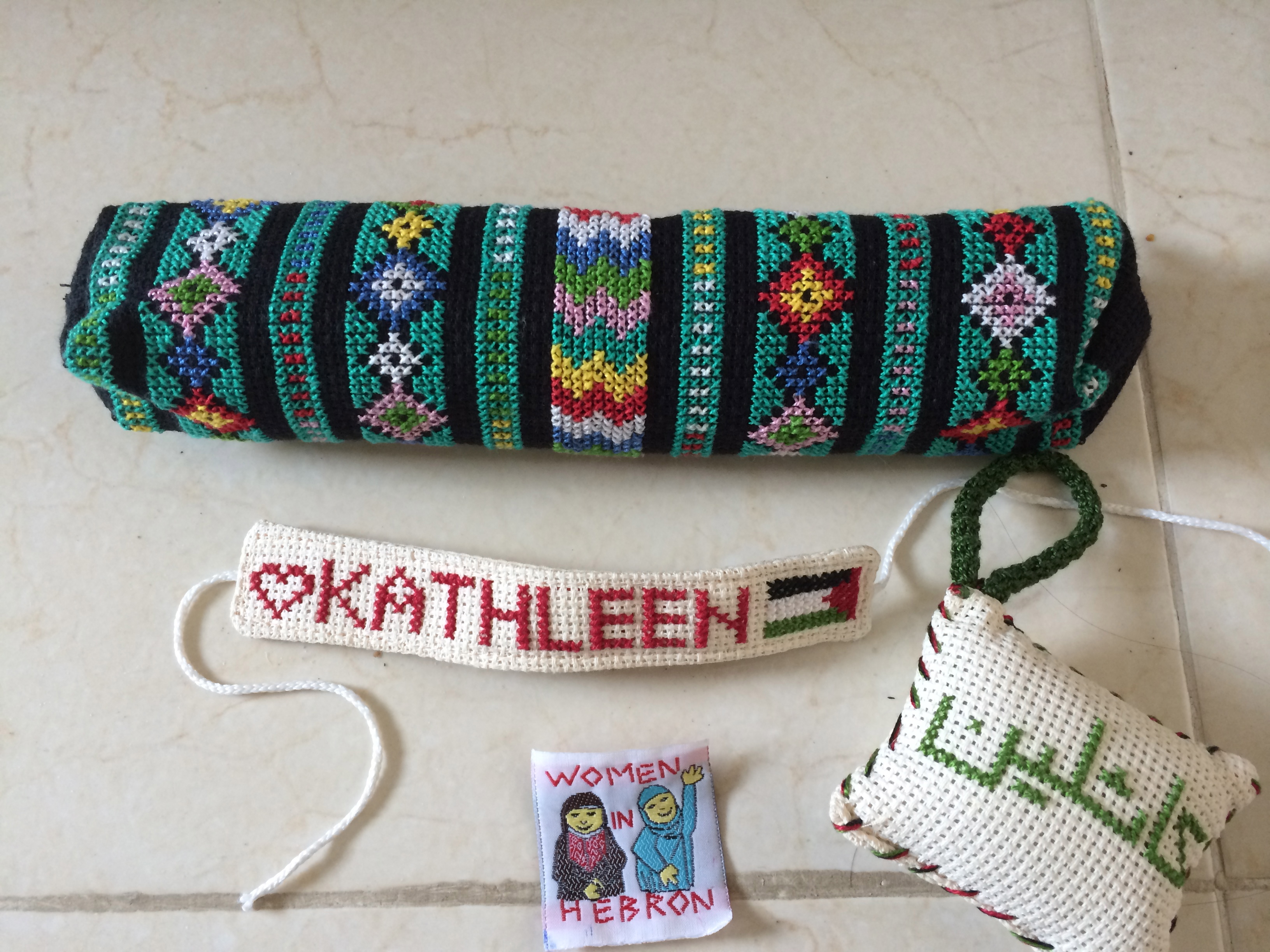
As soon as my friend had finished the bracelet, she started another piece, this time with my name stitched in Arabic. About this time I was getting a little nervous about getting back into Bethlehem and home before dark, and let them know I needed to leave soon to catch the 4:30 Service.   She quickly finished stitching my name in Arabic and again, handed it across the table where the other girl made  it into a little pillow. I started to leave, and she insisted on first finishing if off with embroidery around the edges. She was not about to let me leave with an unfinished item. Maysa also gave me an absolutely beautiful pencil case. IMG_1259

These are my treasures. And below are examples of some of the many different beautiful things made at the cooperative.

IMG_1198IMG_1205IMG_1206I’d really like to see them market to the U.S. to import stores. The items are so beautiful and it’s such a wonderful way for these women to help support their families. Until then, you can buy things online. You can also “like” them on Facebook.  http://womeninhebron.com/  And https://www.facebook.com/pages/Women-in-Hebron/127546997276604?fref=ts

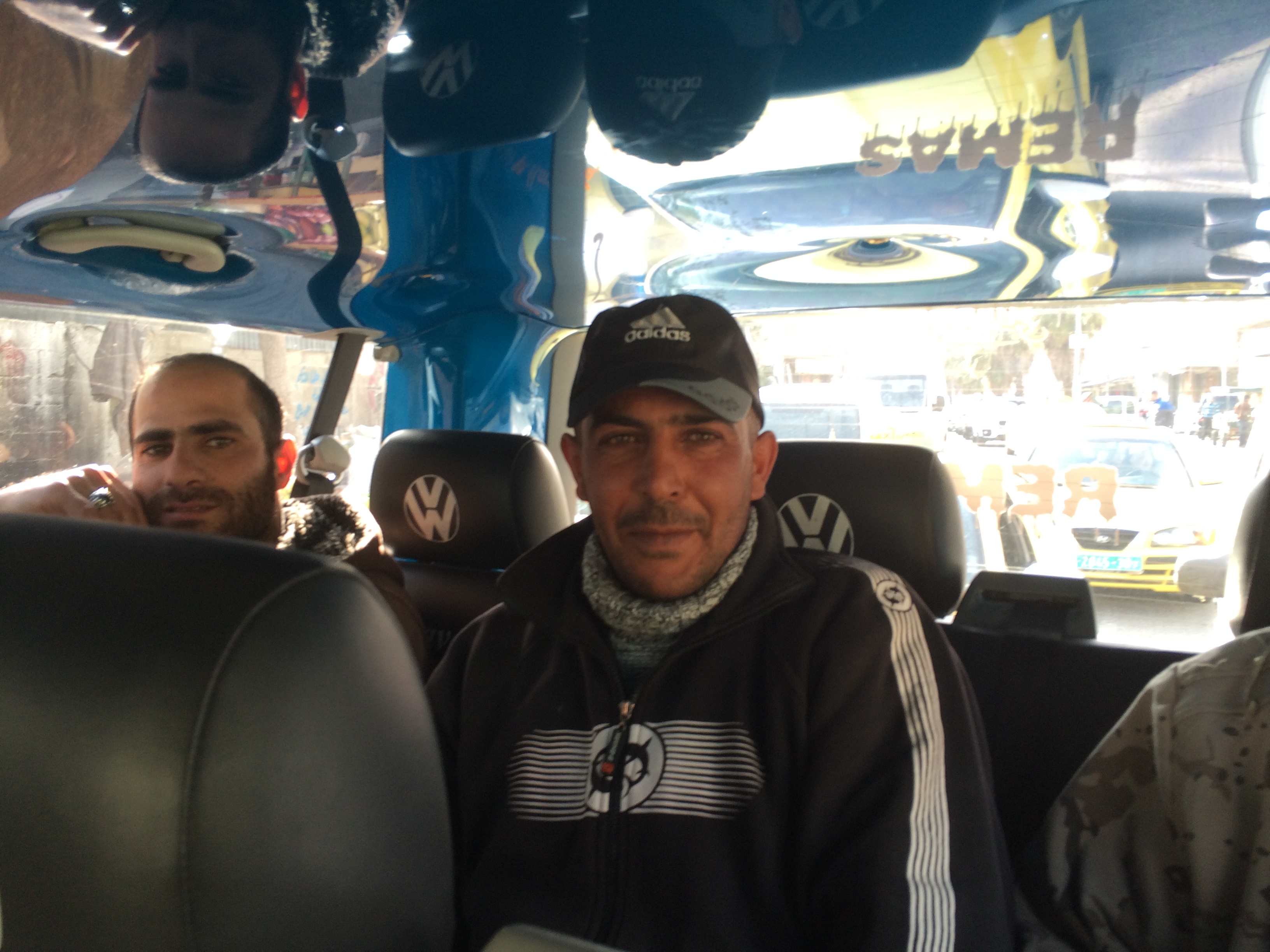
So the ride home was a bit of a challenge as needed to get back to Hebron first to catch a bus back to Bethlehem. I caught my Service in Idna and it was a raucous ride with 3 men in the back seat who all knew the driver and each other and they were whooping it up pretty much the whole ride. I knew they were talking about me at one point.  Finally, one of them who spoke fairly good English deliberately got my attention with a  loud, “Madame!”  I turned around and proceeded to converse. After the obligatory “where you from?” “what’s your name?” line of questions, he proceeded to tell me that they guy next to him wanted to marry me, and it was love at first sight. Haha! At my age, I have to say, rather than getting offended at these sorts of things, I’ll take it when I can get it. Anyway, my admirer insisted on taking a picture of me with his phone, so what’s good for the goose is good for the gander. I took one of him.

IMG_1215

You just never know what you’ll encounter on your rides on the Serveese.

FOLLOW THE TEL RUMEIDA ROAD

IMG_1087

I can’t remember anymore who told me about Ferykal Abu Haikal, but she was high on my bucket list of people I wanted to meet during this trip. After my encounter with the soldier at the check point and my walk up desolate Shurada Street, I really didn’t know where I was going. Along the way a saw a couple of settlers. They look so very out of place, and maybe it was just my bias, but they looked steely, unfriendly and unapproachable. I need to check that way of thinking. It’s those biases that have made the situation here as impossibly entrenched as it is. That said, they do have a  well documented reputation in Hebron for hostile, despicable behavior toward the Palestinians around whom the have chosen to live.

Along the way, I ran into a group of EAPII volunteers, and one of them had been at my first day’s orientation meeting at HRC. They are one of the many groups here to monitor the situation, and one of their major functions is accompanying Palestinians to and from school where they are constantly harassed and attacked by settlers. After a quick chat, they pointed me in the direction of Tel Rumeida. When I came to a cross road, a rather puzzled looking soldier directed me to the left. The street was very quiet, and there was something a little eery and unsettling about it. This is a place where both settlers and Palestinians co-exist, in a manner of speaking.

I encountered a Palestinian boy and asked him where Feryal lived. He pointed me in the direction of her home at the very top of the hill and walked with me a ways, ultimately pulling some Palestinian souvenir trinkets out of his pocket to hawk. I gave him 4 shekels for a plastic bracelet emblazoned with the Palestinian flag and he was on his way. I rang the bell at a house and a young woman answered and when I asked for Feryal, she pointed me to the next house. I rang that bell and waited a minute or two hoping that my climb was not not going to be for naught. Well, in actuality, nothing here is for naught. Every step I have taken on this trip has led to something interesting. One thing is for certain; it has made me a huge fan of walking.

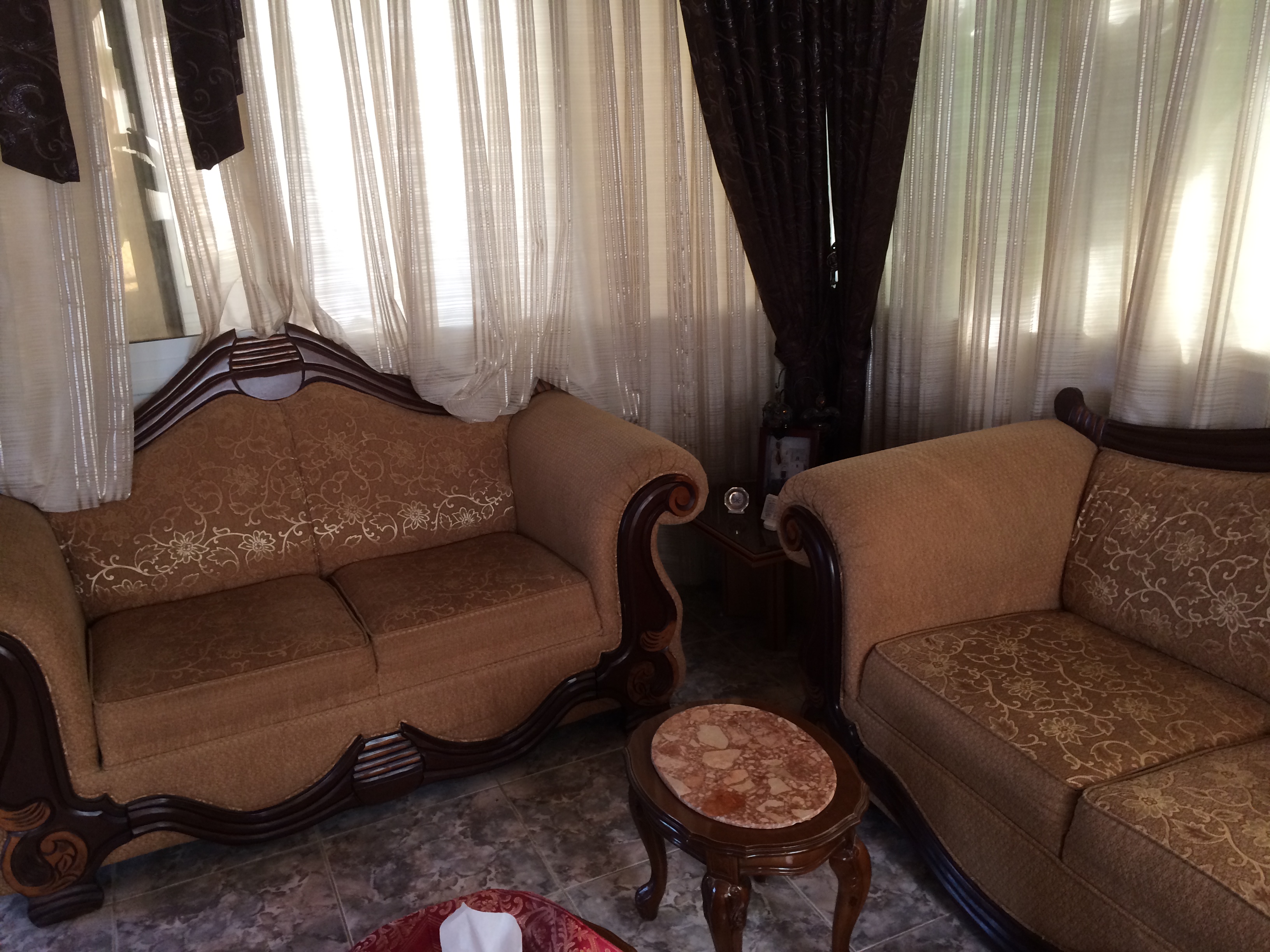
At the top of the building I heard a door open and there stood Feryal with a slightly furrowed brow, no doubt wondering who this unannounced stranger standing at her door stop was. As a Palestinian, she is no stranger to unannounced and often unwelcome knocks at the door. I briefly introduced myself and explained my mission and she waved me up. Her front door was unlocked and I climbed the stairs where she greeted me and took me to her beautiful living room.

IMG_1086

I’ve noticed that although many Palestinian homes are very plain on the outside, they are often lavish and very welcoming on the inside. When we sat down, I explained in a little more detail what I was doing in Hebron and why I came to see her, and then I mainly listened as she recounted some of her stories. She was quite apologetic about her English, but believe me, it was more than adequate to this end.

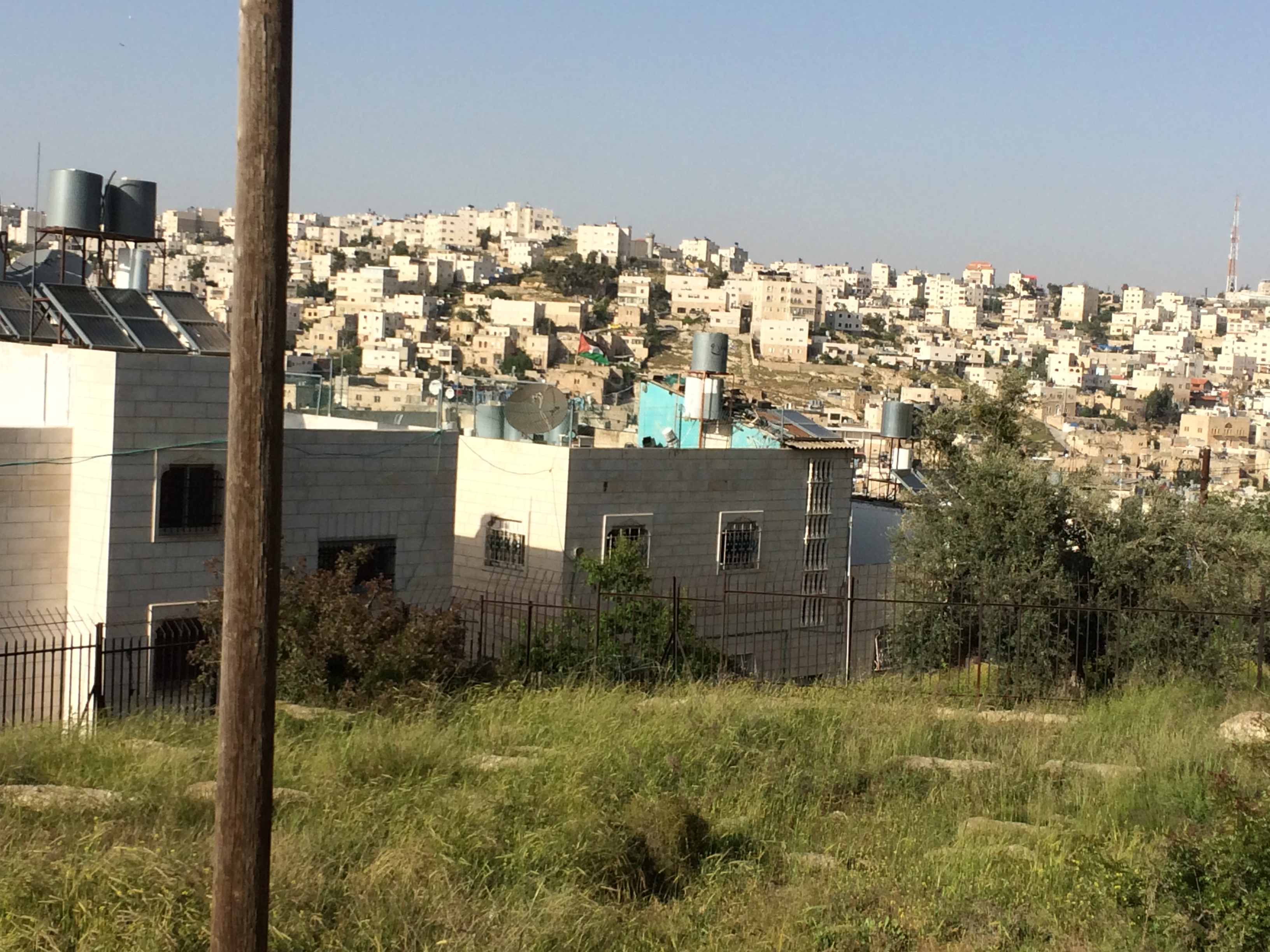
Feryal’s house, as explained is at the top of the hill in Tel Rumeida.

IMG_1093

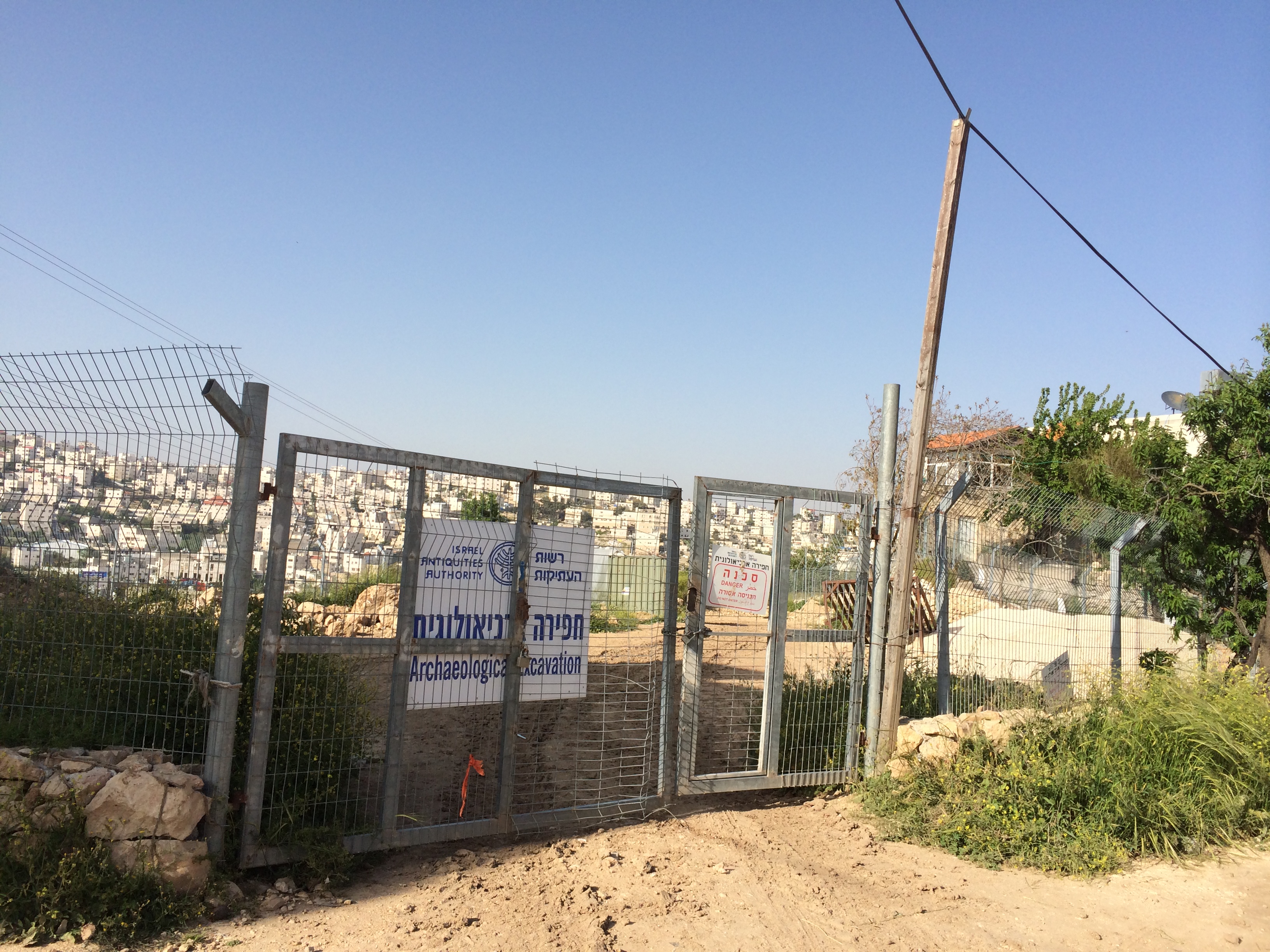
Its location has two strikes against it in the Israeli/settler/occupation scheme of things: it is in the part that is occupied by  Jewish settlers and it is on top of an area that Israel has designated as an archaeological site. Excavations have already begun next to her house to build a “Bible Park.”

IMG_1092

She said that they are digging to the bedrock in attempt to unearth remnants of ancient Jewish civilization. In the process, they are destroying more recent, but significant non-Jewish layers of history, including a hundreds year old Muslim cemetery which was brazenly desecrated. Archaeology is one of Israel’s 1984-ish terms which has been turned on its head. In reality, it is used throughout Israel as a means of erasing Palestinian history in attempt to prove to the world that Jews were the only presence in this part of the world. This is currently happening on a wide scale in East Jerusalem where Palestinian homes are being bull dozed en masse for creation of a massive “King David Park” a Zionist Disney World.

IMG_1112

Another example of this is the planting of groves of pine trees in the countryside to European-ize the landscape and in many cases, hide the remnants of ethnically cleansed Palestinian villages. That foolish practice has not only led to the decimation of the beautiful, natural landscape, but also some massive forest fires because pine trees are like tinder in this dry climate.

Feryal and I chatted for close to two hours.  You can read a little Wiki blurb here about how the occupation/settler movement forced the Haikal family off the land they had farmed for decades. And here is a video of her talking about Tel Rumeida. https://www.youtube.com/watch?v=xf6PuLYzPZ0  (There are others of her on Youtube, as well)

She told me about how the curfews during the 2nd intifada interfered with schooling. If a curfew was on, that meant not leaving the house, and even when curfews were lifted, schools were off limits for a significant period of time. Feryal defied this by holding class outside in the parks. At one point, when a curfew was lifted, she called everyone to school. She was then confronted by a soldier who yelled at her that it was only lifted to allow people to shop for food. Feryal is a master of non-violent resistance.

In 1995, when they were finally able to officially reopen the school, she planted a Palestinian flag on it. It wasn’t long before a settler snatched it and burnt it. No matter, Feryal had two more at the ready. She took the children, flag in hand and marched them through the street to show the soldiers and the settlers that they were not defeated. A settler grabbed the flag from her and started beating children with it.   With resolve they continued, and at the school, she planted her third flag.

I had recounted in an earlier post how Baruch Goldstein murdered the Muslims praying the synagogue. He was tackled and beaten to death only after he killed 27 people. But, that wasn’t the end of people like him in Hebron. Baruch Marzel is another radical member of the Kach organization  http://en.wikipedia.org/wiki/Baruch_Marzel  and is behind a lot of the violence in Hebron. He once angrily confronted Haryel and told her, “every dog has its day.” She nodded her head and looked him straight in the eyes and said, “yes, he does.”

She told another story of how an Israeli worker came to her house asking for ingress through her land in connection with the excavation they were doing. She told him to come back the next day and she would have the entrance ready. After he left, she erected a barricade. When he returned the next day and saw that he couldn’t get in, he said, “I thought you were going to have it ready.” She replied, “Yes, it’s ready.” She laughed and told me that he told her that she should have been a lawyer. And then explained that she knew from experience that if she had allowed him in this “one time” she would never see the end of it.

Israel is trying very hard to confiscate two lots that directly abut her home. Her family has rented them for over 65 years from the Islamic Waqf. There is a case currently pending in the Israeli Supreme Court. She hopes for justice, but it is a rare thing for Palestinians. God knows what will become of her home if those lots are seized.

IMG_1084

Here is a view out of her living room of the land in jeopardy.

She is very proud of her children and the fact that they have all managed to stay out of trouble – no small task in a land where nearly every family has or has had boys or men held in Israeli prisons, often in “administrative detention” which can be as long as six months at a time with no charges filed, and no access to the secret files. When we discussed this, I mentioned a friend whose son-in-law is currently on his second consecutive four month administrative detention, without charges, because of his advocacy on behalf of Palestinian political prisoners, and how he has a baby he has never met. It made Feryal weep. I felt bad, but then again, weeping is probably the healthiest response to the situation.

She told me how she was named Palestnian Person of the Year in 1996 and how she was nominated in 2005  by the Peace Women Project as one of  1,000 Women nominated for the Nobel Peace Prize that year. And she was also very proud to recount how Yassar Arafat had come to meet and congratulate her.

Probably the most notable thing about Feryal is her passion for education. As mentioned, this is her life’s work, but it is also reflected in her 11 children, six of whom are engineers. Girls or boys, it does not matter. Education is paramount in Feryal’s mind. One of her sons is finishing his PhD in engineering at M.I.T. this spring. We were amused by the fact that her son will be leaving M.I.T. just as mine is starting his post-doc work there.

These are just a few of Feryal’s stories. She has toured the U.S extensively and you can watch her on YouTube. Feryal is testament to the Palestinian spirit which is alive and well and will not be put down. I feel very honored to have made her acquaintance.

IMG_1089

(I think I’ve finally gotten the hang of selfies – hehe).

“DON’T YOU KNOW IT’S DANGEROUS THERE?” said the fox to the chicken

Today was a really interesting one. I skipped church and went to work in Hebron as most Hebronites do, because it is largely a Muslim city with a Sunday through Thursday work week. When I was hungry for lunch, I went down the old city street into the market and got a falafel and went to Laila’s shop to eat. Laila is the woman who runs the women’s cooperative shop where the jewelry and needlework made by local women is sold. For anyone who has read my earlier posts, she was my guardian angel when I kept getting lost the first few days of work. She also gave me some heartfelt advice about convincing my oldest child (whose name I won’t mention) that he needs to get married and start having children.

IMG_0817

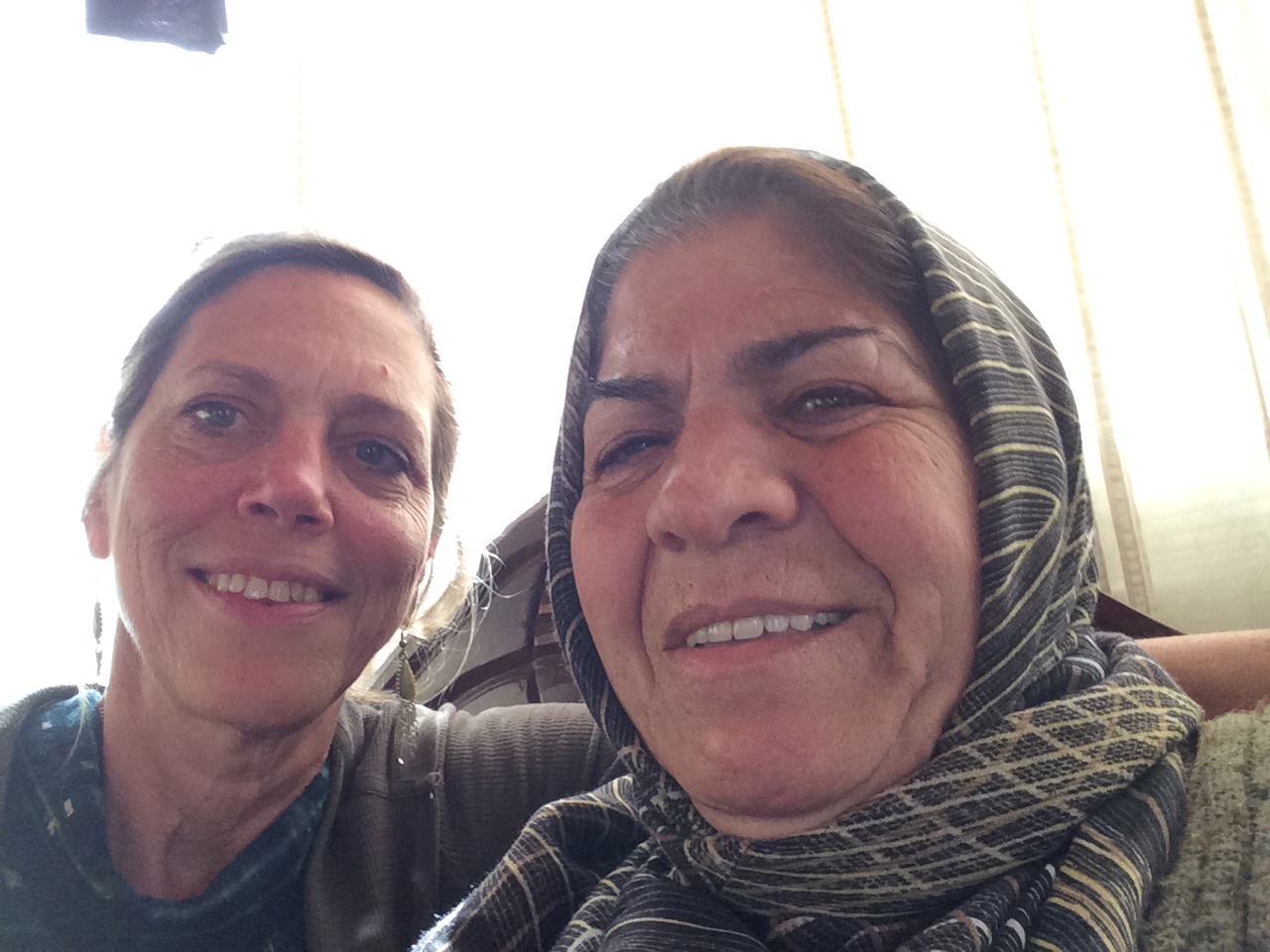
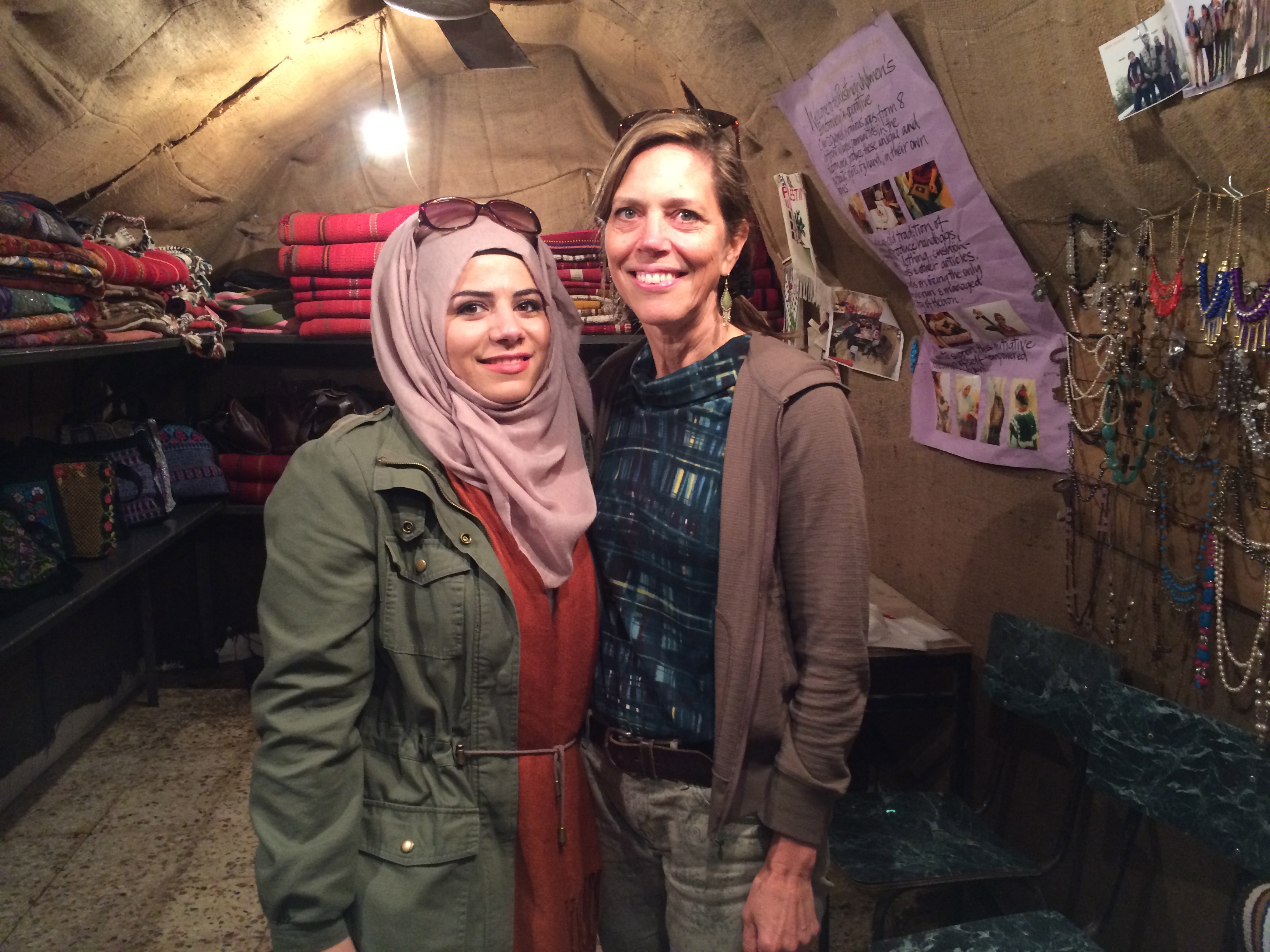
This is a picture of her with me in her shop.

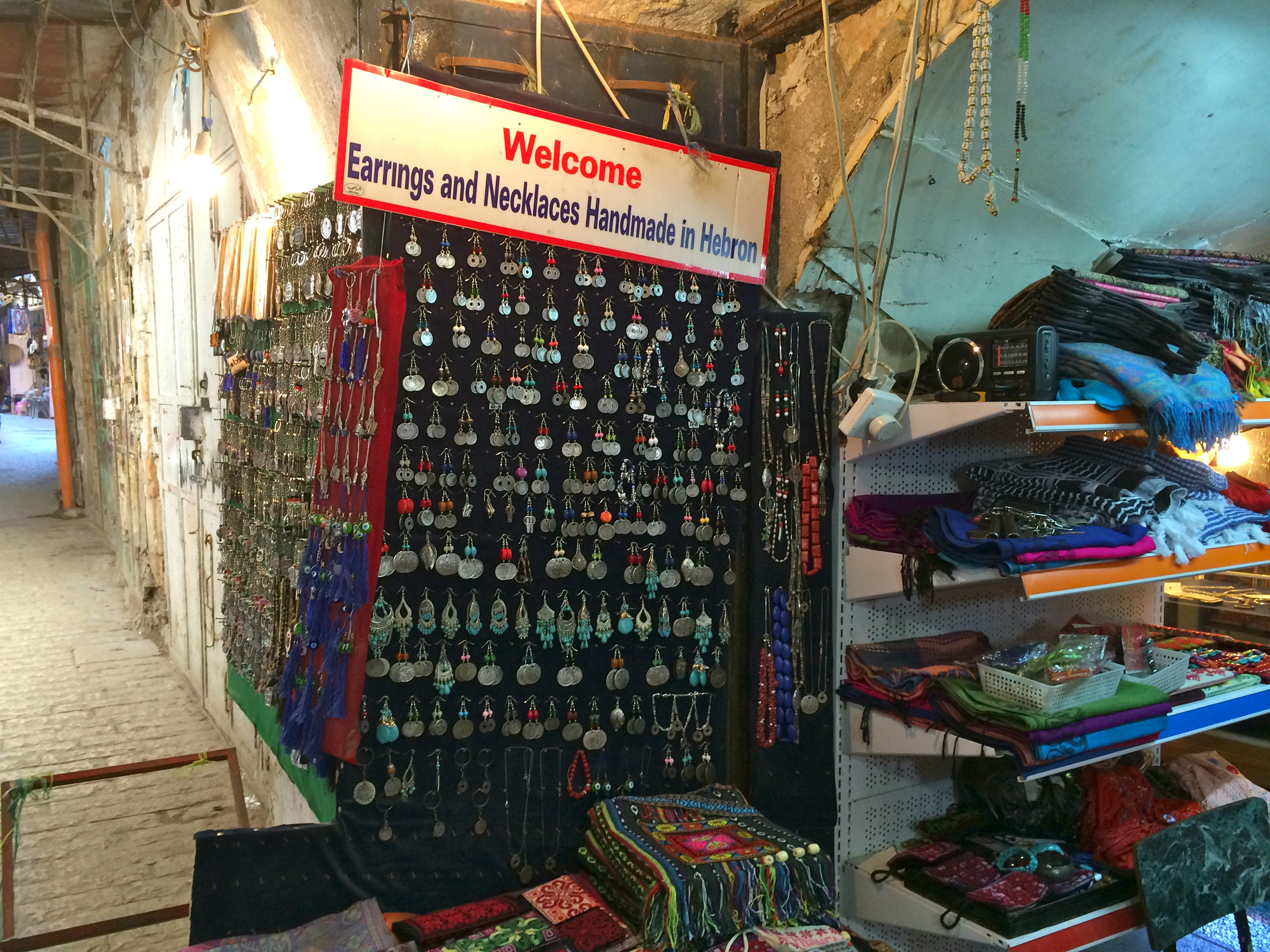
When Sami from HRC gave us the tour of the old town on the first day of work, he had introduced us to Laila.  She served us tea and Sami told us how she vents her frustration at at the occupation by keeping her hands and mind busy making jewelry.  One of the specialties are earrings made from pre-Israel, Palestinian coins. I finally chose a pair for myself today – yippee!  She also sells keffiyas in every imaginable color, all loomed right here in Hebron.

IMG_0857 IMG_0858

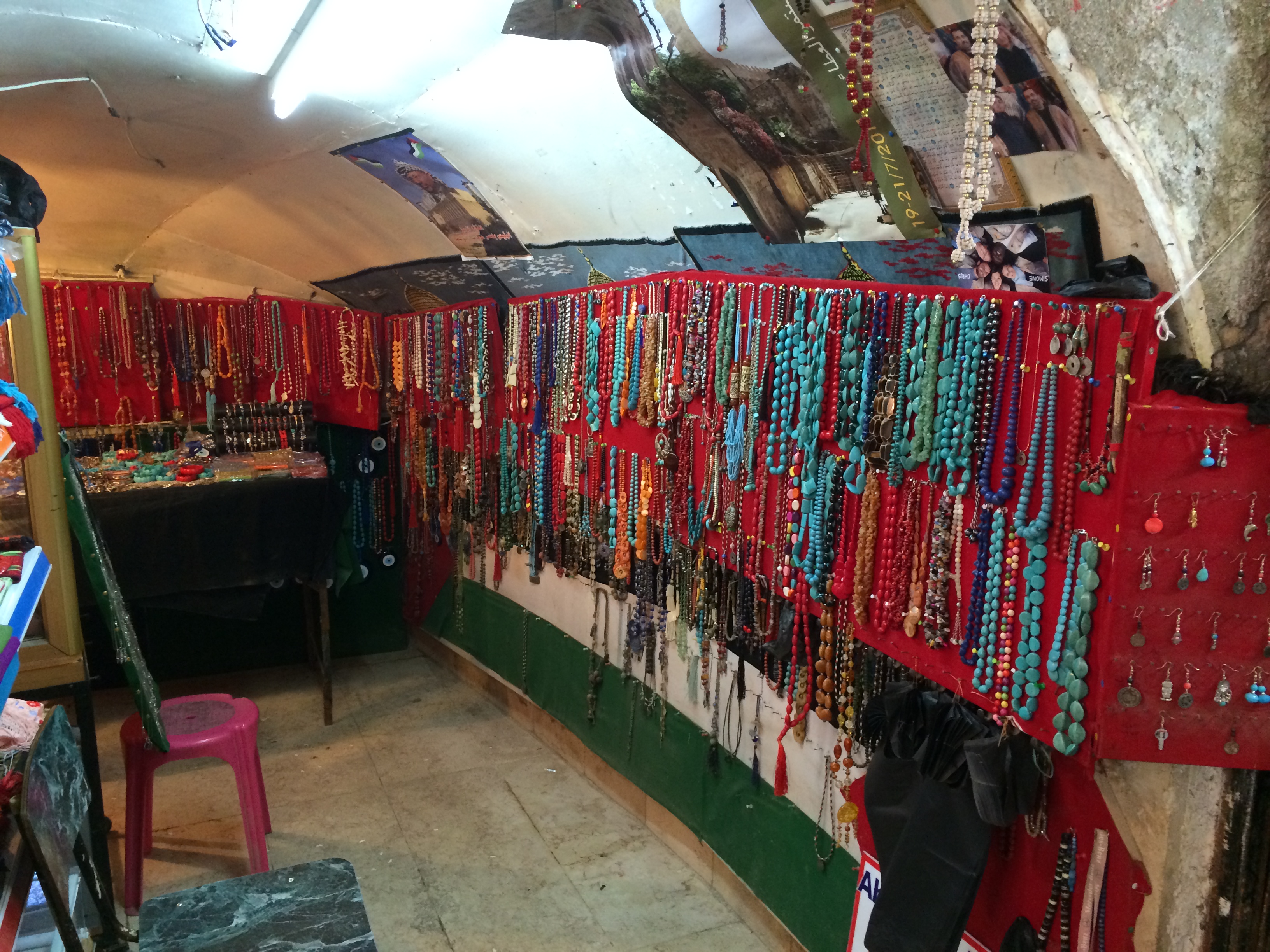
Here are a couple of shots of the women’s handiwork in Laila’s shop. I am hoping to visit the women’s cooperative where these things are made later this week.

As I was chatting with Laila over my falafel, I told her that I want to meet a local woman, Feryel Abu Haikel whom I’ve read about it. She has become quite well known as being on the forefront of the non-violent resistance front in Hebron. She lives in Tel Rumeida which is on the outskirts of the old city and has been very, very hard hit by the occupation and the invasion of the old city by Jewish settlers and their IDF enablers. She was a teacher and then became the principal of the Qortoba School in Hebron. The school is located on Shuhada Street, the street that has become nearly a ghost town because of Israel’s closure of all of the Palestinian stores and erection of check points. Again, bear in mind that this was all to protect settlers from Palestinians, after 27 Palestinians were murdered in the Ibrahimi mosque by a fanatic settler, even though it is the Palestinians who continue to be attacked by the settlers, and even though IDF soldiers by many accounts outnumber the settlers in the old city. If you don’t believe my account of these things, you can read the blogs of the various international observers and peacekeepers who keep a presence here to protect the Palestinians. Here are a few of them http://blog.eappi.org/   http://www.cpt.org/ http://iwps.info/ http://palsolidarity.org/ )

So, as I was in Laila’s shop asking her about Feryal, who should walk into the shop, but Feryal’s youngest daughter along with her sister out shopping for things for her upcoming wedding. So, I was able to get the go-ahead to visit her mother, with assurance that she is in her house most of the time, and general directions as to walking there. I am really loving fate these days.

IMG_1059

This is Feryal’s daughter and me in Laila’s shop. Her sister declined to be in the photo but obliged by taking this shot of us.

I left work a little early to make my way over to Tel Rumeida to try to pay my visit to Feryal. This took me a little bit out of my comfort zone, in that the streets are rather confusing and I do have a tendency to get lost. To get there, I had to go through a check point. As I approached the turnstile, the soldier guarding it asked me where I was from. I answered “the U.S.” He then responded, “What are you DOING there! Don’t you know it’s dangerous?” He was referring to the old city where I have been walking and working nearly every day for the past three weeks. The irony of this heavily armed IDF solider whose very presence is nothing short of intimidating chiding me for taking such a reckless risk as to mingle with Palestinians just about bowled me over. I just smirked and replied, “It’s not scary in the least.” Sigh.

IMG_1101

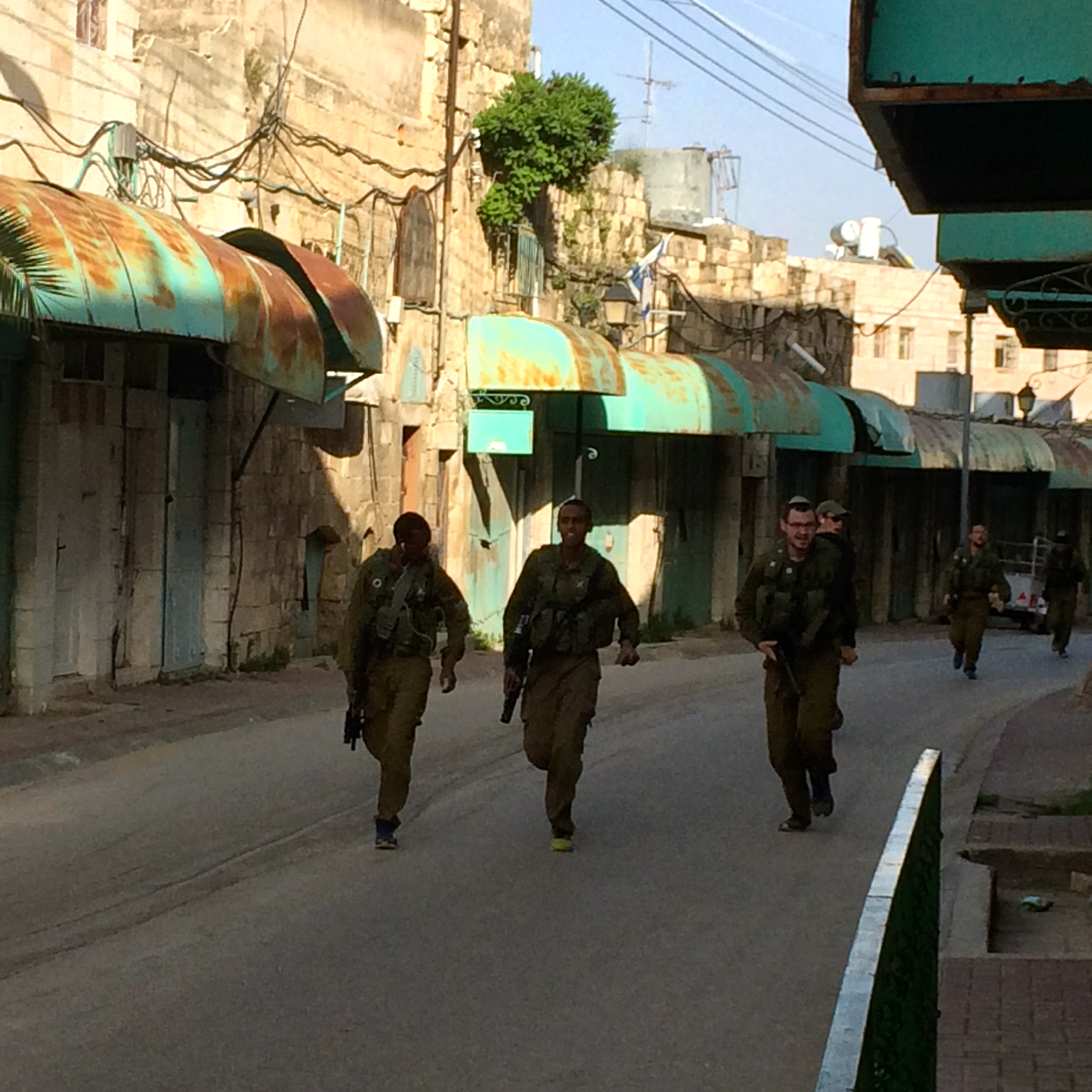
This is what I find scary.  This scene was from just today –  young, testosterone driven soldiers with big guns, everywhere you look. How very brainwashed these people are, and it starts in kindergarten when IDF soldiers come to their classrooms to glorify the army and fill the children’s heads with  fables of the scary “other”; namely the Arab.

Another reason I’m glad I took this walk is to once again see Shuhada Street and to snap a few more pictures. Bear in mind, that this was the busiest market in Hebron before Israel came in and shut down the shops and closed off numerous entrances and egresses.

IMG_1077 IMG_1078

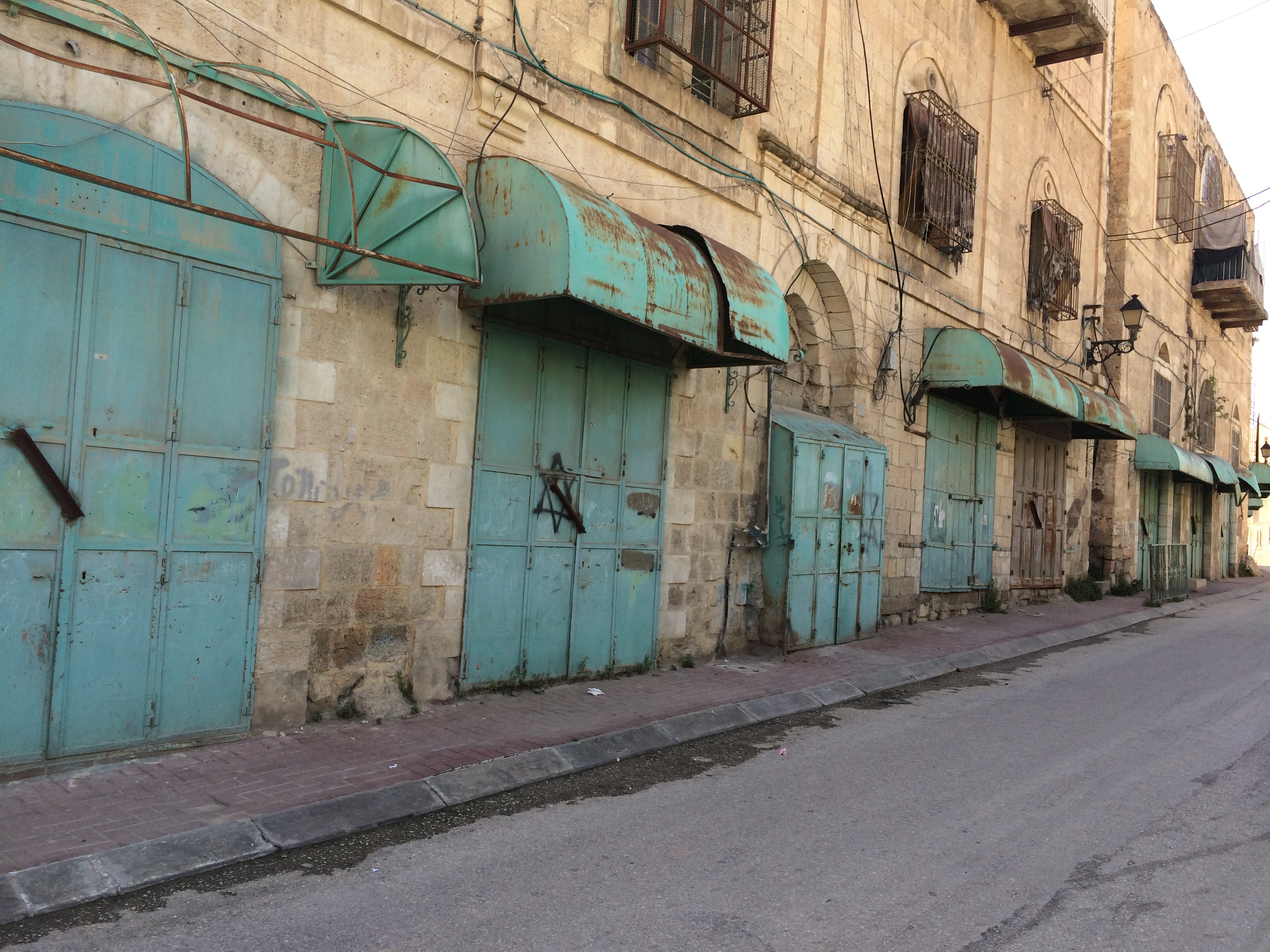
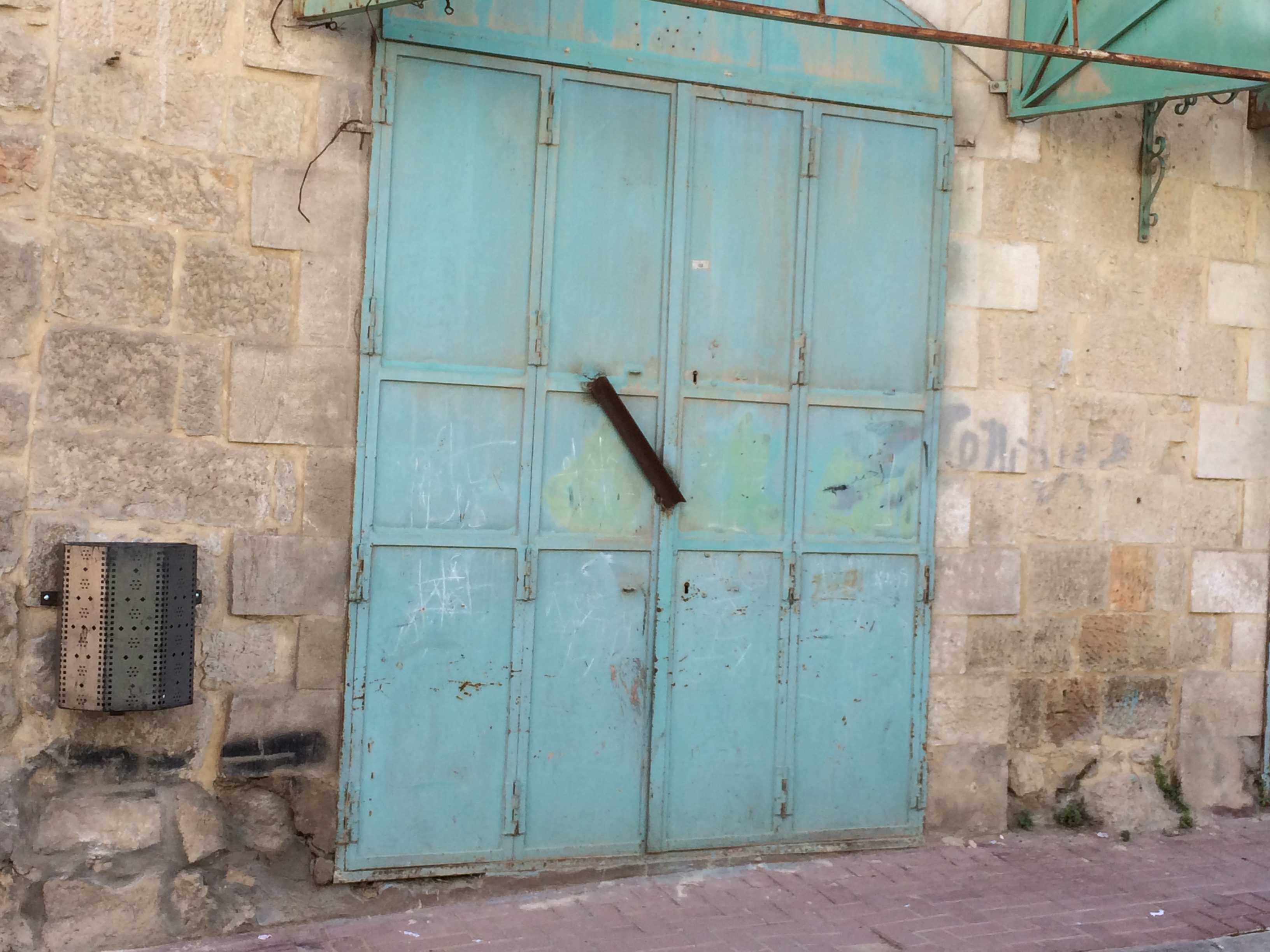
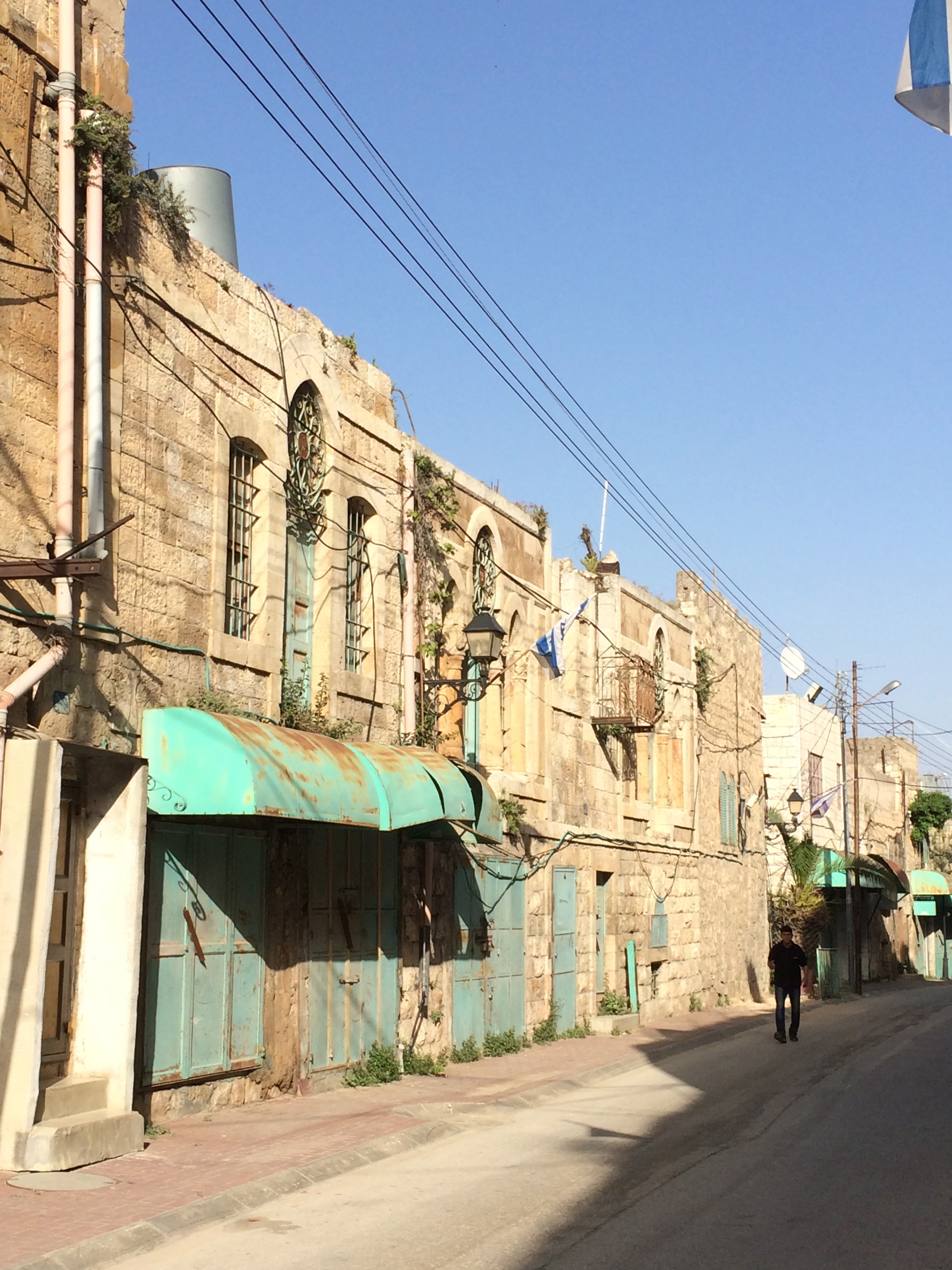
You can see the barred shops. The doors are welded shut and the shop owners are not even allowed inside their own buildings. What a sad and desolate sight is Shuhada Street.

IMG_1098 IMG_1102

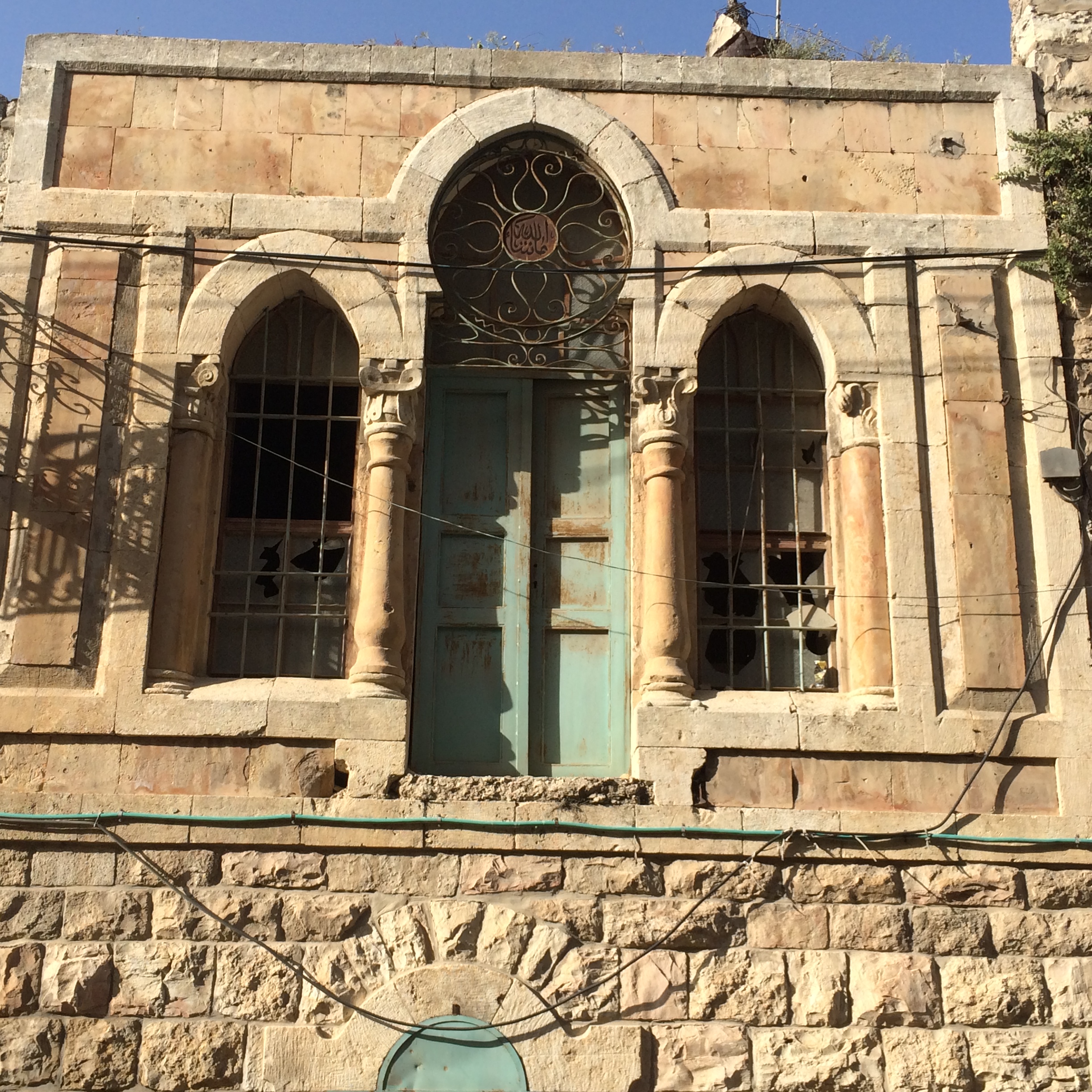
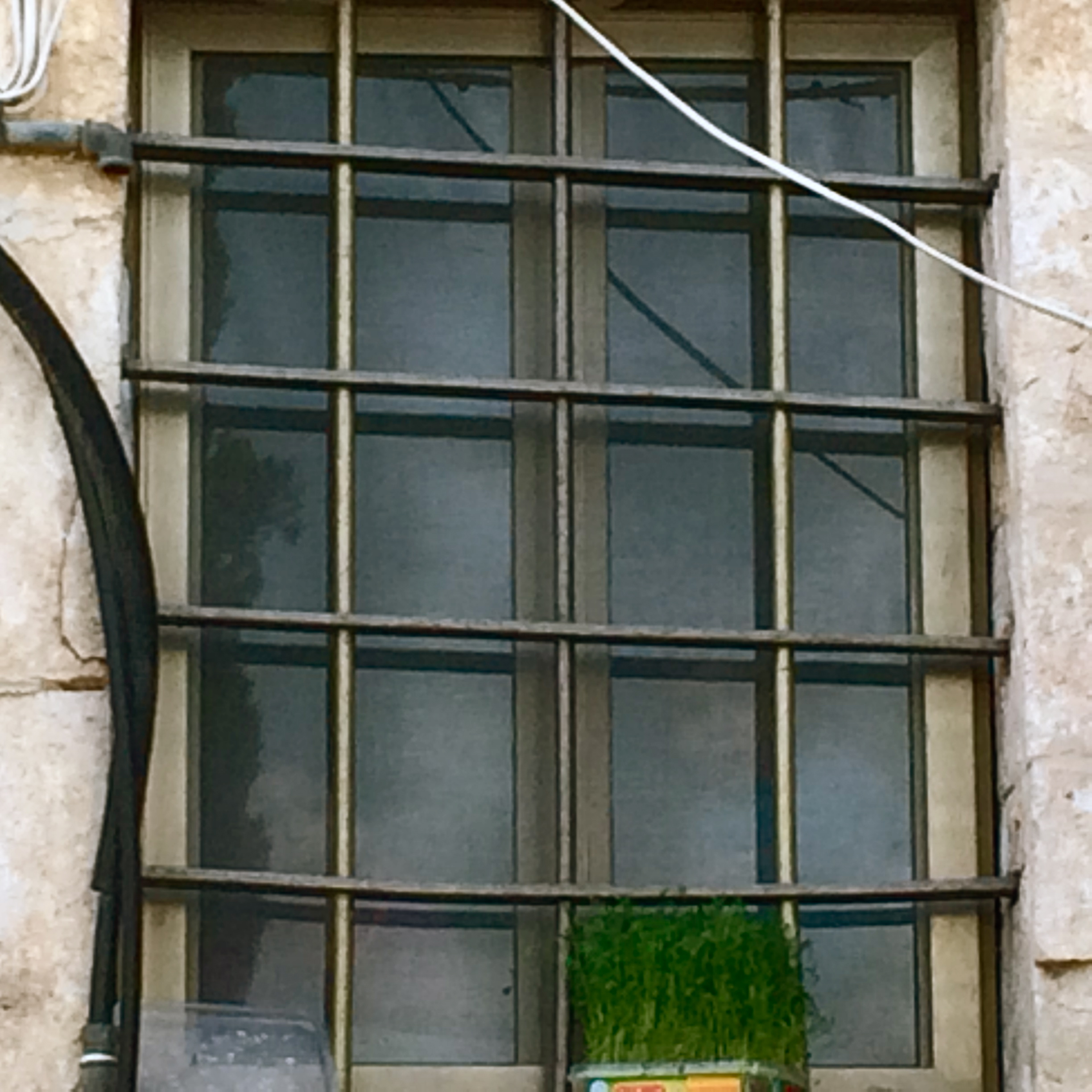
More closed shops and a a beautiful set of windows, pains all broken above one of the shut down shops.

There was another propaganda sign that stated how the shops were all shut down because of the murderous Palestinians. I saw a hasidic Jewish couple intently pointing at and reading the sign, no doubt beaming with pride that their people were able to put those dirty Arabs in their rightful place. Sigh

So, after a couple of stops along the way for directions,   climbing up, up, up the hill to Tel Rumeida, I finally found Feryal’s house. (to be continued 😉 )

EVERYBODY HAS A STORY – HIAM IN ABOUD

I am so happy to have been able to reconnect with Hiam Saleh, a woman who agreed to entertain all 39 of us Lutheran pilgrims last May in her home. If that doesn’t tell you something about her hospitality and sheer energy – well, I am about to tell you more. For me, Hiam is one of those people who you feel you have known all your life.

Getting to Aboud is a little bit of a challenge if you don’t have a car. From Bethlehem you first have to get to Ramallah and then it’s another 20-30 minutes. I had the good fortune of being able to hitch a ride with Hijazi, another person from last year whose friendship I was able to rekindle. I had mentioned my hope of visiting Hiam, and since he was going to Ramallah for a visa application, he offered to let me come along for the ride and then swing over to Aboud to meet Hiam.

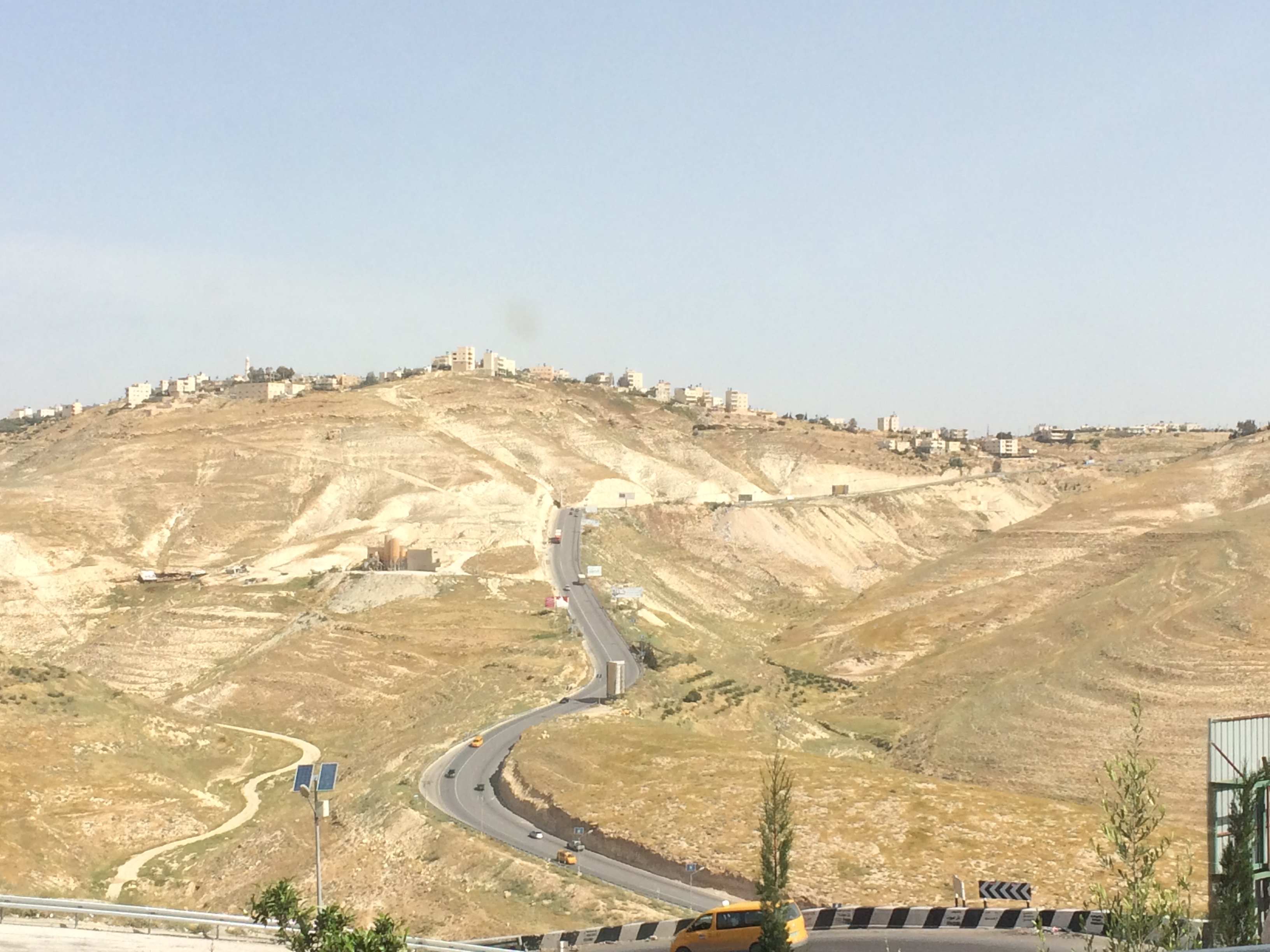
Once again, I got to traverse that US Aid built road that detours around Jerusalem through the Wadi Nar – the Valley of Fire. This adds around 45 minutes to the trip to the direct route through Jerusalem from which Palestinians are now barred.   And it is the only north-south route for Palestinians – one more example of life being made miserable and hazardous for Palestinians at the whim of the occupier.

IMG_0877

I do have to say, it’s a breathtakingly beautiful road if you don’t have to get anywhere too quickly and the weather is good.

Along the way we passed by a town under curfew.  Both entrances were blocked by the IDF.

IMG_0880 IMG_0883

Too bad for you if you needed to get in or leave town that day.

We ended up being later than we had planned because Hijazi had to wait a couple of hours for his European visa application.

IMG_0886

This is the entrance into the city. I killed the time by roaming the streets of Ramallah.I’ve done so much walking during this trip, I’ll be surprised if there aren’t holes in my boots when it’s over.

IMG_0892 IMG_0890

The area around the German/French consulate was really pretty, with old buildings and lovely gardens.

IMG_0889 IMG_0888

Of the cities I’ve visited in the West Bank so far: Jerusalem, Hebron, Jericho and Bethlehem – Ramallah definitely seems the most urbane. It is where most of the Palestinian Authority government offices are located and it has quite a cultural/art scene. I noticed quite a few hipster types among the more traditionally clad Palestinians.

IMG_0887

Hijazi still waiting to be seen at the consulate.

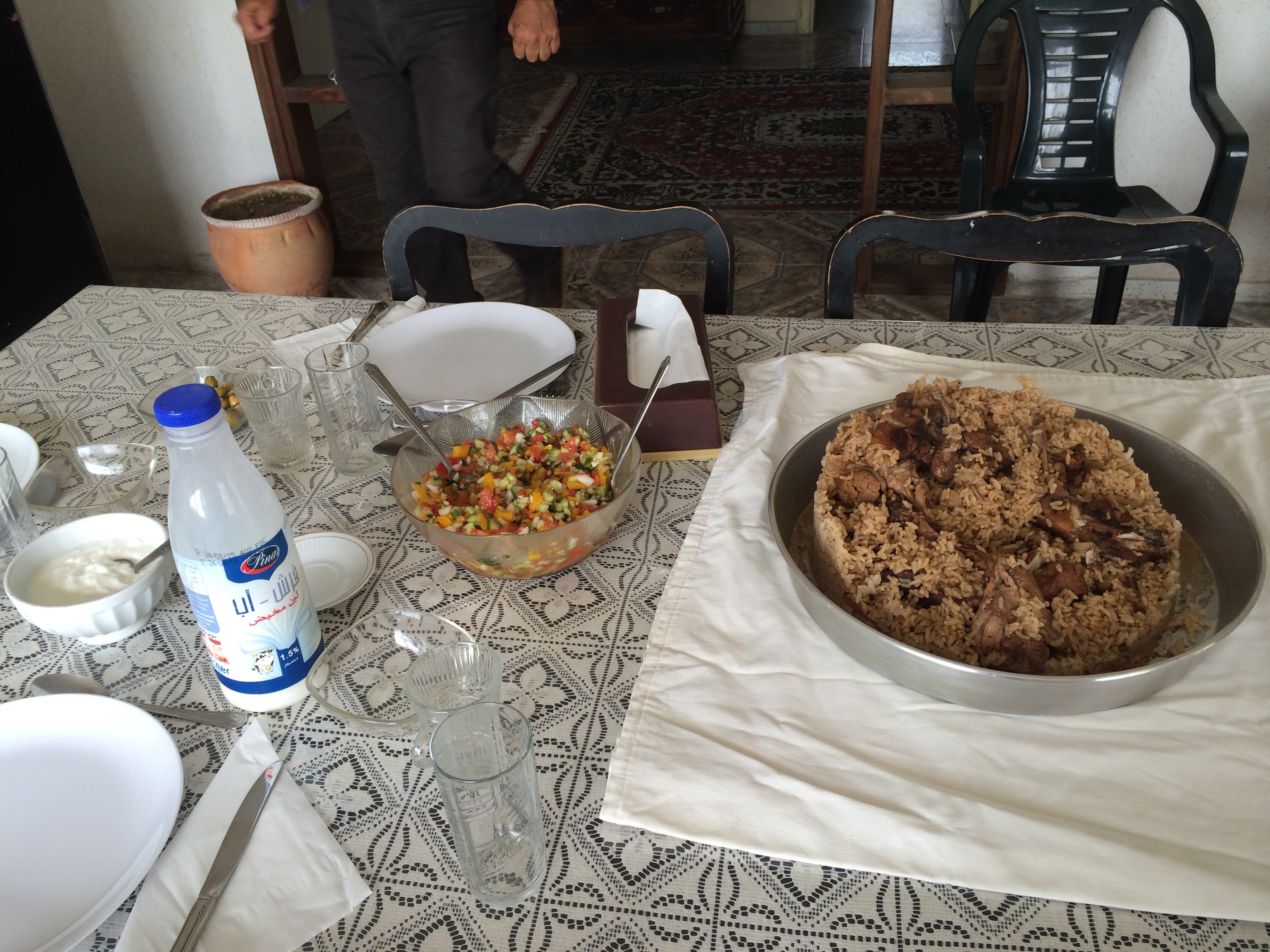
When we finally made it to Aboud, Hiam had a huge meal waiting for us: Maqloobeh, which means upside down.

IMG_0895

It’s one of the most famous Palestinian dishes. It’s made with layers of rice, vegetables and meat (usually chicken) in a pot which is flipped onto a platter when everything is cooked, hence the name. It was quite a treat. She also had some wonderful date and almond Easter cookies to go with Turkish coffee to top it all off. After our late lunch, Hiam was ready to take us for a tour of her little town.

IMG_0898

This is on the balcony of Hiam’s house.

IMG_0894

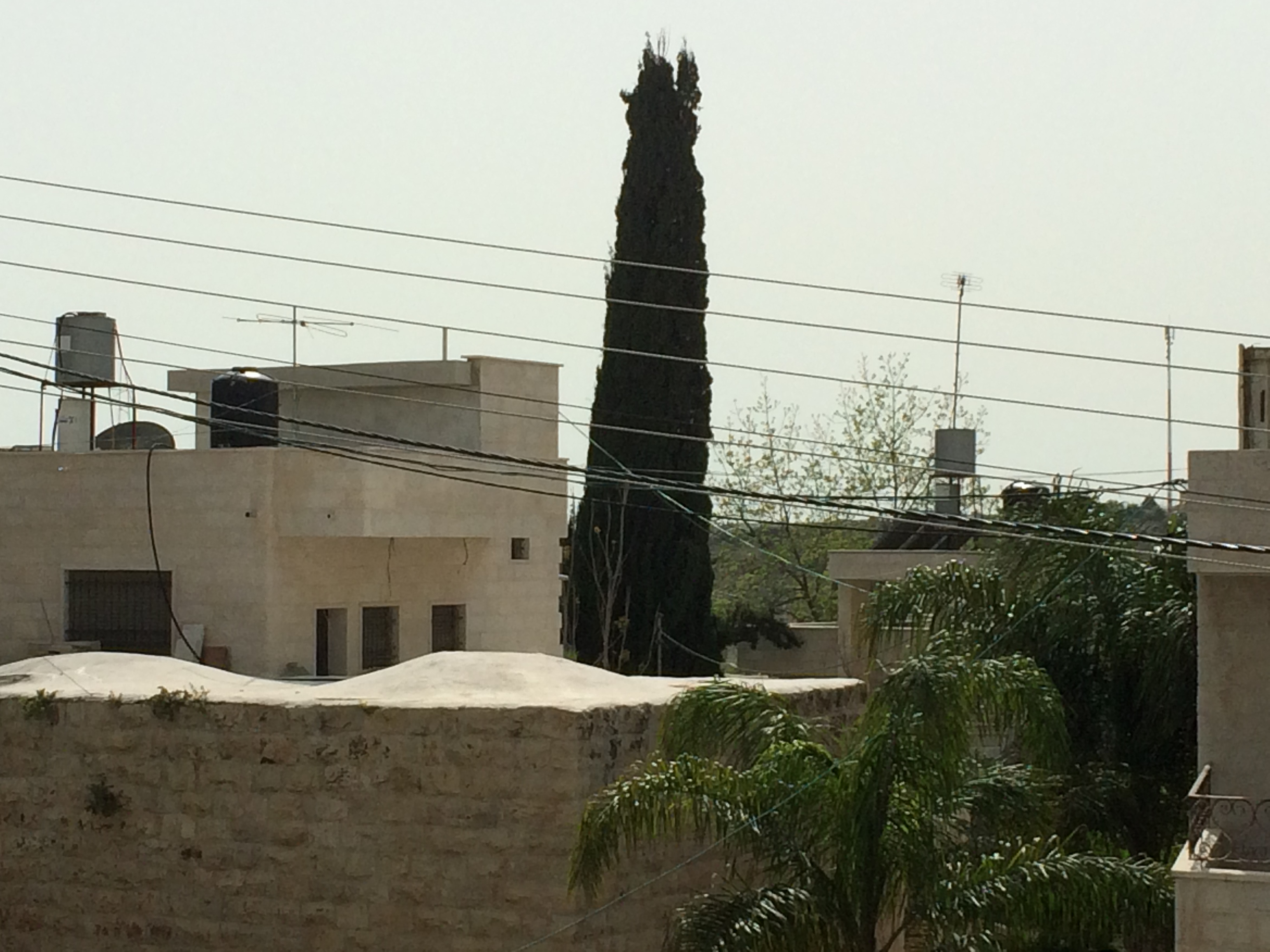
And this is the view across the street from her balcony. I love the domed roofs on the old Palestinian homes. It takes me back to the picture books from Sunday school classes.

Hiam has lived in the village of Aboud for most of her life; however, her family sent her to England for nursing school in the 1960s. While she was there, the 6-day war erupted. When things had settled down a bit, and she embarked upon a trip back home, she encountered the shock of her life. As she was attempting to enter Israel and showed her Jordanian passport, the Israeli customs official told her she was not allowed in. Exasperated, Hiam explained that she was merely trying to return home to her country after being abroad studying. To that the official curtly stated, “this is not your country anymore.” Through a series of coincidences and pulling of strings, she was able to get a very short term visa and made it back home to the country where she was told she no longer belonged.

Amidst all of the turmoil, arrangements were made for Hiam go to the United States to continue her nursing studies. She ended up living in the Boston area for several years, and worked for awhile at Malden Hospital where my son Peter was born. I love these coincidences. The other one with Hiam is that she has an unusual, antique German wall clock that is the identical twin of one that I inherited from my mother. After around ten years in the US, Hiam craved returning to her home and was able to do so. Fortunately, her family home was still intact and for the most part, the Israelis have left Aboud alone. Her extensive nursing training was put to good use in her community.

First stop on our tour of Aboud was  across the street from Hiam’s home to the original family home which is now inhabited by her nephew and his family.

IMG_0903

The gate to the old family house which is in the foreground.

IMG_0905 IMG_0910

The courtyard of the old family home.

Hiam  is very, very close to her nephew’s  three little girls who she calls, cheeky monkeys and they did not disappoint.

IMG_0909

You can barely make out the shadows of the two younger girls who were bouncing with excitement when they saw their Ama approaching.

IMG_0916

The little girls were just as adorable as Hiam had promised.

IMG_0922 IMG_0921

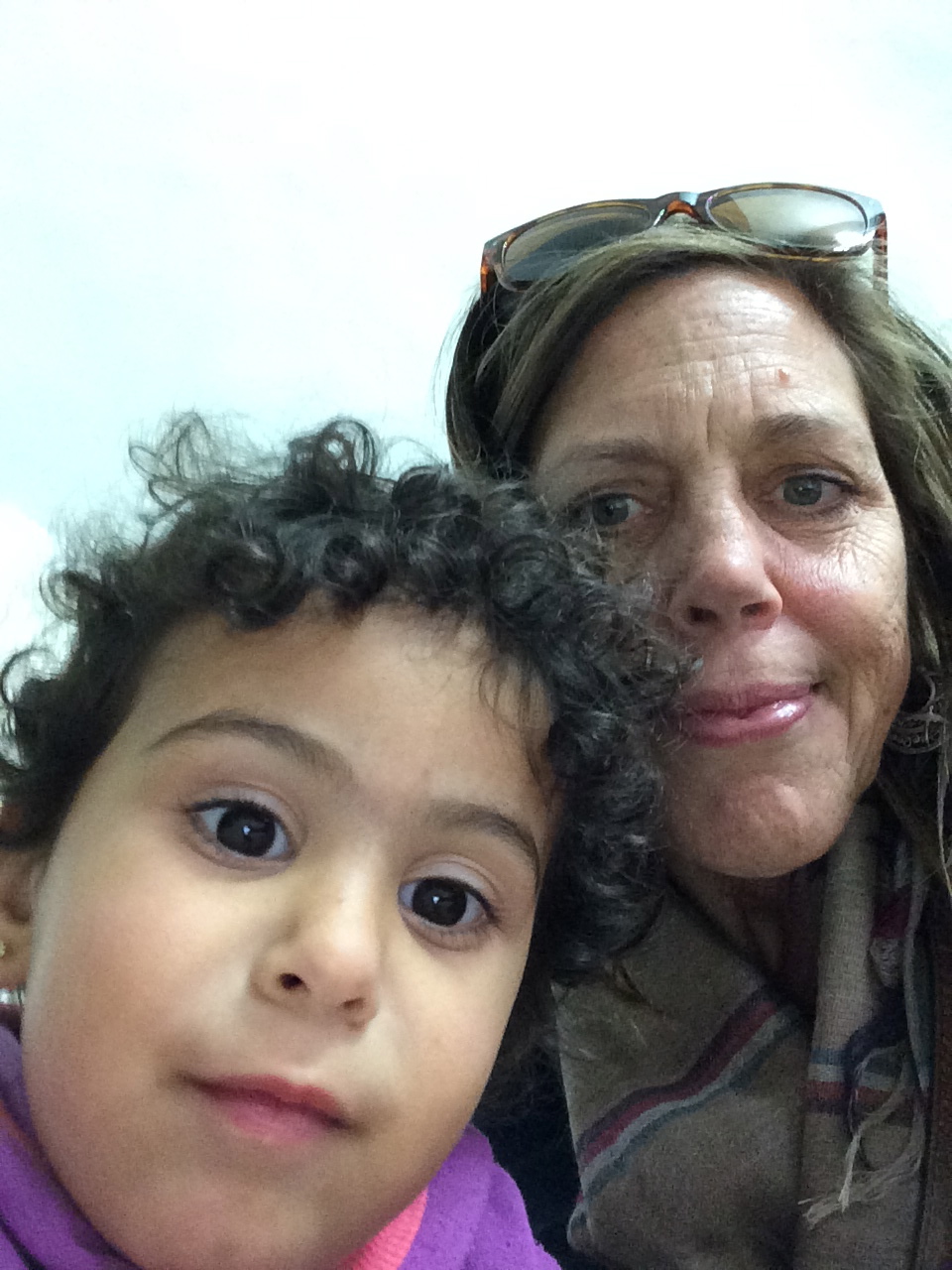
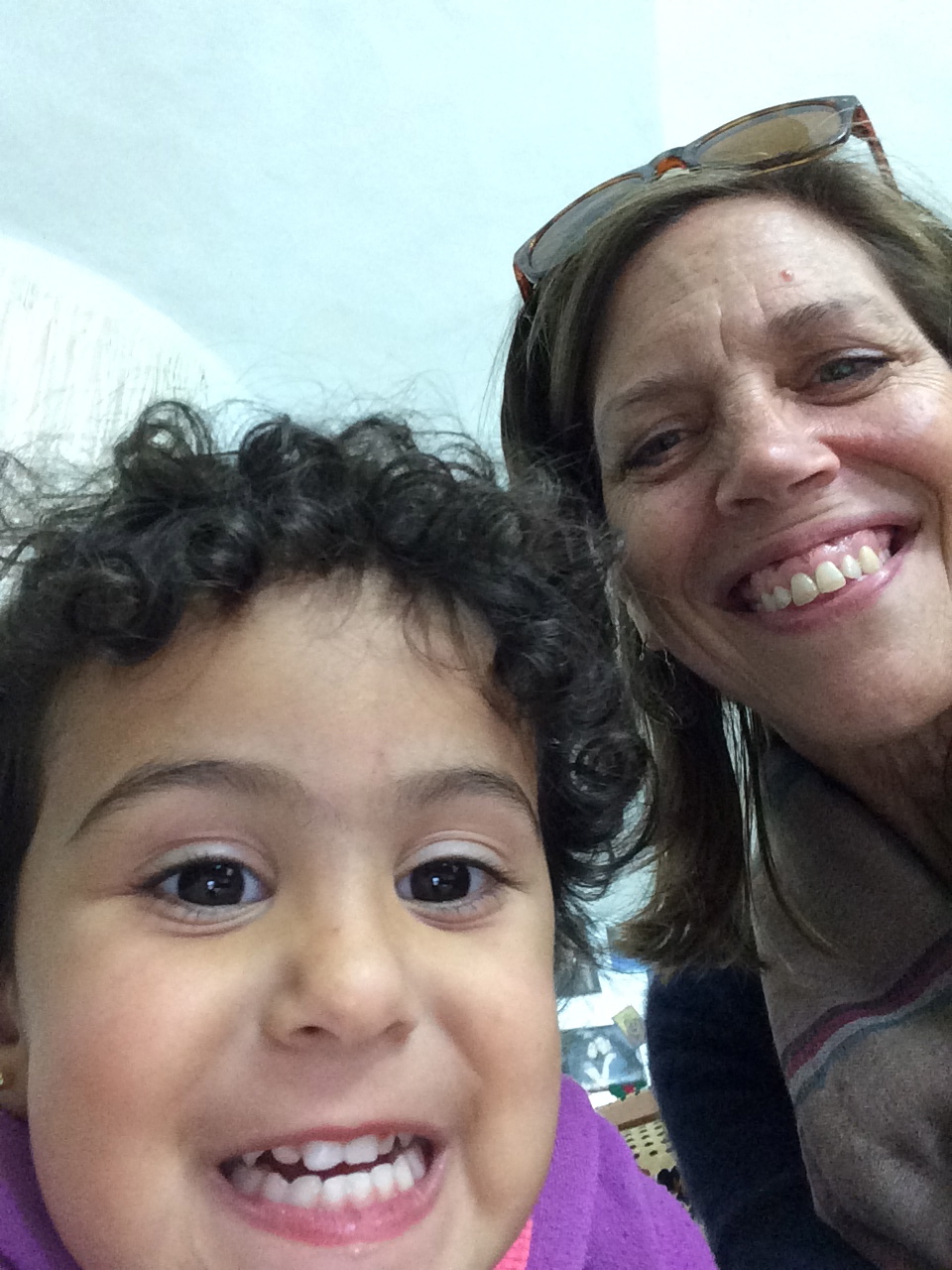
The youngest and I decided to do some selfies – hehe.

IMG_0920IMG_0925IMG_0923

And then her older sister decided to get in on the action. The girls had some fun teasing me about my faltering attempts at Arabic. So, after a nice visit with the girls and their Mom, we were off on our village tour.

Aboud is a really beautiful little town of around 3,000 inhabitants. It is populated fairly evenly by Muslims and Christians whom Hiam likes to point out get on together very well. They do tend to live in their own sections of town, as do the two different Christian populations. Hiam said that in all of her life she remembers only one substantial conflagration between Christians and Muslims and that was basically a teenage neighborbood brawl which was quickly dispersed by the police. It sounded to me a little like the sharks and the skins.

IMG_0938

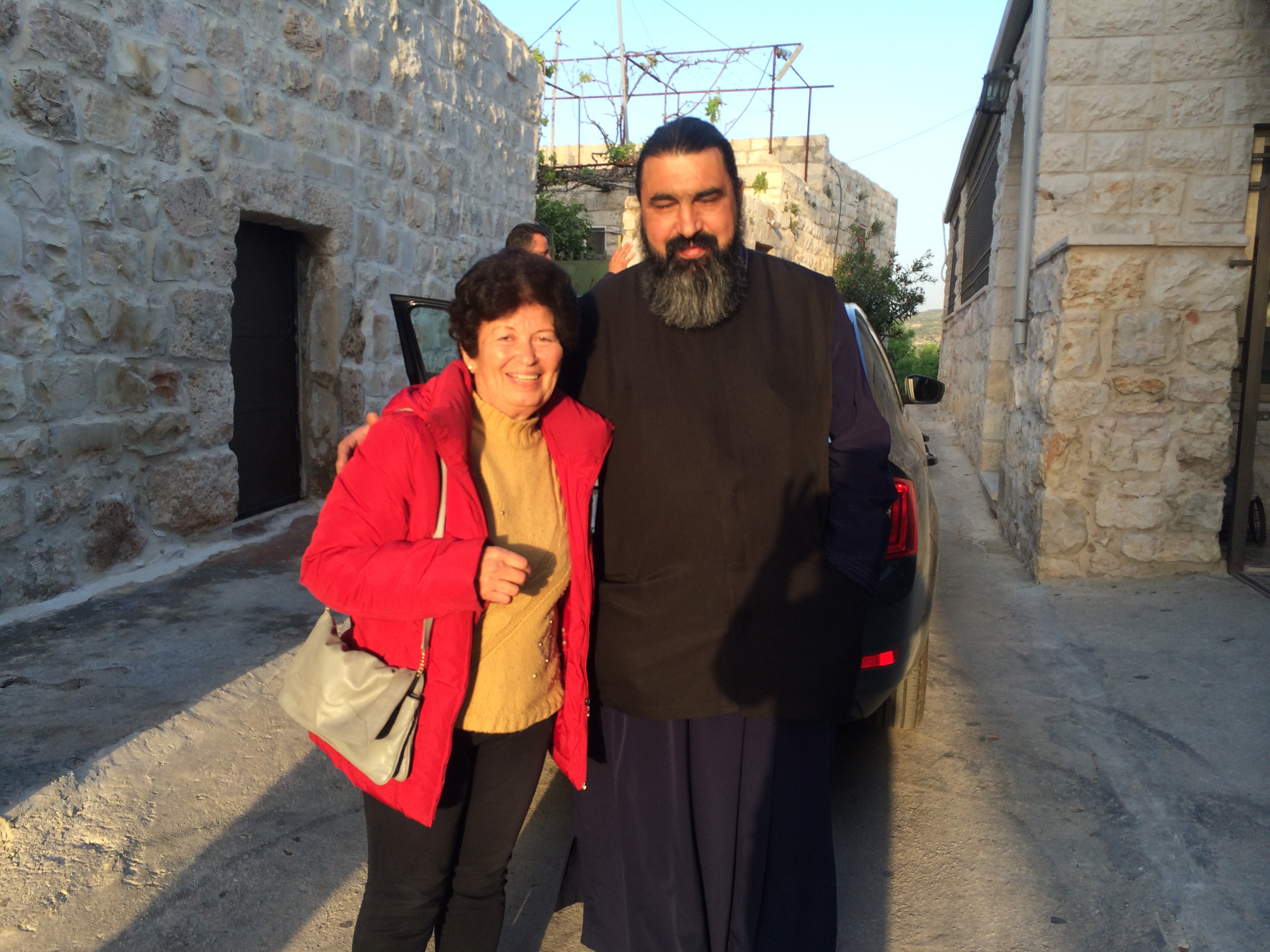
We stopped and chatted with a number of people along the way. Hiam knows everybody in town. This is the priest of the Orthodox church which hosted my pilgrim group for lunch when we visited last year.

IMG_0936 IMG_0932 IMG_0940IMG_0931 IMG_0930 IMG_0929 IMG_0928 IMG_0927

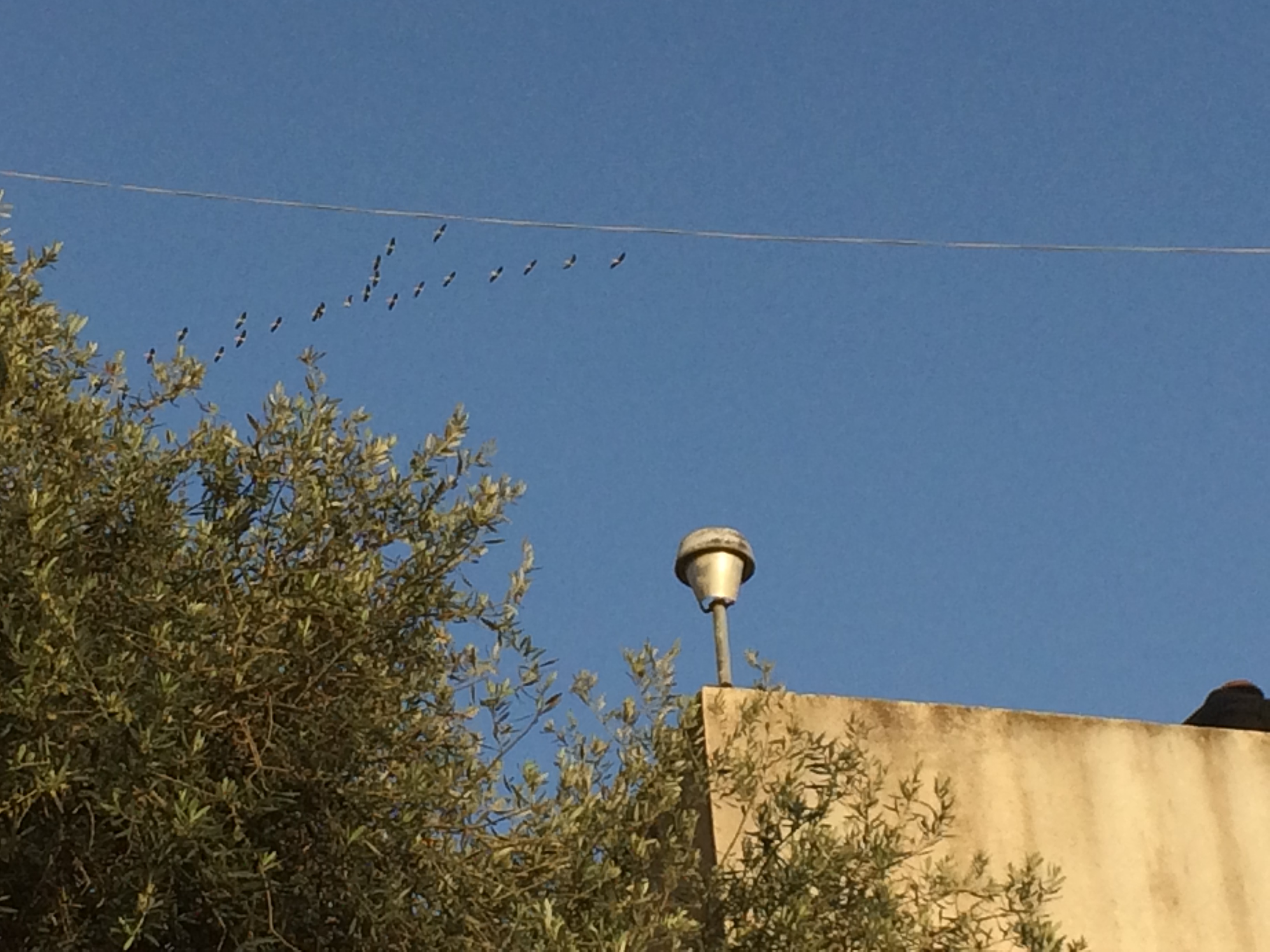
As we were walking, Hijazi spotted this flock Egyptian vultures migrating back up from their winter post.

Although the town is picturesque and quiet, it is far from immune from the indignities and hostilities of the occupation. As we walked down the main street of Aboud, we came to the end, except it didn’t used to be the end. The street used to continue as one of two ways out of town.

IMG_0944

The road, however was blocked by a mountain of dirt and concrete to “protect” two illegal Israeli settlements which have been built on Aboud village lands after uprooting many ancient olive trees. Apparently villagers dug this egress through the road block and so far it remains open, at least to this extent. Resistance comes in many forms.

IMG_0946

This is on the other side of the roadblock looking onto the settlement. There are plans to confiscate yet more Aboud land for the separation (Aparthed, if you will) wall.

The other thing Hiam told us about was a recent raid in which nearly every house was stormed my IDF soldiers in the middle of the night. She says that she was lucky because hers was one of the last, and so she was already awake at 6 am when they came pounding on her door. I asked her what prompted the raid, and she had no idea other than it was probably some sort of drill. The soldiers frequently ruthlessly tear apart homes during these raids, and children are traumatized. Of course there is no recourse for damage, physical or psychological,  because it’s all about Israel’s security.  I get so angry when I hear these stories and it never ceases to amaze me how in stride most Palestinians seem to take it all. I guess, what choice do they have.

IMG_0942

Sun setting on the sweet little town of Aboud.

LET SLEEPING DOGS LIE

The reaction of many people in the US to my stated plan to visit Palestine has been a breathless, “Be Careful!”, as though I were about to enter an active combat zone. In a sense, it is, in that Israel Defense Soldiers (more appropriately, Israel Offense Soldiers) are a constant presence in and threat to Palestinian life.

IMG_0864


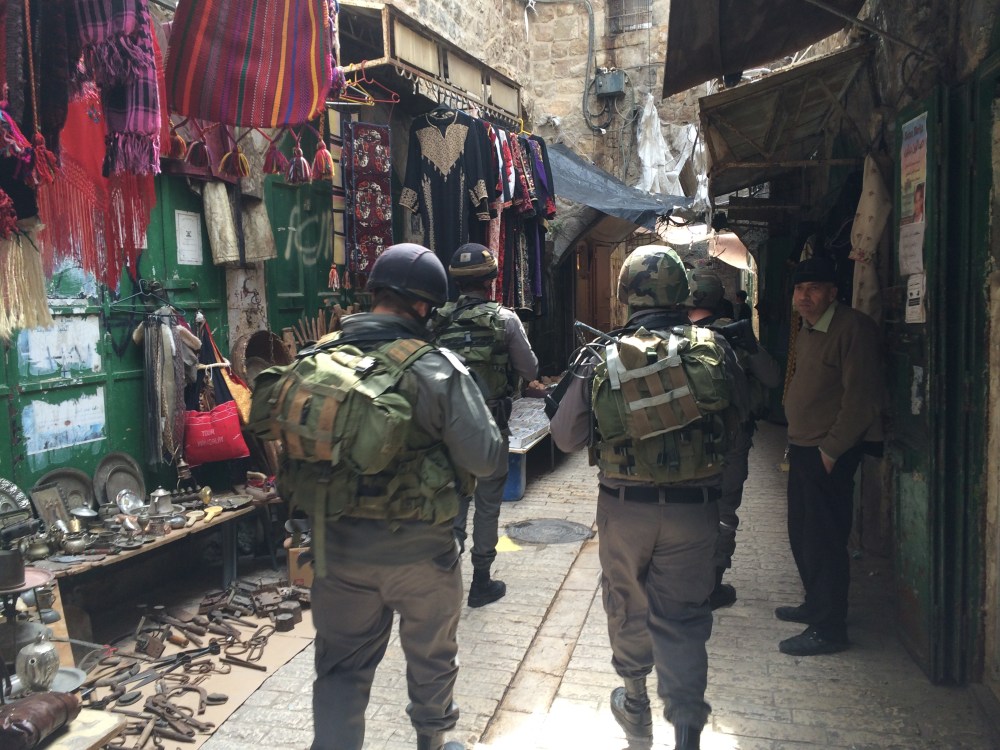
This is a shot I took the yesterday in the old city of Hebron. I was chatting was a shop owner when this little squad came stomping by. The street was quiet and there was nothing particular going on, but they constantly make their presence known. They are there for the sole purpose of protecting the 700 or so extremist, squatting Israelis who have decided to make their home in the middle of Hebron – a major Palestinian area for at least the past 800 years. And by most accounts, the IDF soldiers here outnumber the settlers. The visceral reaction is a quiet, angry tension, biting one’s tongue until the big guns have moved on by.

The irony is that this grossly disproportionate military presence in Hebron all started after an extremist Jewish settler entered the Ibrahimi Mosque and started spraying the Muslim worshippers with machine gun fire, killing 29 of them and wounding many more.  Instead of taking actions to protect the Palestinians, Israel sent in the IDF to harass them by imposing severe limitations on their movement and the use of their own property. Even though the indigenous residents of Hebron were victimized by this brutal attack, Israel provided its protection to the perpetrators of the violence. It is worth noting that the attacker, Baruch Goldstein is venerated by the radical settlers as a great hero of their cause of reclaiming Hebron, even though it was never theirs in the first place.  This is the epitaph engraved on his grave stone:

“The revered Dr. Baruch Kapel Goldstein… Son of Israel.  He gave his soul for the sake of the people of Israel, The Torah, and the Land.  His hands are clean and his heart good… He was assassinated for the Sanctity of God” – See more at: http://mondoweiss.net/2013/07/murderer-baruch-goldstein#sthash.tNywWy2R.dpuf

A little of the settler’s narrative is worth noting. The radical settlers hope to reclaim all of Hebron as it is the locale of the Tomb of the Patriarchs where Abraham and some of his progeny are buried, as well as Rachel’s tomb. Their claim, of course, goes back several thousand years in time. No only that, these patriarchs are sacred to Jews, Christians and Muslims alike. They provide the roots for all three religions. Until the Balfour Declaration announcing the creation of a state of Israel, people from all three groups lived quite peacably together. It was only when the indigenous population started to feel threatened by the influx of European Jews and their creeping confiscation of land that widespread violence between Palestinians and Jews erupted.

In the early 1900s, there was a small community of Jews living in Hebron which was primarily Muslim.   Because of the perceived threat from the influx of European Jews, there were riots in Hebron and 67 Jewish Hebronites were killed . In response, the British government exiled the remaining Jews from Hebron who numbered around 400. This is the event that the modern, Jewish settlers, many of whom herald from the Bronx, New York, use as their justification to retake the city, even though they comprised only a  tiny minority for many hundreds of years, while simultaneously giving a hearty nod of approval to the much more recent brutal mosque massacre by one of their own.

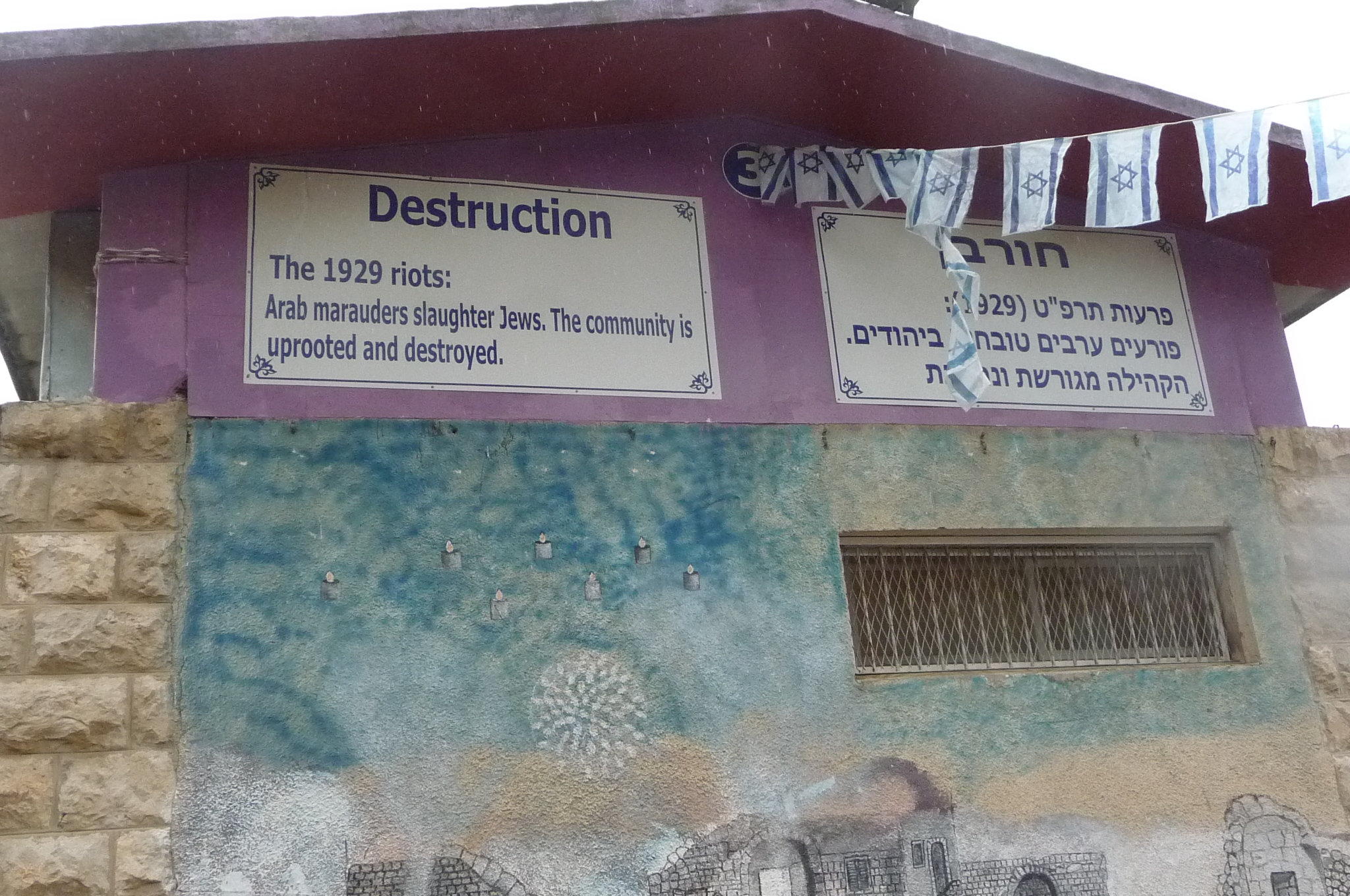
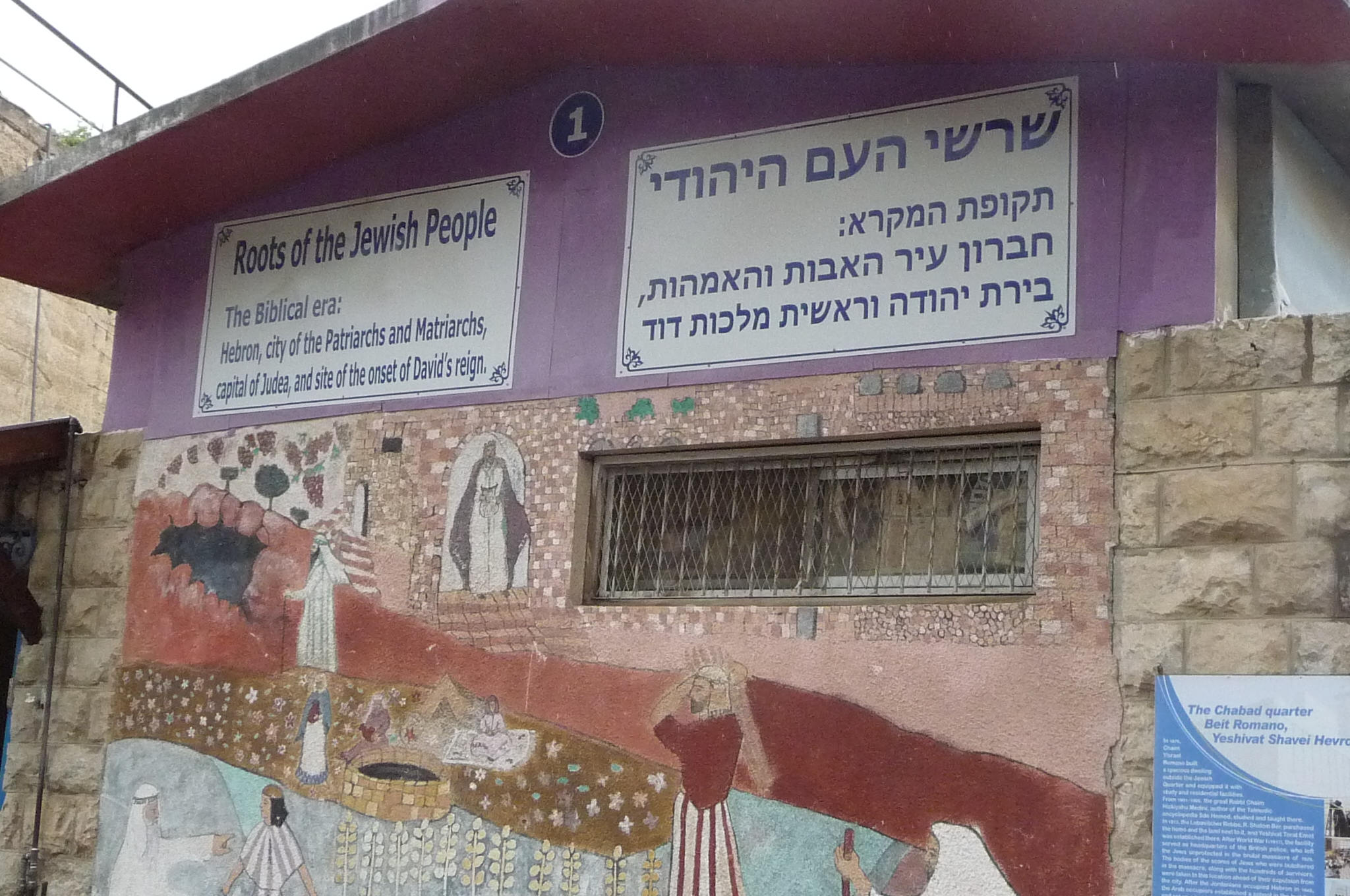
P1120337 P1120336 P1120335 P1120334

These signs are from the settler-only portion of the old city of Hebron and tell a very 1984-esque version of events – a narrative embraced by many Zionists of both Jewish and fundamentalist Christian persuasions. Well financed American foundations bring in busloads of people to which to spoon feed this propaganda and seek ever more funding for the purpose of pushing out the Palestinians. In addition to the small Jewish presence in the city of Hebron, there are two large settlements outside of the city with around  7,000 settlers. As mentioned in an earlier post, these tour groups also arrogantly traipse through the Muslim section of the old city flanked by IDF soldiers. It is a continuous reminder to the inhabitants that their presence in their ancient homeland is under constant threat.

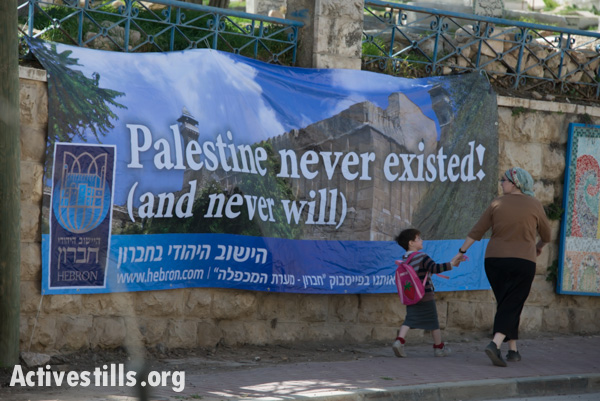
20140307-palestine-0552

Just a few years ago, this banner hung prominently in the the section of Hebron taken over by the settlers. Apparently the powers that be thought that was just a tad too inflammatory  and perhaps didn’t play well to the media and had it taken down.

IMG_0850

This picture is taken from the point where the old city street leading to my office begins. To the right are concrete blocks delineating the section of the old city taken over by the settlers. The large building to the right was a Palestinian school. When it was turned over to the settlers, they built on top it, destroying the historical integrity of the building. You can see a solider standing watch on top. Straight ahead is an ancient building not yet confiscated by Israel but left in a state of dangerous disrepair because Israel will not allow its rehabilitation. Not only is this yet another piece of Palestinian cultural heritage left to waste (HRC was ready and willing to do the rehab), it is also a hazard as whole sections of buildings like this often collapse during extreme weather events.

So, about the question of my own personal safety that I keep countering, here is the scariest thing that has happened to me during all of my time in the West Bank. The other day, I took a walk in the fields and up the hill behind my apartment building. I wanted to get a closer look at the Har Hona settlement which is one of the several settlements which are slowly and with planned deliberation, separating East Jerusalem from the rest of the West Bank.

IMG_0705

Here it is, complete with its ugly separation wall and watch towers.

As I approached the top of the hill, I noticed the hulks of about a half dozen sleeping, feral dogs. I have heard stories of packs of dogs viciously attacking people, so I quickly and quietly backed away, hoping to avoid arousing their attention. Just as I thought I was in the clear, one started barking and charging toward me. With an adrenalin rush, I instinctively reached down and grabbed a couple of large stones. The dog took notice and backed away. Of course the dog didn’t know that I can’t throw worth beans, but the gesture was enough to signal danger to the dog. To me, it was a visceral experience of the power that one can feel in wielding a stone. If only the stones thrown by young Palestinian boys evoked a similar response from the occupiers.

For anyone interested, you can read more about how the settlements in and around Hebron are making Palestinian life extremely difficult. http://electronicintifada.net/content/hebron-settlements-make-palestinian-life-nearly-impossible/7138

RAINY DAYS AND BLOCKADES ALWAYS GET ME DOWN

Apologies to Carpenters fans for the title, but that song stuck in my head as I was looking for inspiration to write a post. The view from my apartment window was not so inviting this morning. The weather here for the past couple of days has been horrific. As one Palestinian shopkeeper put it today, “we’re getting our second winter.” The daytime temperature probably never even reached 50 deg., it’s been near freezing at night and there was intermittent pelting rain with strong wind. I thought I was brilliant in having the foresight to pack an umbrella, but darned if I could find it today. I must have left it in Hebron on my first (rainy) day there. So, on the way to church, I stopped and bought one. It helped a bit, but the wind was so strong I had to stop several times because it had collapsed outward, and by the time I got to church, my shoes and pants were soaked. I actually broke down and took a taxi home.

Yesterday was similar. Thankfully, I didn’t need to go to Hebron because it was Friday, the Islamic day of rest and my first weekend day off. I was able to take a little road tour up to Ramallah. At one point, the rain actually turned to hail. In a way, the gray, unforgiving weather was an appropriate backdrop to what I was witnessing – the deliberate decimation of the Palestinian homeland. Bethlehem, my home for the month is now surrounded on three sides by walls and Jewish-only settlements.

Between bursts of rain today, I took a walk up the steep hill toward the Har Homa Settlement.  As I mentioned before, I can’t see it from the beautiful view from the apartment, but it is right over the hill from me.

IMG_0806

You can see the snaking wall, and the fortress-like construction high up on the hill which is typical of all of the illegal Israeli settlements in the West Bank, which now house nearly 1/2 million Israelis.

This has been a slow and deliberate Israeli plan to annex all of Jerusalem from the West Bank notwithstanding that East Jerusalem is and has always(or at least for the past 800 years) been primarily Palestinian. In addition to making travel from East Jerusalem to the West Bank incredibly difficult because of roadblocks and the wall, Israel continues to confiscate and destroy Palestinian homes in the East Bank and is planning to build a huge Bibilical theme park. If this does not comprise ethnic cleansing, I don’t’ know what does.

The other thing that I experienced yesterday was something I only just learned about. I knew that Israel has built Israeli-only roads traversing the West Bank to allow “safe passage” to Israeli settlers to their illegally built West Bank settlements – all part of the continuous land confiscation of the West Bank which has made a two-state solution a pipe dream. What I didn’t know was that Israel has built a Palestinian-only road here and there., or I should say allowed them to be built, because they are financed almost exclusively by the US and other nations. How good of them to recognize that Palestinians need to get places too. These roads are euphemistically referred to as “fabric of life” roads – 1984 anyone? One of the roads I traveled on replaced a direct route which went through the outskirts of Jerusalem to Ramallah. Since Jerusalem is being slowly annexed, this route was closed down to Palestinians, and instead they now have a crazy, roller coaster, hair-pin turning, absolutely treacherous road through the mountains. It’s breathtakingly beautiful, but a hazard for the heavy traffic that traverses it. During the rain yesterday, we saw semi tractor trucks unable to make it up some of the steep inclines, and some actually sliding down the slick, rainy road. Fabric of life indeed; shroud of death would be more appropriate. So, our US tax dollars are poured into projects like these. On their face, they look like they’re helping the Palestinians, but in reality, they are furthering Israel’s Apartheid policies.

Now, the Palestinians of the West Bank are not allowed into Jerusalem without a special permit, and those permits are given very stingily. The Al Aqsa Mosque/Dome of the Rock  in Jerusalem, one of Islam’s holiest sites is now off limits to the majority of Palestinians in the West Bank.

P1120359

This photo is just outside of Bethlehem and from this vantage point, you can see the dome of the Al Aqsa mosque.  Unfortunately, “you” can’t see it in the photo, unless your eyes are better than mine, even though it was visible when I snapped the shot. it seems to have disappeared. This illustrates the sad irony that this is the only point at which many Palestinians will ever be able to see it, and they often come to this very spot to catch longing glimpse.

Of course all of this crazy quilt of road building and walls is done in the interests of Israel’s security. To justify the confiscation of land, the separate roads and the wall, they cite instances of Israelis injured and killed by Palestinans. Never mind the fact that the number of Palestinians injured and killed by Israeli is many times greater, http://israelipalestinian.procon.org/view.resource.php?resourceID=000639 but this excuse begs the question: Why are Palestinians targeting Israelis? The obvious answer is because they are resisting a brutal occupation. I am not an advocate for violence, but even international law recognizes the right of resistance. As explained by human rights lawyer, Linda Brayer:

““The Palestinian’s legal right to resist occupation—to fight for their ability to promote, sustain, and nurture human life, to fight for their right to grow, to flourish—comes from two documents: the 1960 Declaration on the Granting of Independence to Colonial Countries and Peoples and the Fourth Geneva Convention and its subsequent protocols.

Taken together, people have the right to “fight against colonial domination and alien occupation in the exercise of their right to self-determination.””

The system they have created is unsustainable and it will collapse. It is just a matter of time. All the walls and separate roads they erect will not create security. Wouldn’t it be wiser for Israel to reconcile itself with the fact that it has served grave injustice on the Palestinians and move toward a truth and reconciliation process?

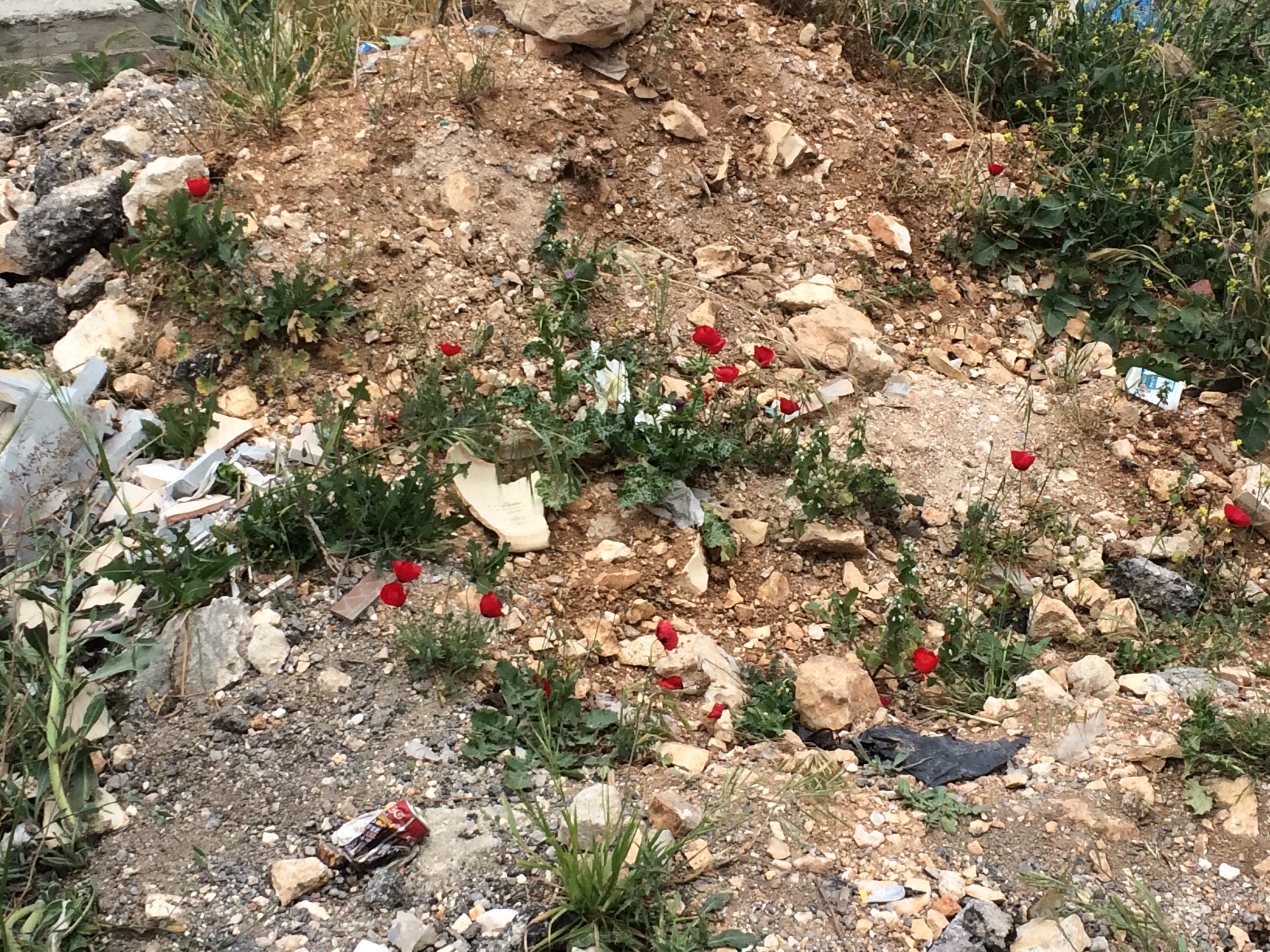
Since I can’t end on a completely gloomy note, I think this pictures sums up the situation beautifully. Poppies springing up amongst shards of porcelain tile.

IMG_0735

ANIMALS AND APARTHEID

My backyard in Bethlehem is amazing. Every day I gaze  out onto the beautiful ancient landscape, and I have been greeted by some heart stopping sunrises and moonscapes. Yesterday, I awoke to this sunrise.

IMG_0711

P1120357

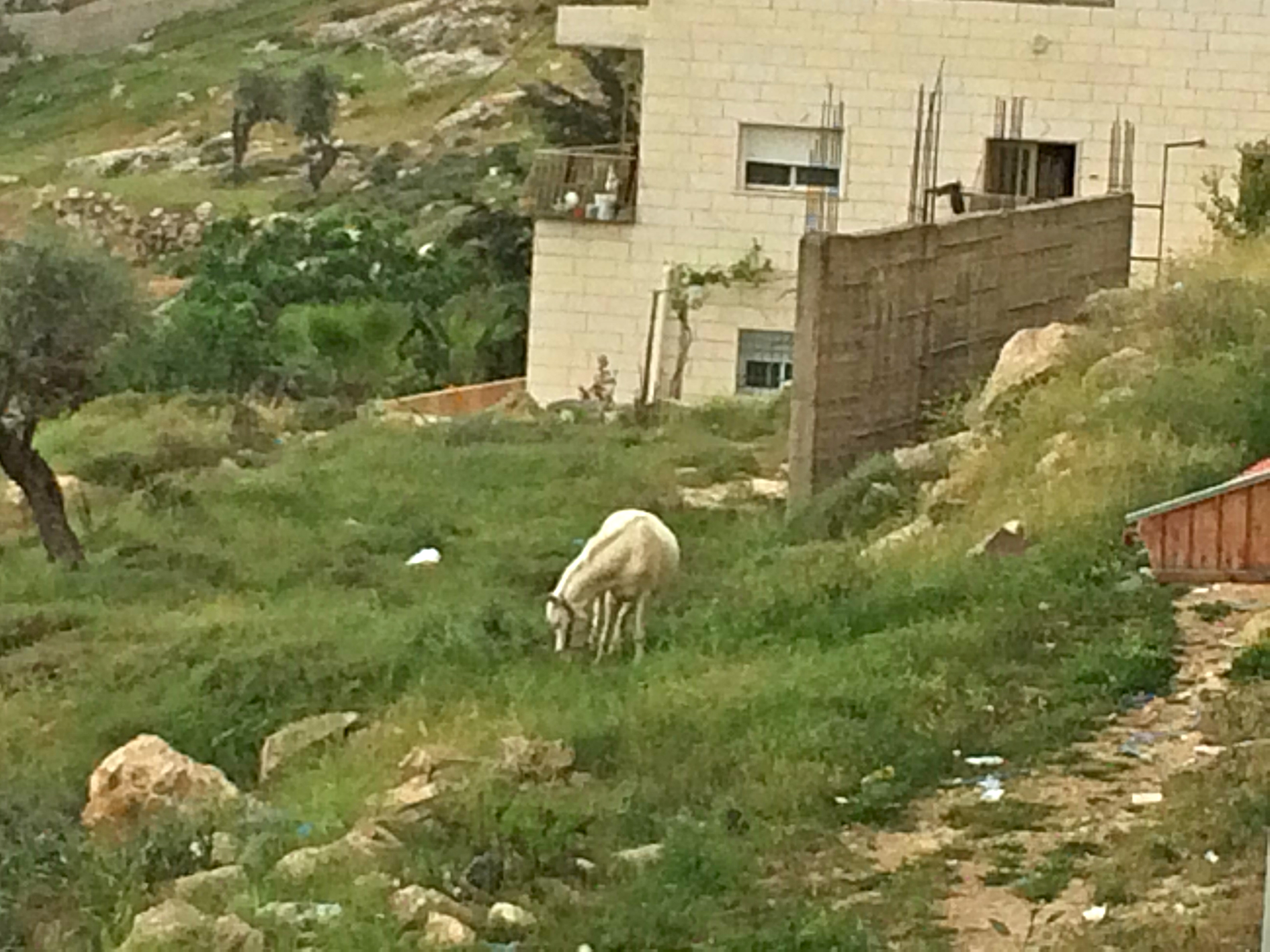
I also continue to be delighted by the bucolic sight of animals, not only grazing in the stony fields, but sometimes being herded up the street.

IMG_0733

This guy appeared in my backyard just this morning.

IMG_0718

And this little scene was just up the street from me yesterday morning as I was walking to the bus station.

IMG_0694

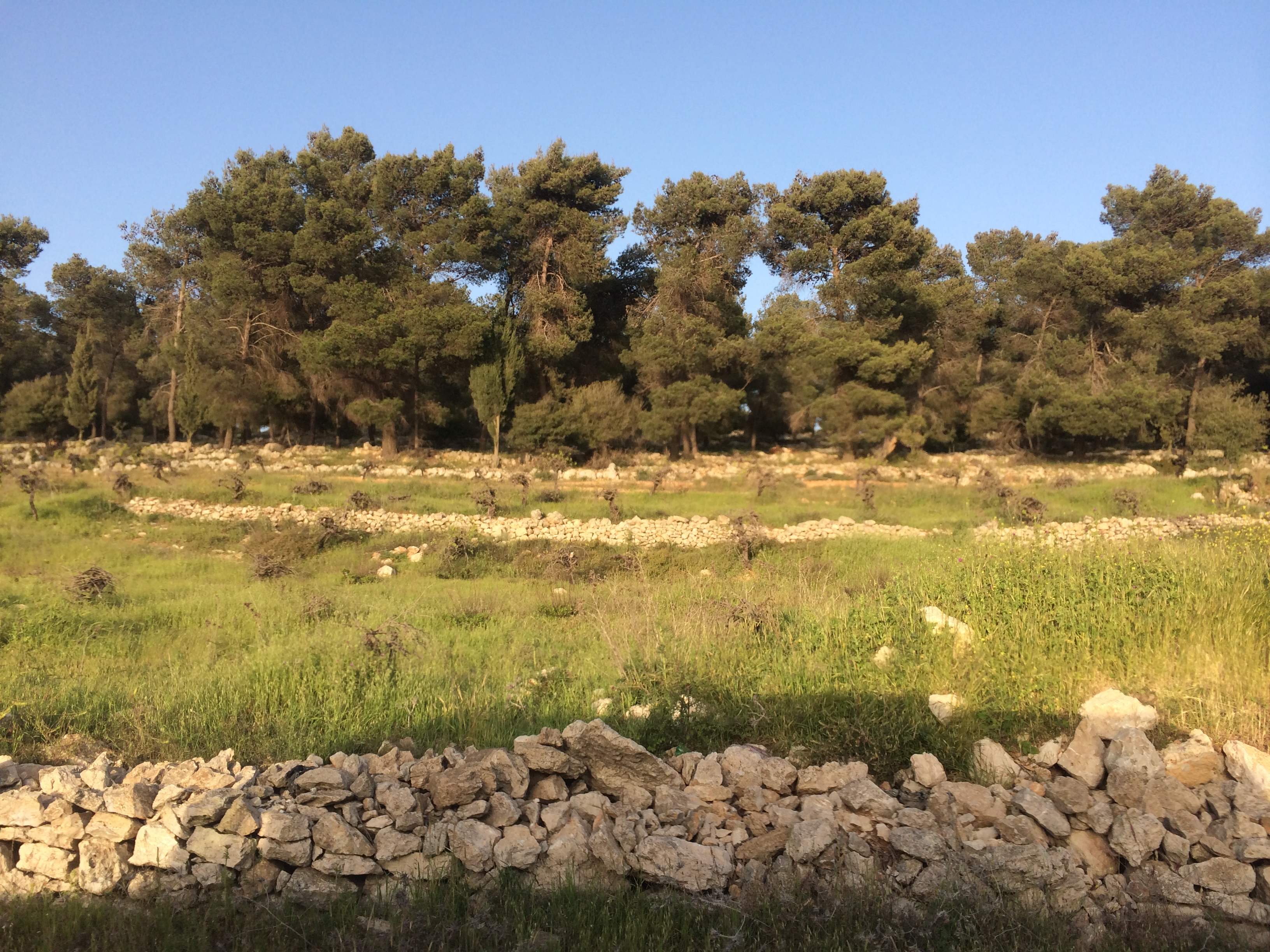
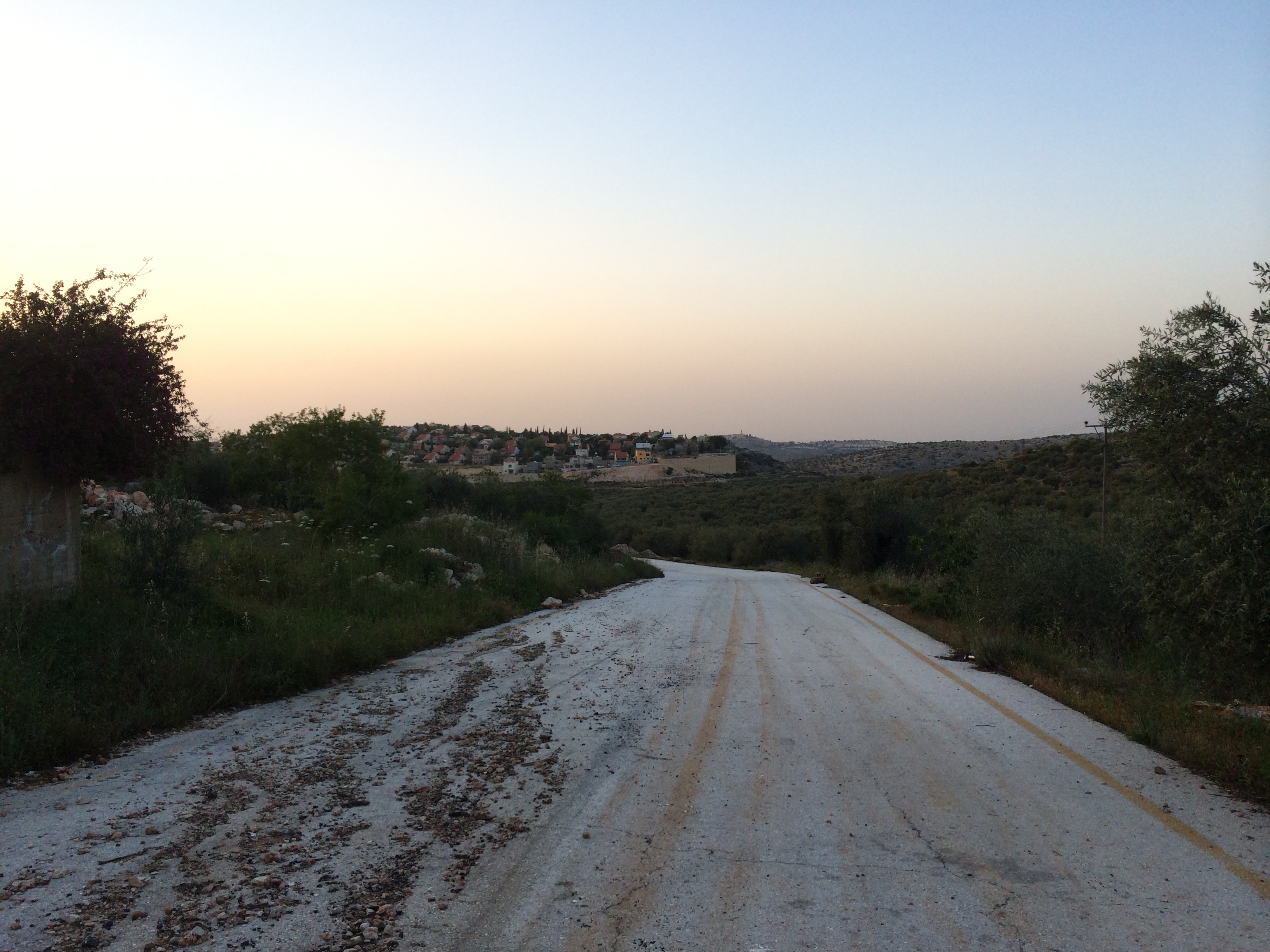
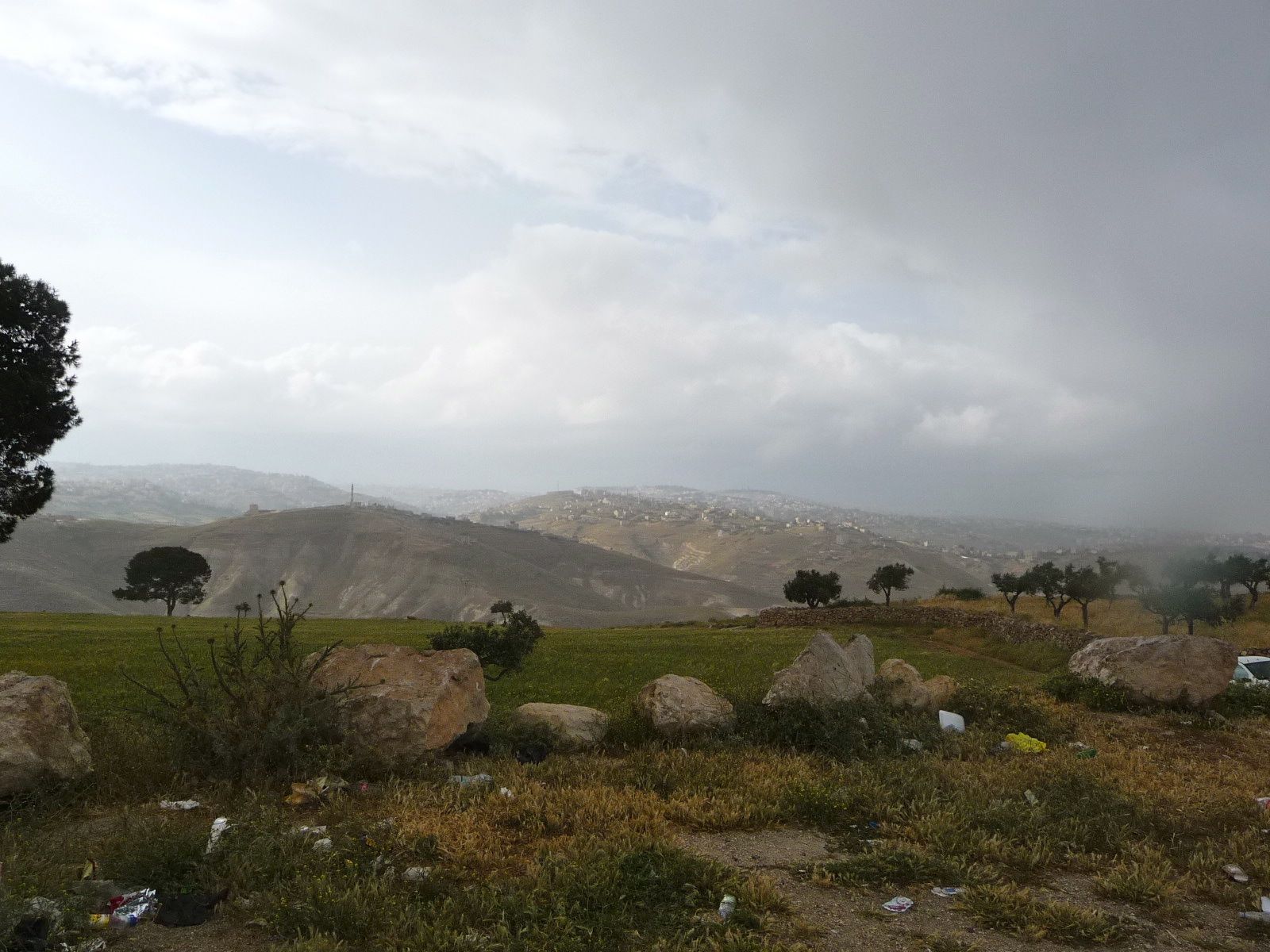
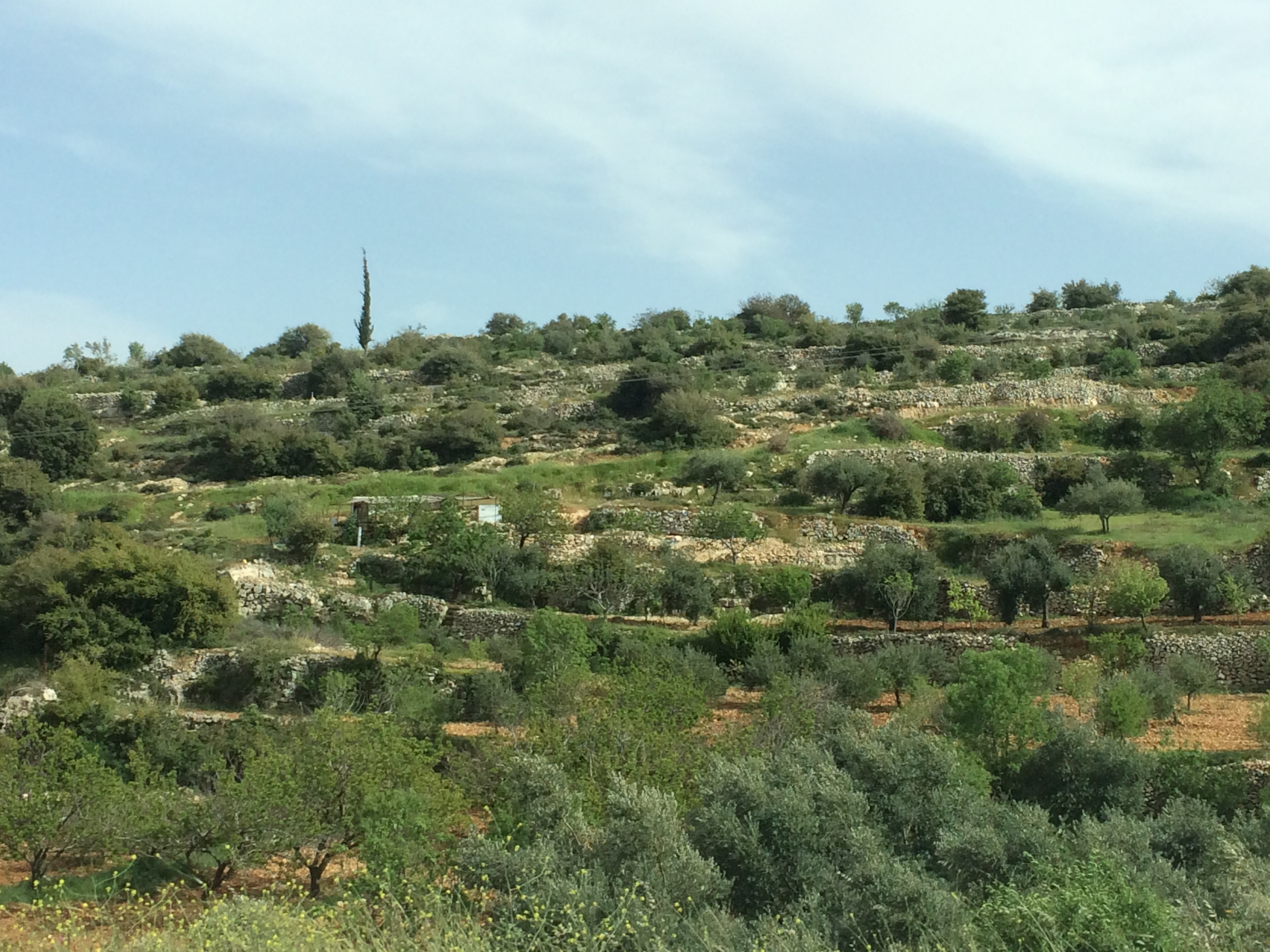
This is a typical country landscape in Palestine: hills that have been meticulously terraced over hundreds and hundreds of years in a very planned design to allow for an even flow of rain water so as to optimize agriculture on the craggy, stony hills.

Unfortunately, the landscape has been scarred by the many illegal settlements erected in the West Bank. After Israel’s capture of the West Bank and Gaza in the 6-day war of 1967, contrary to all protocols of international law, Israel started building Jewish only settlements in those lands, destroying homes, displacing many indigenous residents, chopping up ancient farmlands and villages and seriously impeding any chances of peace. To date, there are now over 500,000 Jewish settlers in the West Bank.

IMG_0710 IMG_0705

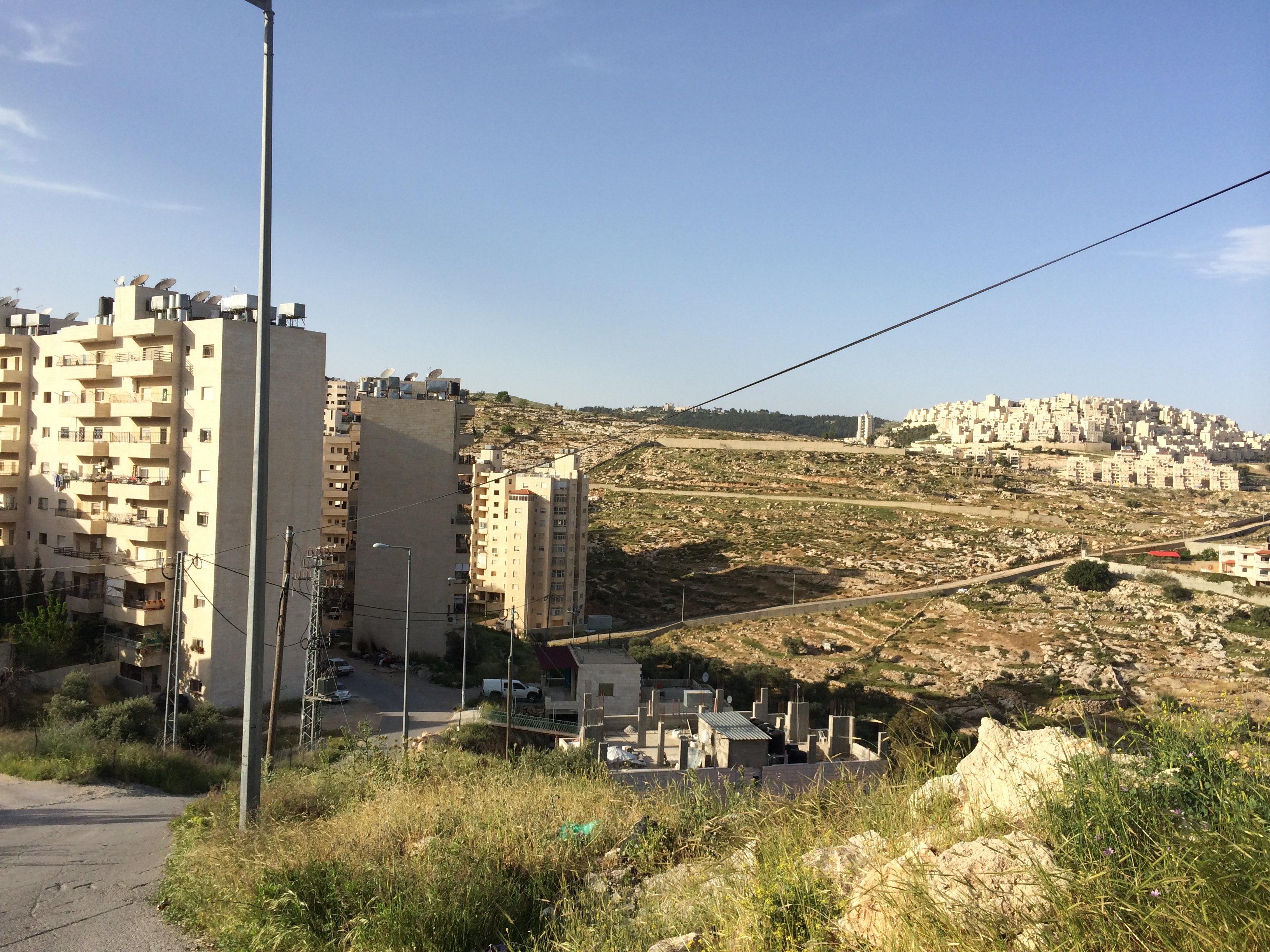
This one looms over the apartment complex in which I reside. Happily for me, I am deep enough in the valley so that I don’t have to look at it from my apartment. That is not true for many Palestinians. The family that hosted my home-stay last May lives in Beit Sahour just outside of Bethlehem. The entire landscape outside of their home’s veranda is the ever expanding settlement of Har Homa. http://electronicintifada.net/content/beit-sahour-microcosm-israeli-colonization/8790

The settlements are always placed on top of hills, encircling Palestinian villages where they mockingly loom and constantly remind Palestinians of how their land and heritage is slowly being eaten away.

The term settlers is an a euphemism.  In my opinion, squatters would be more appropriate, reflecting the illegality. That said, these so-called settlements are huge, resembling sprawling suburbs.  This article from Amnesty International discusses the issue of house demolitions and displacement in detail. https://www.amnesty.org/en/articles/news/2011/12/record-number-palestinians-displaced-demolitions-quartet-continues-talk/

If the land confiscation for settlements wasn’t injury enough, Israel has also seized huge swathes of land to construct Israel-only roads cutting through the West Bank to allow the settlers “safe passage” to the settlements.  And of course the separation wall, commonly referred to as the Apartheid Wall by those opposed to these practices cuts deeply into the UN designated Palestinian territory.  The road to Hebron is an exception. Because there are also some very large settlements on the hills around Hebron (as well as the extremely controversial small settlement in the old city),  and because Hebron until very recently was almost exclusively Palestinian, this is a road which is shared by both Israelis and Palestinians.

IMG_0695

Consequently, one sees an increased military presence. Note the barbed wire and sniper tower.

On the turnoff to Bethlehem, however, it once again becomes Palestinian territory.

IMG_0728

IMG_0727

And Israel lets us know in strong terms with these foreboding signs, lest anyone forget how scary and terrifying Palestinians are.  Funny, in my days here so far, I haven’t run into a single scary Palestinian yet. In fact, they are regular people with two eyes and a nose and a mouth, and they have been exceedingly welcoming and friendly. Stoking fear is an age-old mechanism for controlling people.

WATER DREAMS AND CLASHES

When my water ran out, my landlord told me to keep the taps on as there would be a period that the air would have to bleed out once the PA released the next allotment. After the second day without water, I kept imagining that I heard the water flowing from the taps, and in a dream that night, I had all three of my children running around and filling up containers with water. I was so disappointed when I woke and there was still no water. But, alas, when I came home from work that day, it was running again! I don’t think I have ever had as great an appreciation for water.

Work has been good. I’m pulling up and reading a lot of cases on universal jurisdiction and have connected with a friend who has done a huge amount of work on a case against Chiquita Banana by a whole class of Colombian residents for redress against Chiquita for funding a paramilitary group responsible for deaths of family members. I’m hoping that he can steer me in the right direction. This is some pretty dense and heady stuff for a little ol’ elder law attorney like me.

I had previously posted some pictures of Hebron Rehabilitation Committee’s main office. The legal office is across the street. Today was the first day I did not get lost getting there. I was so embarrassed having to ask for directions again yesterday that I finally drew myself a map. A dear Palestinian woman named Laila (I will definitely get a picture of her for this blog if she allows it) has been my guardian angel in this regard, and helped me get a rid of a man who was just a little bit too helpful as I was making my way to the office.

P1120339

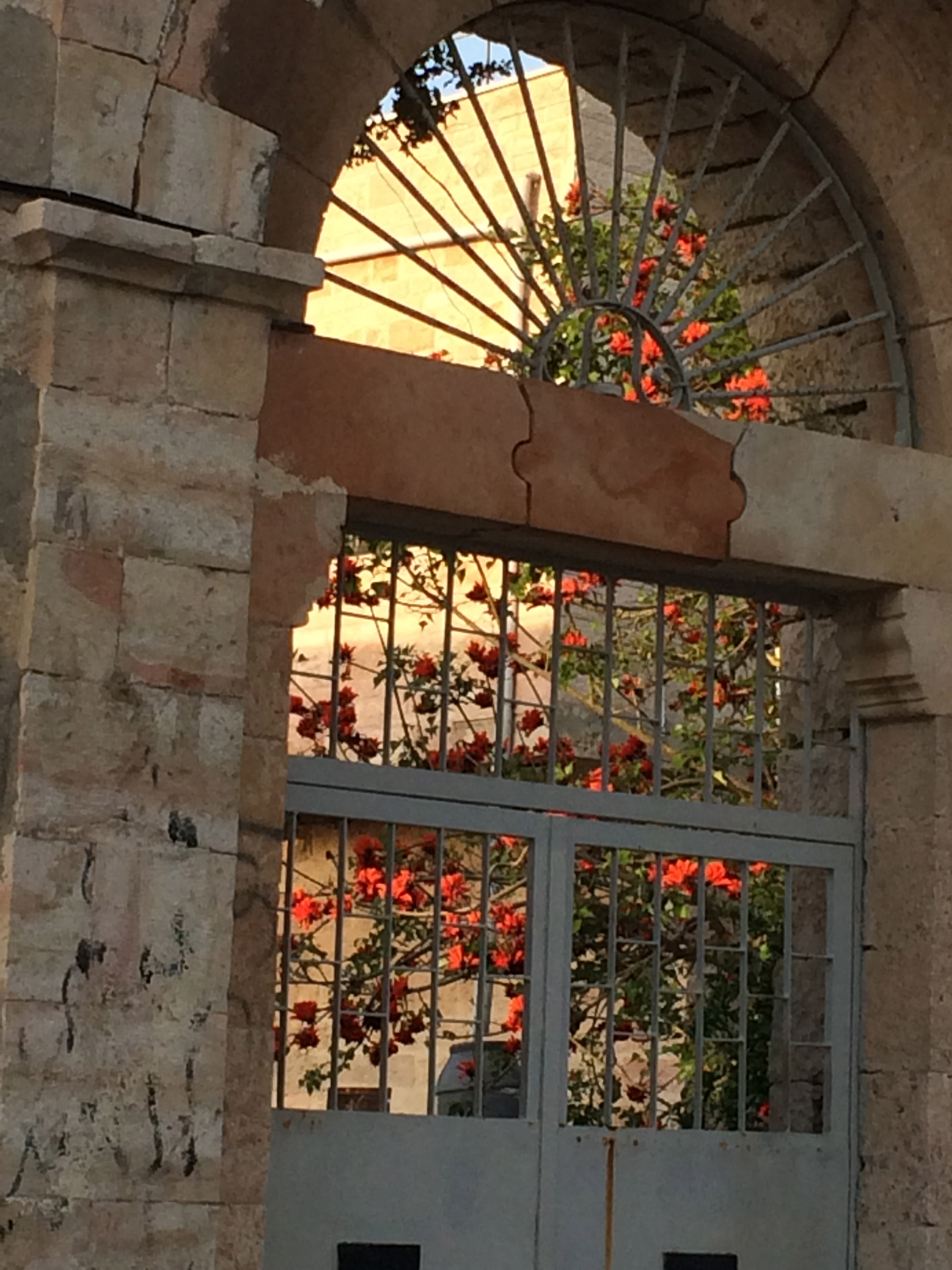
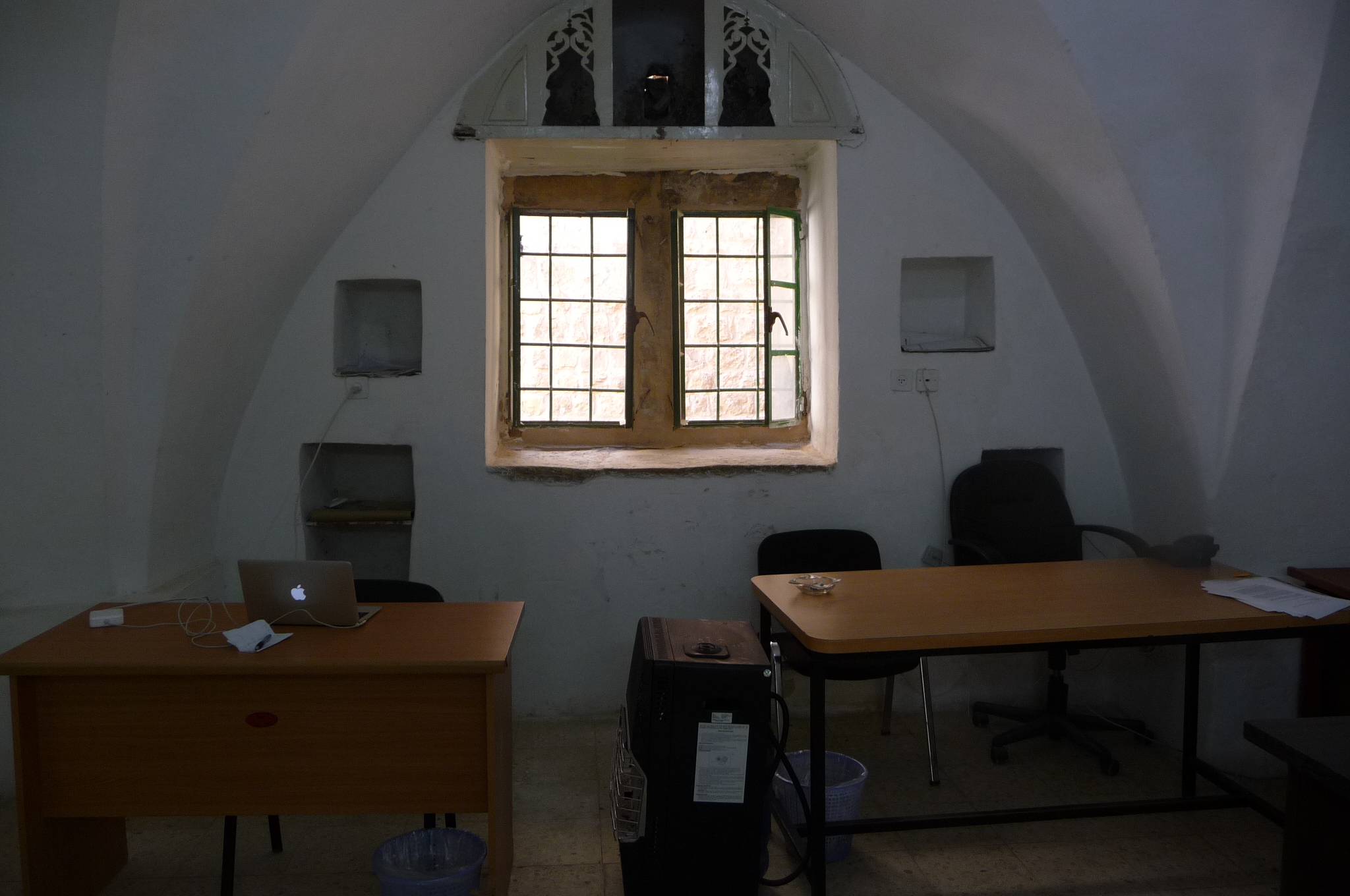
This is a picture of my office. I love the aesthetic of this architecture and HRC has done a fabulous job of restoring a lot of it. It truly is a  pleasure to walk through these ancient streets every day. The featured picture, btw is through the window of the office. The one thing that takes a little getting used to, however, are the stand up toilets. I must say, though, the squats and lunges I’ve recently done at Group Power  were good preparation (My Y friends will appreciate this).

Yesterday, there was a lot of ruckus outside the office. Bear in mind that it directly abuts the section of the Old City that the settlers have taken over. Well apparently every Saturday (Sabbath) and Jewish Holidays, the military ups it presence and Jewish visitors and settlers parade through the remaining parts of the old city left open to Palestinians. I wanted to snap some pictures, but I’m always afraid some soldier will come and knock my phone out of my hand and smash it. The fear is probably unfounded and hopefully I’ll get over it.

I felt huge indignity at the sight of these Jewish people proudly parading through, flanked every which way by heavily armed Israeli soldiers seemingly flaunting the fact that they could be there while Palestinians could no longer be on the streets that they had recently inhabited; visiting Jews and Jewish settlers stemming from the Bronx who have displaced families and businesses which have been there for centuries. Oh, and I musn’t forget the visiting Zionist Christians who support all of this because of their view that all of Israel must be returned to Jews in order to fulfill the prophecy of Armaggedon; never mind that in that prophecy all the Jews who don’t convert to Christianity will go straight to hell.

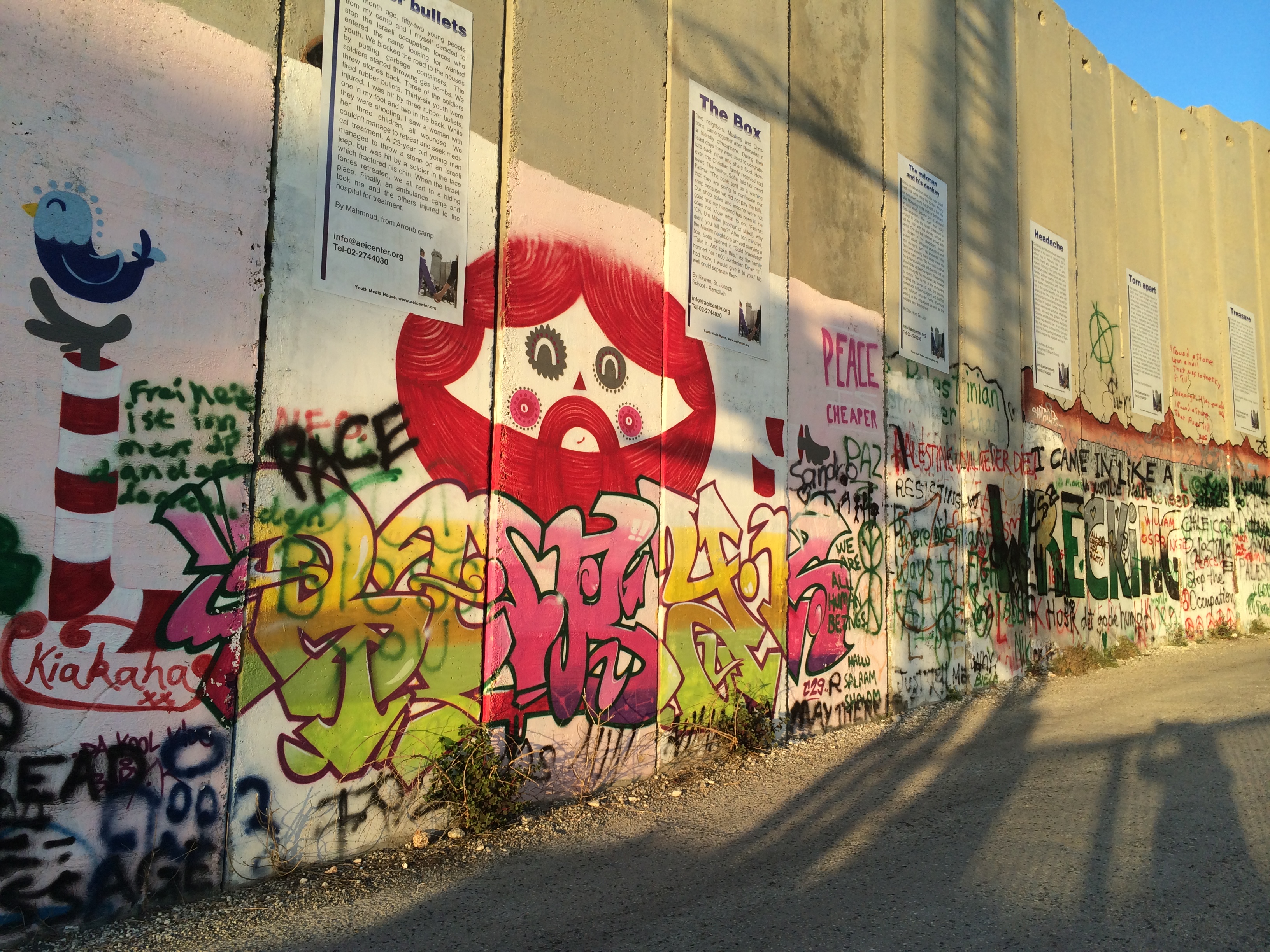
What I did get some pictures of is graffiti on the separation wall (aka apartheid wall) near the check point form Bethlehem to Jerusalem.

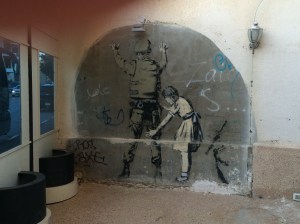
Probably the most famous separation wall artist is Banksy, a somewhat mysterious pseudonymous character whose real identity is apparently unknown.

IMG_0676

This is probably the most iconic, (reproduction, I believe) and there is now a whole Banksy shop at the check point. http://www.whatsinbethlehem.com/banksyshop.html

IMG_0681

A shot of the wall at the checkpoint.

IMG_0682

Also on the wall at the checkpoint were several placards like this commemorating Palestinians who had been injured by IDF forces.

Serendipitously, or perhaps just a day in the life of occupied West Bank, while at the check point, I happened upon a whole group of young men with face masks and big chunks of stones in their hands. Just like in Hebron, things were tense yesterday, apparently also because of the Jewish holidays and the consequent increased military presence. Once again, I failed to snap a shot because I felt a tad intimidated. As intimidating as boys with stones are, they don’t pack nearly the punch that boys and girls in full military gear toting AK-47s do. As to stone throwing, here’s a great article on the social-psychology of that phenomenon.

http://www.haaretz.com/opinion/the-inner-syntax-of-palestinian-stone-throwing.premium-1.513131

Excerpt: Throwing stones is the birthright and duty of anyone subject to foreign rule. Throwing stones is an action as well as a metaphor of resistance. Persecution of stone-throwers, including 8-year-old children, is an inseparable part − though it’s not always spelled out − of the job requirements of the foreign ruler, no less than shooting, torture, land theft, restrictions on movement, and the unequal distribution of water sources.

HAPPY EASTER – THE BEAUTY AND TRAVAILS OF LIFE IN PALESTINE

P1120357

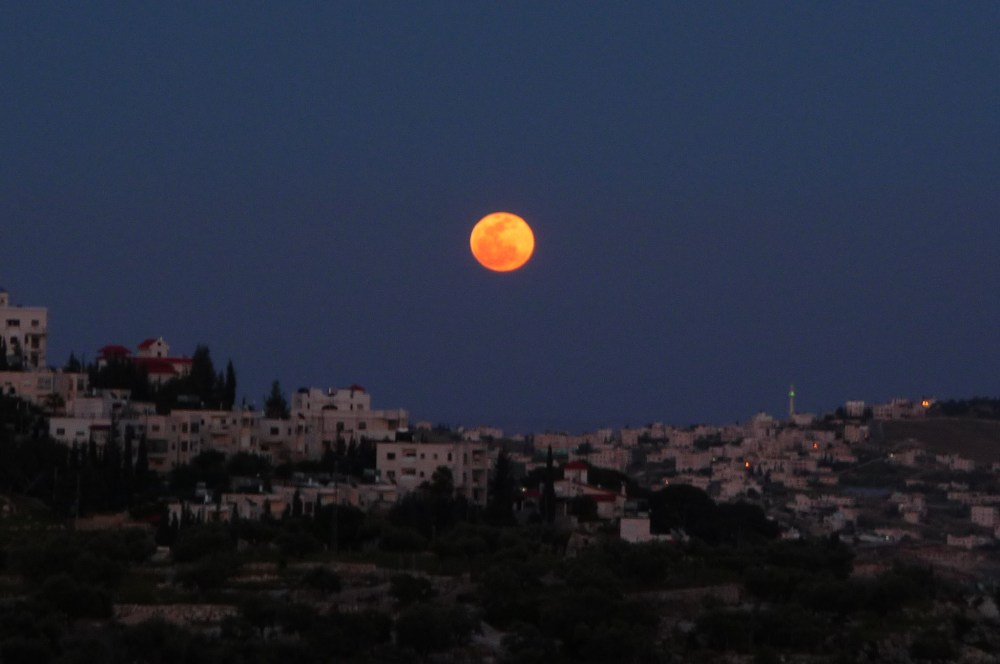
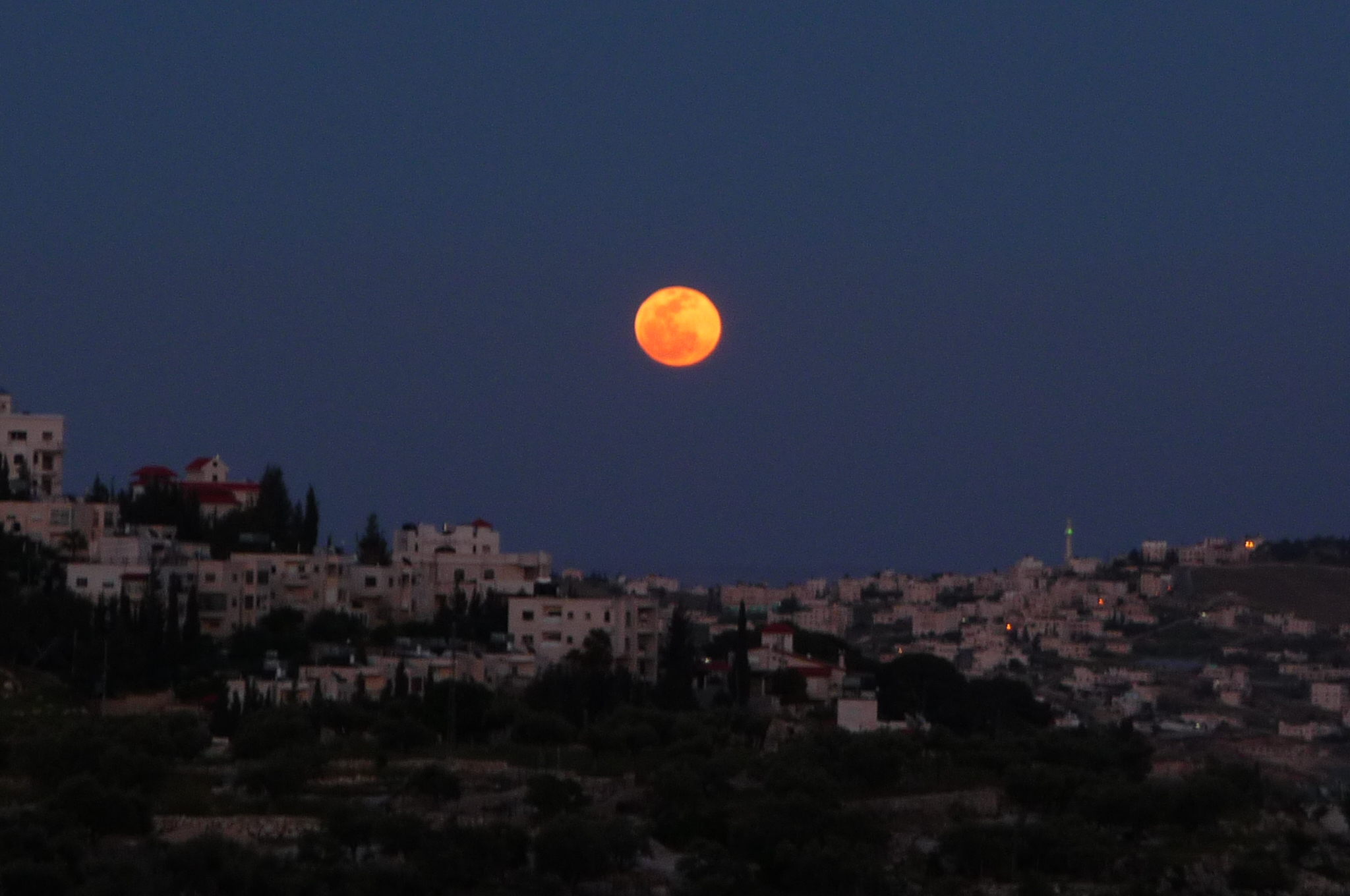
I will start with the Beauty. Last night, Easter Eve, I enjoyed the most amazing moon rise I think I’ve ever experienced. Apparently this was the blood moon. Could it have been more timely? This was taken from the balcony of the apartment where I’m staying in Bethlehem.

P1120347

And this shot was taken from the same vantage point the other morning, capturing the beautiful sky shortly after sunrise.

IMG_0658

The apartment complex is lively, full of children’s voices, barking dogs, roosters crowing and the occasional baaaa of a sheep or goat. This is up the road a bit from the apartment building, along my walk to stores and the old city.

P1120344

Here is a sneaky shot I took from a window in the apartment.  It’s a little enclosure some young guys had erected with mattresses in the corner of a playground where they shoot the breeze, check their cell phones and smoke sheeshi.

For my fellow Living Waters Pilgrims and Grace Lutheran-ites, I was able to attend Good Friday service at Christmas Lutheran Church and I got there without getting lost! I was worried about not getting enough exercise during my month here. So far, that has turned out to be of little concern as it’s a good 5K walk even when I don’t get lost with a long hill with a seemingly vertical incline coming out of the apartment complex.

P1120341

There are all sorts of beautiful little spots along the way and a very lively and intriguing market along the way.

It was a well attended service, of which I understood very little as it was all in Arabic (no surprise there), but I knew the general order of the service and to top it off, Bishop Munib Younan was there to deliver the sermon.

IMG_0660

Although I couldn’t follow it, it was interesting to see him in this context. He is quite the dramatic orator. I left a little early as it was getting dark and I was intent on not taking a cab home.

Today, I attended Easter Service. It was a beautiful, sunny morning which made for a very enjoyable walk. I don’t think I mentioned that the walk takes me smack through Nativity Square.

IMG_0669

As would be expected on these days, the square was absolutely packed with cars and people.

IMG_0662

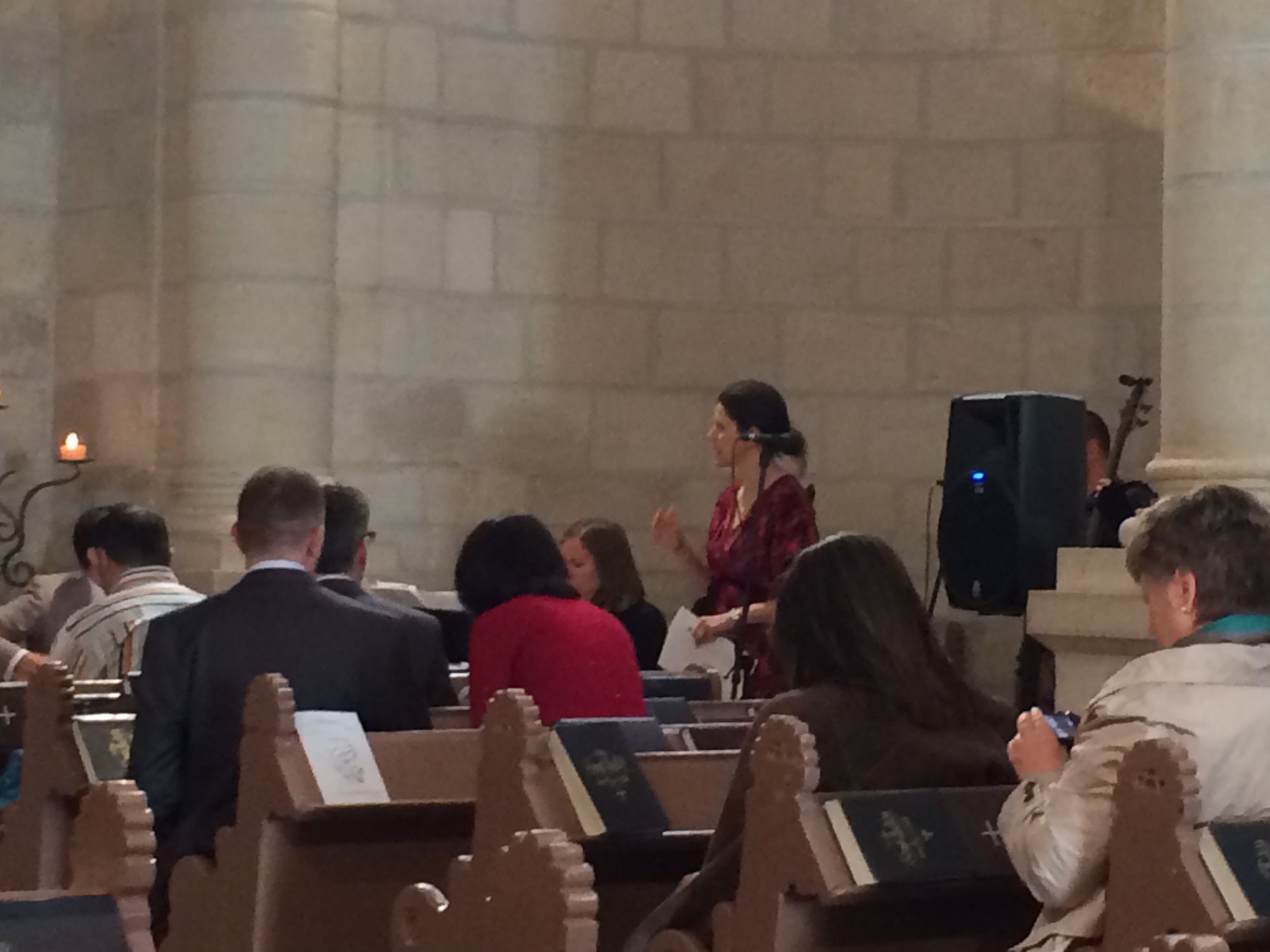
This service was particularly enjoyable because there was a  service bulletin in English. This picture was before the service as the church was filling. I wanted to get a shot of that little girl with her fancy dress. There were quite a few young girls who were really dolled up.T

IMG_0664

he same very talented musicians who participated in the Friday service also led much of the singing this time.  I met the woman in red afterwards. Her name is Ghada and she is Palestinians but was raised in Jordan and eventually married an American. She is here with her husband from Florida working at a Christianschool here in Bethlehem.

IMG_0666

This is an upside down shot of the ceiling with a little bit of the organ.  This is the first Easter in at least 20 years that I haven’t played the organ. It felt a little strange.

In true Lutheran form, these Palestinians sang loudly and exuberantly.

I was able to chime in an Alleluia every now and then and sing along on the hymns which were transliterated in the bulletin. I also had jotted down a transliterated version of the Lord’s Prayer, so I was able to sing along with it – in a fashion.  When I flipped to the page in the Arabic hymnal it took me aback to see that they even write their music from right to left. That would take a little getting used to. I guess you could always use a mirror.

After the service, I met Ghada and her husband Jeff and walked over to Mitri’s house where he hosted an after church get-together. This is when I finally got to say “hello” to him and he was able to make the connection with this persistent woman who had been e-mailing him over the past months. I look forward to talking more to him about what I’m doing here later this week.

IMG_0670

The walk back was also beautiful. The old city sits atop a large hill. This photo is taken from the edge of Nativity Square.

IMG_0653

One of my favorite parts of the walk is a very long stair case in the side of the hill that creates a bit of a short cut from walking the winding road down.  On the way down sits this chicken coop with a tree growing through it. To me it is a sign of how Palestinians love and respect nature.

P1120342

Here’s another little bit of nostalgia for the Living Waters peeps. I stumbled upon this the other day when I was quite hopelessly lost getting back home from my Serveese drop-off.

So, now for the not so good news. The hot water stopped working a couple of days ago. My hair was so in need of a wash, I finally heated water on the stove, and washed it in the sink – no big deal. But, as of yesterday, I have no water. at all – hot or cold.  When I informed my landlord, he came over and took me up to the roof of the building – it’s 8 stories and no elevators.  Well, actually there are elevators but they’re non-functional because electricity is so expensive. At the top of the building, every apartment has a water tank.  He thought that perhaps the valve had been shut off by a hostile neighbor. Unfortunately for me, that was not the case; the tank was dry. These tanks are filled periodically when the Palestinian Authority releases water. As most of you know, water is a very precious commodity in this part of the world. When your tank runs dry, that’s the end of your home’s water supply until the next allotment comes. He assured me that it would probably be today, but so far, the taps remain are dry. Fortunately there are a lot of bottles filled with water which you can bet I am using very judiciously. I am thankful for my time roughing it at our family camp where similarly, when the pump down by the lake breaks, we have no running water. The difference is, we can go down to the lake to bathe and to draw water. Here there is no such option.

And the kicker is, although a huge portion of Israel’s water comes from aquifers under the West Bank (Palestinian territory), those water resources are fully controlled by Israel. Here are a few sobering (and infuriating) facts and figures. As aptly put in this article http://www.haaretz.com/news/middle-east/1.574554 in the Israeli newspaper, Haaretz: “Israel has adopted a drip-feed approach to providing the Palestinians with water instead of letting them control their own natural resource.”

The result  is that the West Bank is allotted ¼ of the water resources from its own territory as is allotted Israel. And Israel has its own resources on top of that. This leaves the  2.7 million Palestinians living in the West Bank with a huge water shortage and a per capita use of  less than 100 litres per day,the WHO’s minimum standard for health and safety.  And keep in mind that to attain even this substandard amount of water, the Palestinian Authority has the piled on indignity of being forced to buy desalinated water from Israel. So, not only is the fresh water of the West Bank siphoned off at the whim of Israel, Israel profits from selling desalinated water to Palestine. And adding insult to injury, water flows freely to the ½ million or so illegal Israeli settlers of West Bank who consume about 600 liters per day and freely water their lawns and fill their swimming pools.

I stated my wish that every American could spend time in Palestine to witness first hand their culture and the difficulty of life under occupation. I would now add to that: and to experience first hand what it is like to not have enough water because your own water is being stolen from you.

So, that was one my travails, which I might add, I feel sheepish even calling a travail, because for me this is a very temporary situation, while for Palestinians, it is every day life. Moreover, things in Gaza are ever so much worse.

The other minor inconvenience was my long, and expensive trip back to Bethlehem from Hebron on Thursday which I had mentioned in my last blog post. Well, it turns out that there wasn’t an accident that caused the Serveese drivers to have to take a longer, more circuitous route. It was a lovelorn Israeli man who staged a fake kidnapping to impress his girlfriend.  http://972mag.com/israeli-fakes-own-kidnapping-palestinians-pay-the-price/105262/  This little prank could well have caused another onslaught in Gaza, as did the kidnapping of the three teenagers last summer.

“Israelis were enraged by Asraf’s “prank” [because the huge operation to catch the “perpetrator/s cost millions of shekels] yet somehow managed to ignore the army’s regular, violent response. Media outlets failed to report on the fact that thousands of people were put under collective punishment Thursday night, and how, once again, they were the victims of searches, checkpoints and arrests — because they are Palestinians. Because the ends justify the means. Because they are used to it. What difference does it make? And, let’s face it, they deserve it.”