Reunions – we are David

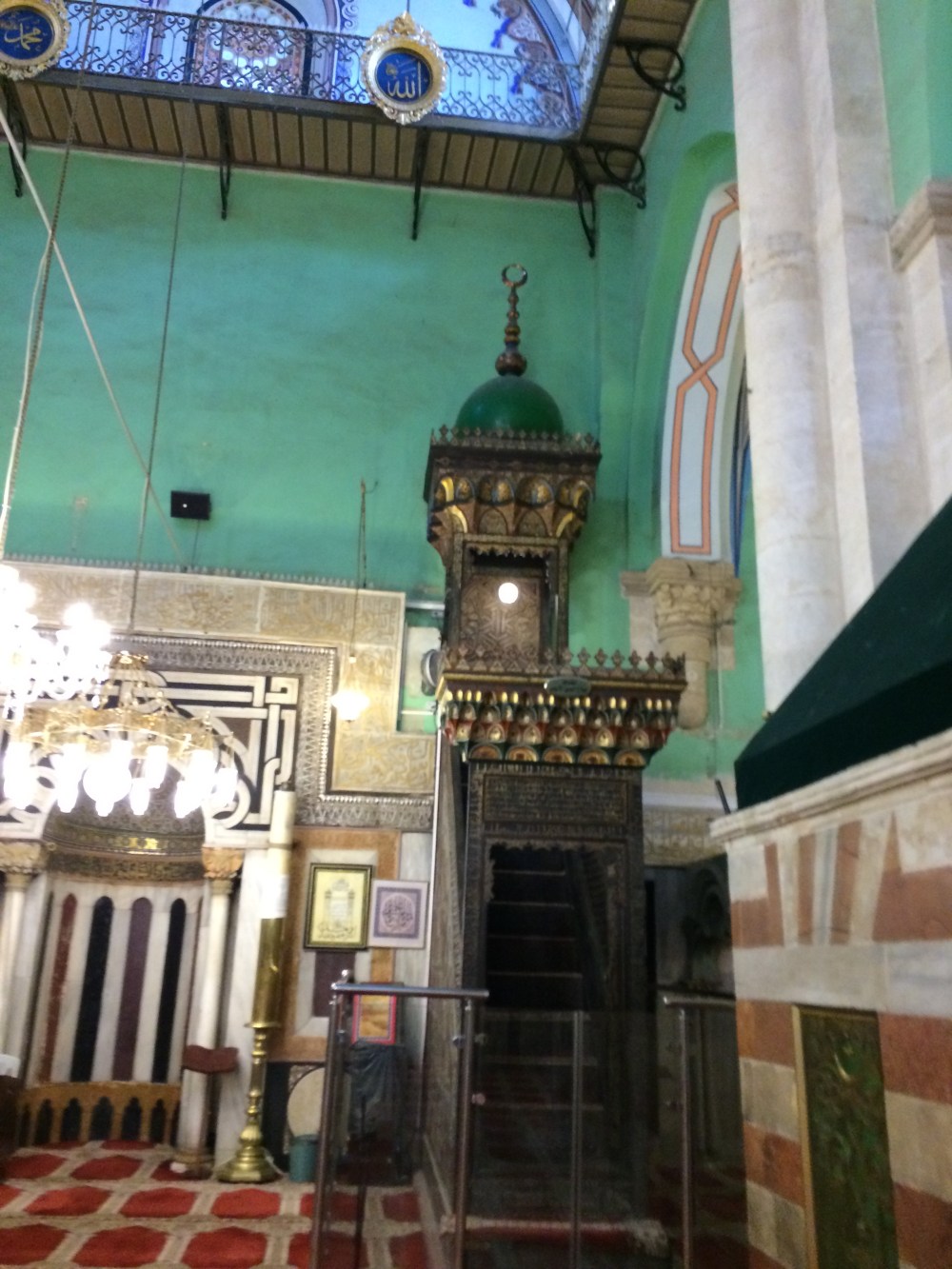
During this  picking venture, I had the chance to meet up with some friends from my past two visits. After one morning of work, our group toured the old city of Hebron, where I had spent a month working in 2015. I had written about Leila, a lady in the market. She had become my friend after she  kindly guided me through the confusing narrow streets my first week there. https://kksjournal.com/2015/04/19/dont-you-know-its-dangerous-there-said-the-fox-to-the-chicken/  We initially visited the al Abrahimi Mosque, which was infamously partitioned to create a temple for the 500 or so squatting settlers who had turned this ancient Palestinian city upside after one of their minions, an American, Baruch Goldstein  machine gunned down 30 or so worshippers. Mind you, this had been exclusively an Islamic place of worship for over 800 years.
IMG_1091
To the right is the newly erected division creating in this ages old Mosque a new Jewish temple. Jews were never barred from visiting here, which supposedly sits atop the tombs of Abraham and Sarah, but now, as with the rest of Israel, Jewish rights supersede the rights of the indigenous peoples.
IMG_1094
A little Hand Maidens Tale-ish

In one of the more bizarre twists of the stilted history of the occupation, this flagrant act of violence of a crazy Zionist against the indigineuos inhabitants, rather than drawing protection from Israel, the occupying force for the native inhabitants, did the exact opposite. Shuheida  Street, the Main Street  of commerce in the old city  was closed down, Palestinian businesses were shuttered, Israeli forces were called in, not to protect the Palestinians, but rather the squatters, outnumbering them  by four soldiers to every squatter, and erecting check points severely restricting movement of the inhabitants of the old city.   The injustice of this is so profound, it pains me to recount it. But yet I’m compelled to,  because the pain resides daily in the lives of those Hebronites who remain, struggling to maintain subsistence and a semblance of dignity in the face of such oppression.

I ran ahead of the group afraid that I’d miss the opportunity before our bus was to leave. As I ran through the narrow street, a couple venders shouted out to me to stop and look at their wares. One shouted, “I remember you!” Others cried out to stop at their shops. I replied, “Leila, I’m looking for Leila.” I heard one scoff, “Leila, always Leila.”  Finally, there she was, pretty much at the end of all the venders. Such a sweet reunion. It’s strange how certain interpersonal connections are made. Is it cosmic, in the DNA, the stars?  All I know is that it was instantly and mutually felt. Leila looked much the same, but life had not become any easier. She told me that her son had been arrested two days earlier for having “illegally” sought work in Israel. This, of course could mean six months in jail with no outside contact with the world, abuse/torture, and imposition of impossible fines. it’s hard, so very hard to feel so useless and impotent.  A very bitter sweet and shirt reunion.

IMG_1100

I was also very interested to know what become of Feryal  Abu Haikal. FOLLOW THE TEL RUMEIDA ROAD. When I enquired, all I learned was that she had taken ill. Hardly a surprise given the immense pressure she faces on a daily basis. In Googling I further learned that she had lost her case against the continued destruction and confiscation of her land  in the Israel Supreme Court.   Losses continue to mount The pillage  of the ancestral land of the Abu Haikal family continues under the auspices of archeology, but as one Israeli archeologist pointed out in disgust, who ever heard of an archeological dig being conducted with backhoes? Moreover, ancient finds from the Roman times are found and destroyed only to dig deeper. The only thing of interest in this farcical Zionist venture is to find artifacts dating to the time of King David’s mythical reign to bolster the claim that this is the rightfully seized land of Israel.

On a more positive note,  I was able to meet up with my friend and hiking guide Hijazi Eid who joined us for dinner at the hotel. He also does his part and teaching of the beauty and history of the ancient land of Palestine and its deep shared culture among Jewish, Christian and Islamic peoples.

IMG_1137

We also were able to spent  one night with Mirvate Anwar in Beit Sahour. I stayed with them during my first trip, and have kept contact with her ever since. They have a beautiful house which keeps getting taller to accommodate their growing family. Palestinians are very rarely allowed building permits by the Israeli government  so their only option to expand is upwards. This is why one often sees rebar sticking out from the top of Palestinian houses.

Payne and I also had a chance meeting with her lovely daughter, Natalie as we were wandering the streets of Beit Sahour on our one free day. She was working in a tourist center when we were looking for an ATM. Unfortunately, I didn’t get photos.

The struggle continues, but more and more people are becoming aware and adding to the force for change. Israel has become Goliath and the Palestinians David. Justice will prevail.
 

Pressed

Our final day of picking was the most dramatic in several respects. It was on a farm just outside of Bethlehem on land that has been slowly and systematically being scooped up as part of the strategic plan to encircle Bethlehem with colonies of Jewish settlements to choke off access to Jerusalem. Mind you, this is all being done on land which was to have constituted the state of Palestine, in contravention of international. The farmer in question has held out on letting go of his farm against all odds. He is one of the fortunate ones who has rock solid proof of ownership. Israel has offered him a huge sum for his land and he has been harassed to no end, including having been mysteriously poisoned which put him in a coma for three months. Speculation is that Israel has designs to use it for airport. In short, he could be very wealthy and live a carefree life just about anywhere he might choose, but there is no price he would accept for the land which has sustained him and his family for generations. This has not stopped Israel’s expansionist plans in his area. Israeli colonies are being erecting on all sides of his farm. Although they have not been able to seize his farm, they  haveliterally closed him in by building the wall around him. In the name of security on this land to which they have no legal claim, they have created one of the most absurd and invidious strictures placed on Palestinian land that I have as of yet witnessed.


IMG_1144
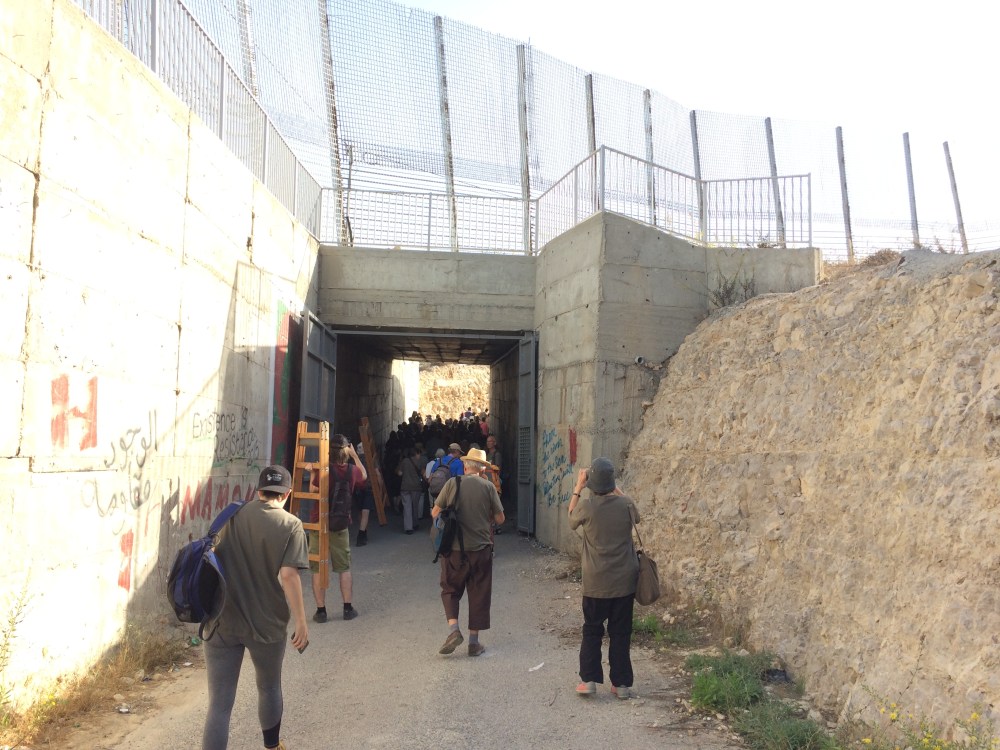
This show part of the barrier fence that surrounds the entire farm. He now has access through this specially created, huge metal gate through which only the family has free access. If he has guests, he must first get permission from the Israeli authorizes.
IMG_1143
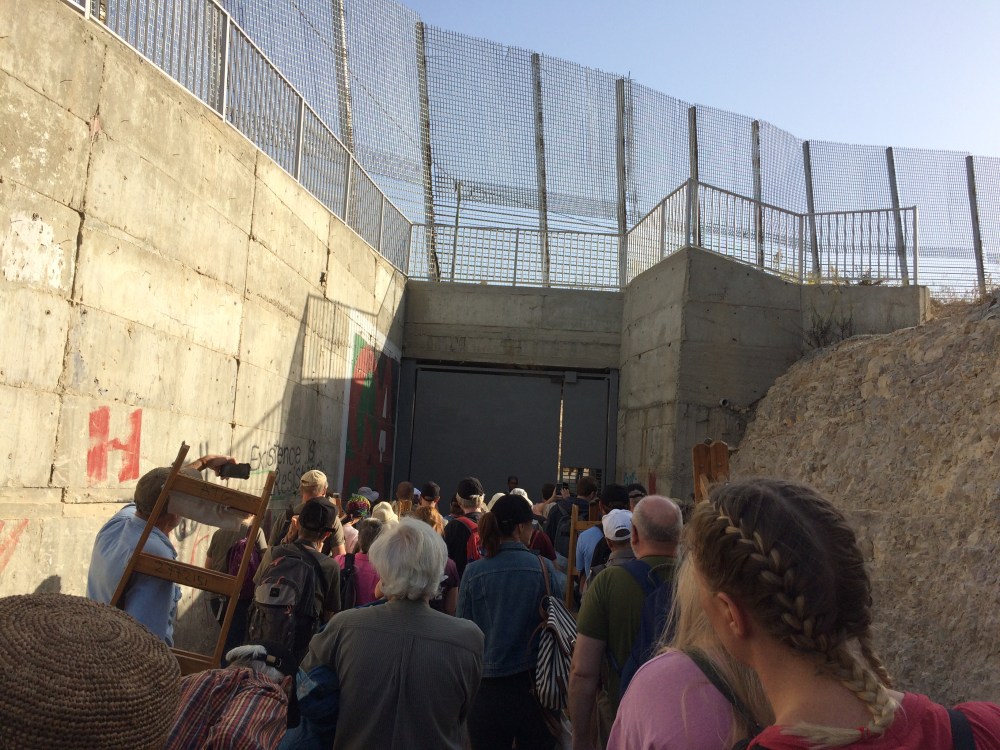
Here is our group entering the gate under the apartheid wall which closes off the farm from the rest of his Bethlehem suburb surrounds. We were allowed entry as the authorities allowed him help to harvest his olives. I guess we should all be grateful.
I
This shows one side of the huge steel gate with some words of hope

.

IMG_1169
This gate blocks entrance to the farm from the road which leads to it, the access to the farm that has been in place for generations. Now the only access is through the new steel gated tunnel under the apartheid wall.

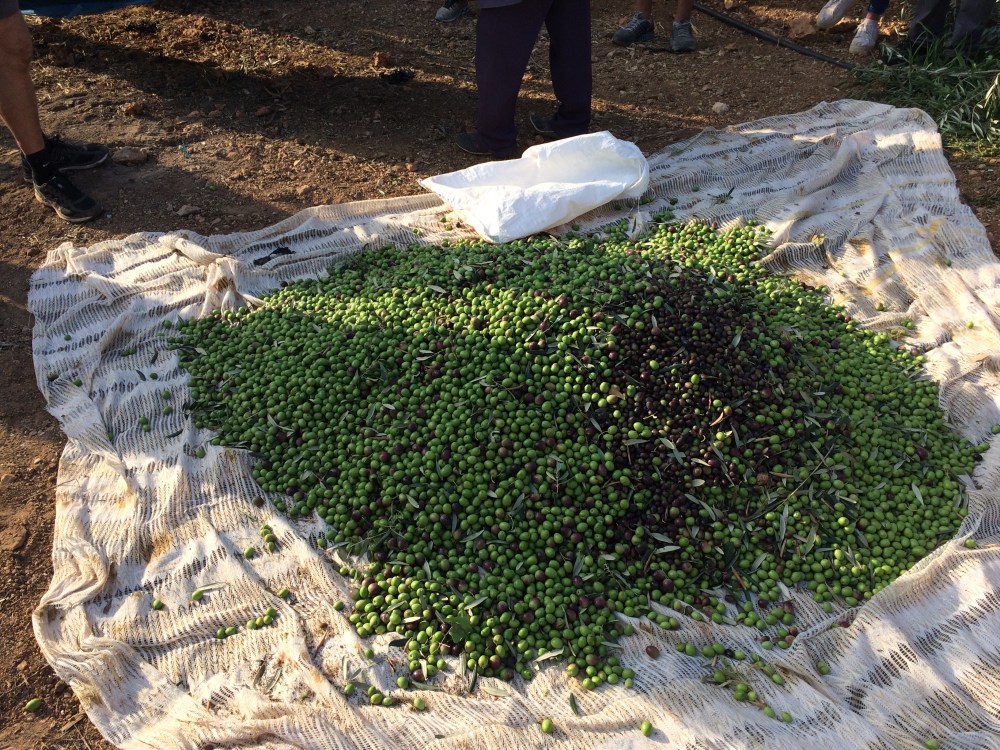
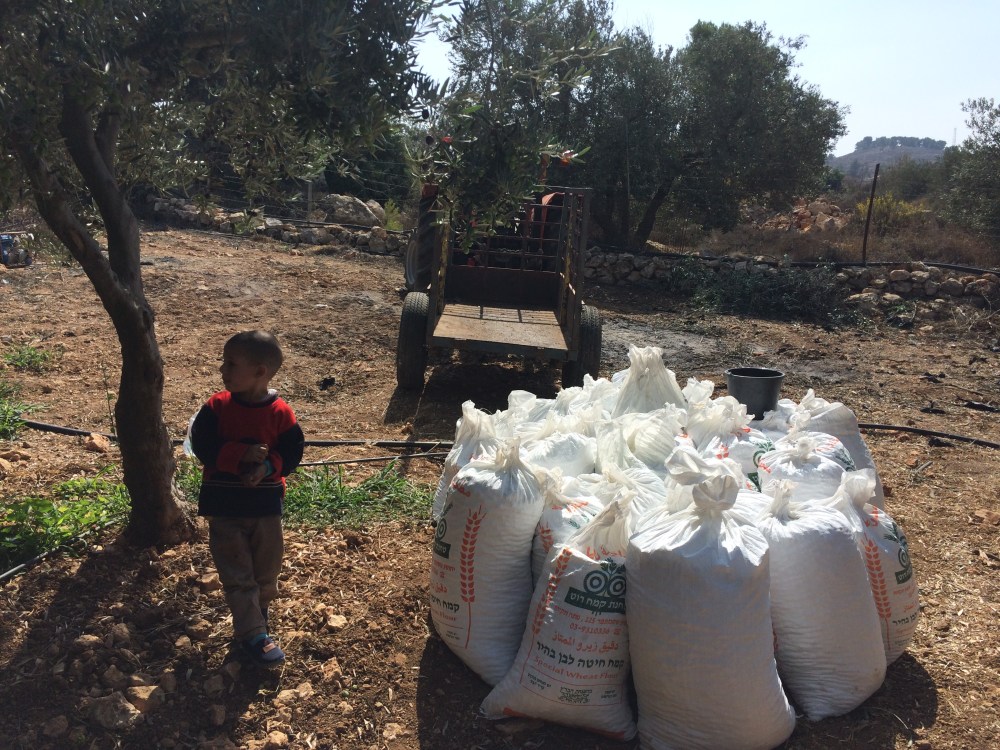
After  the incredulousness of the experience of this draconian barrier to the farm, we experienced the lushest, most satisfying picking of the trip. We were there for entire day, a swarm of worker bees milking the huge, copious olives weighing heavily on the trees. This farmer had the good fortune of the continued use of the well on his farm for irrigation, a luxury that most Palestinians are denied. It made a huge difference in the yield. We picked 105 trees and filled around 80 huge sacks.

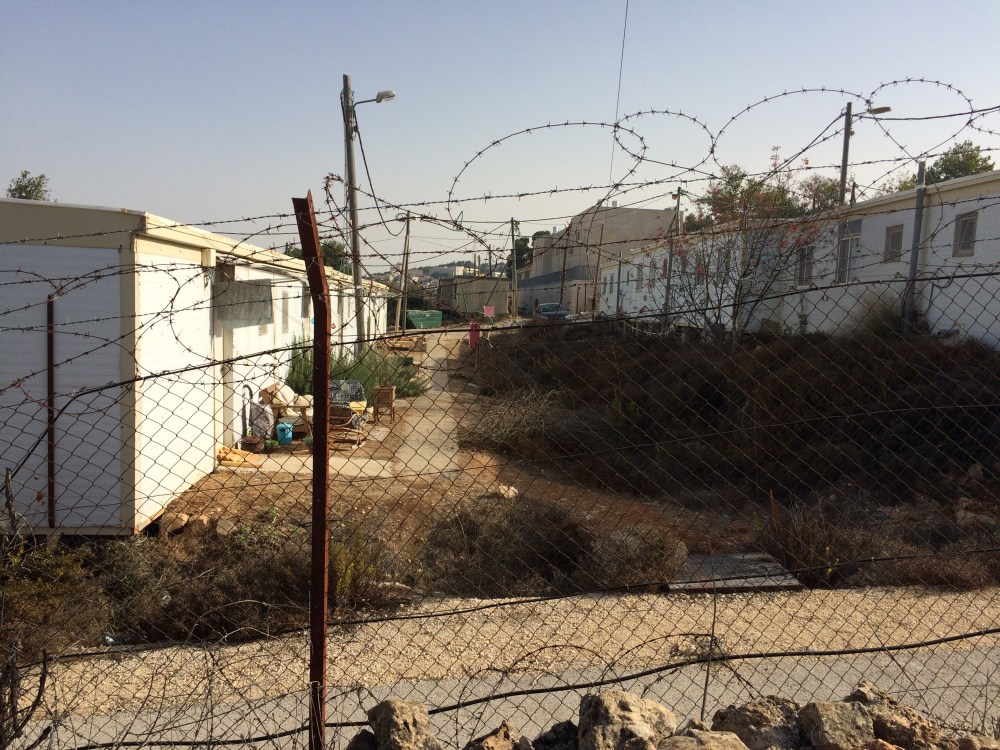
we started at the back of the grove which was just feet away from a colonist outpost of mobile units. This is how many of the illegal settlements begin – with temporary structures that are eventually replaced with a quickly erected monolithic suburb.

IMG_1187

IMG_1200

IMG_1216
The four women from our six person Maine contingent.
IMG_1192
The four women from our Maine contingent. The six of us were the only Americans in our group of around 70.
IMG_1194
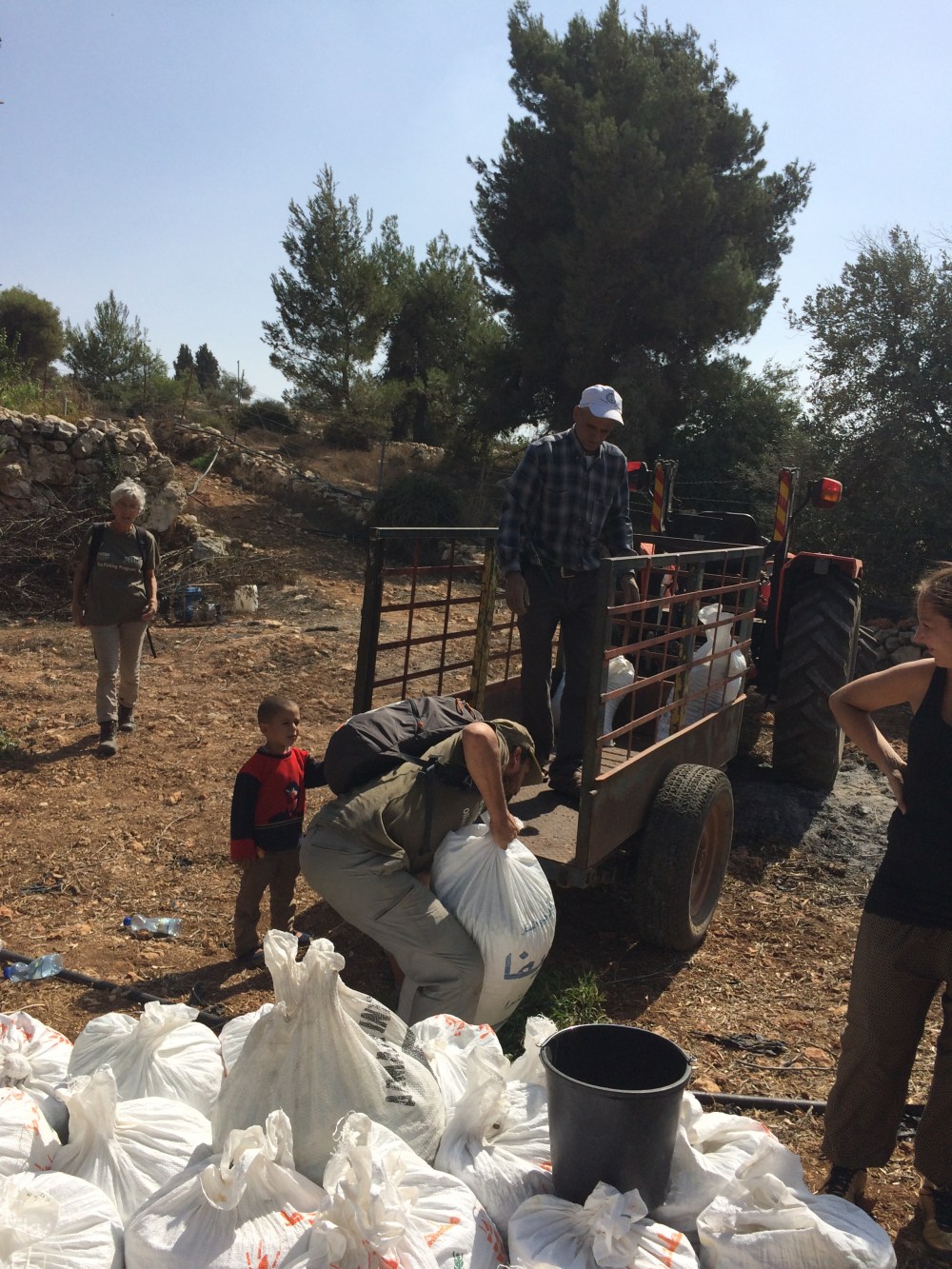
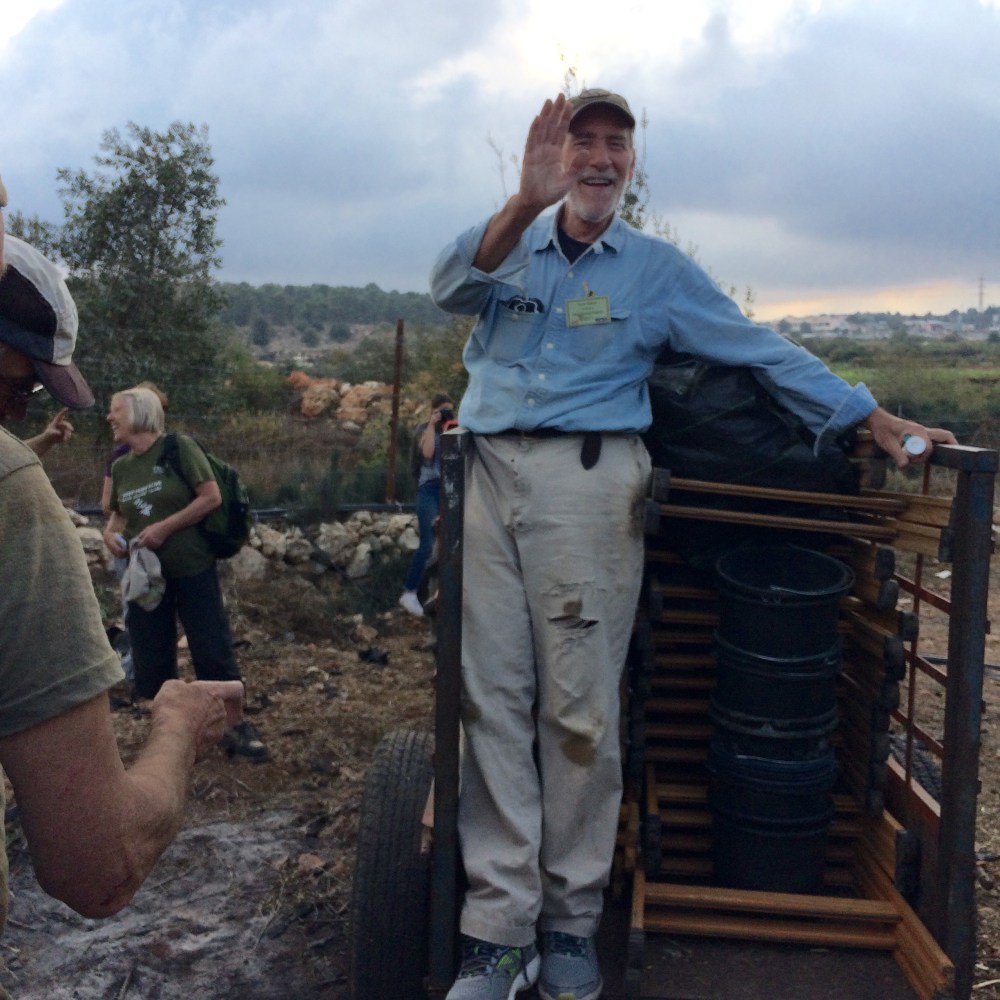
Our farmer on the wagon as bags of olives are being loaded
FullSizeRender
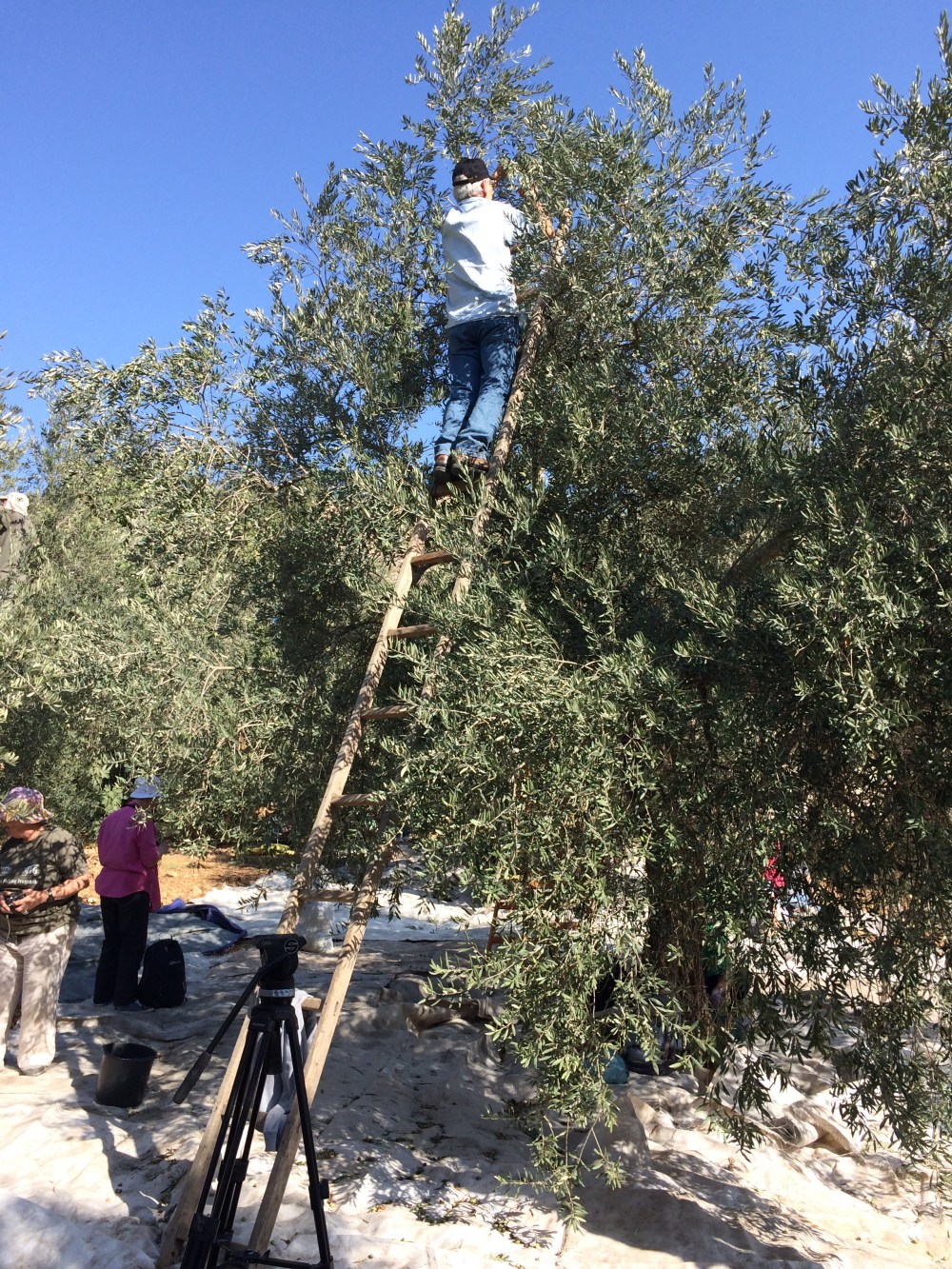
After a whole day of picking, we suffered only one casualty. Payne sprained his ankle when his ladder toppled. But he got a great send off on the wagon.                                                      

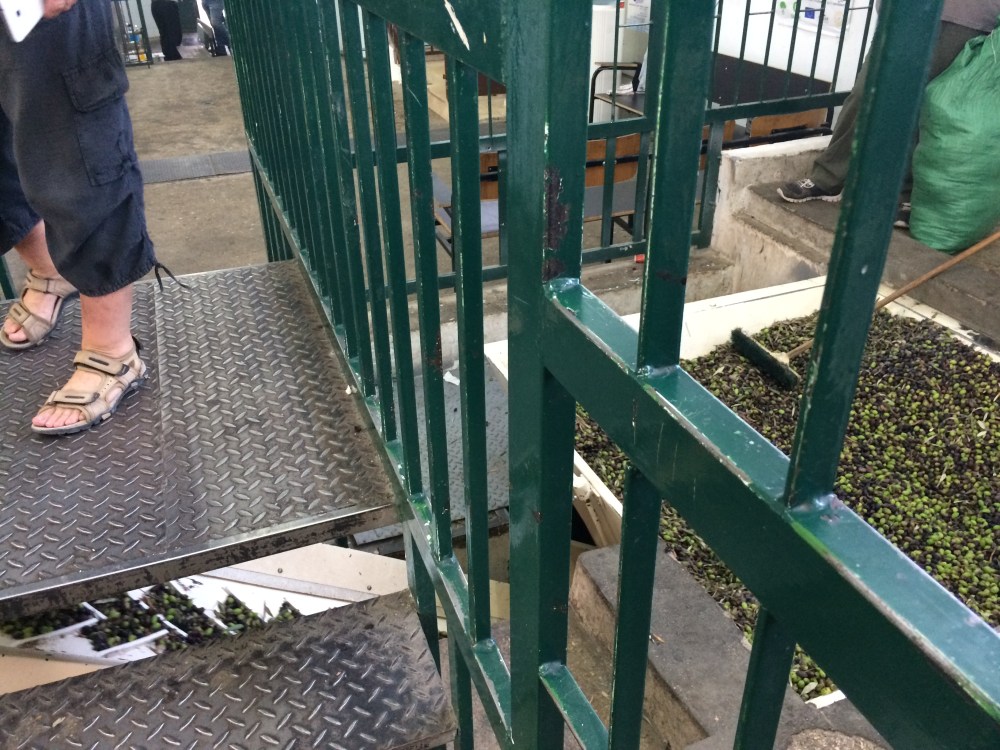
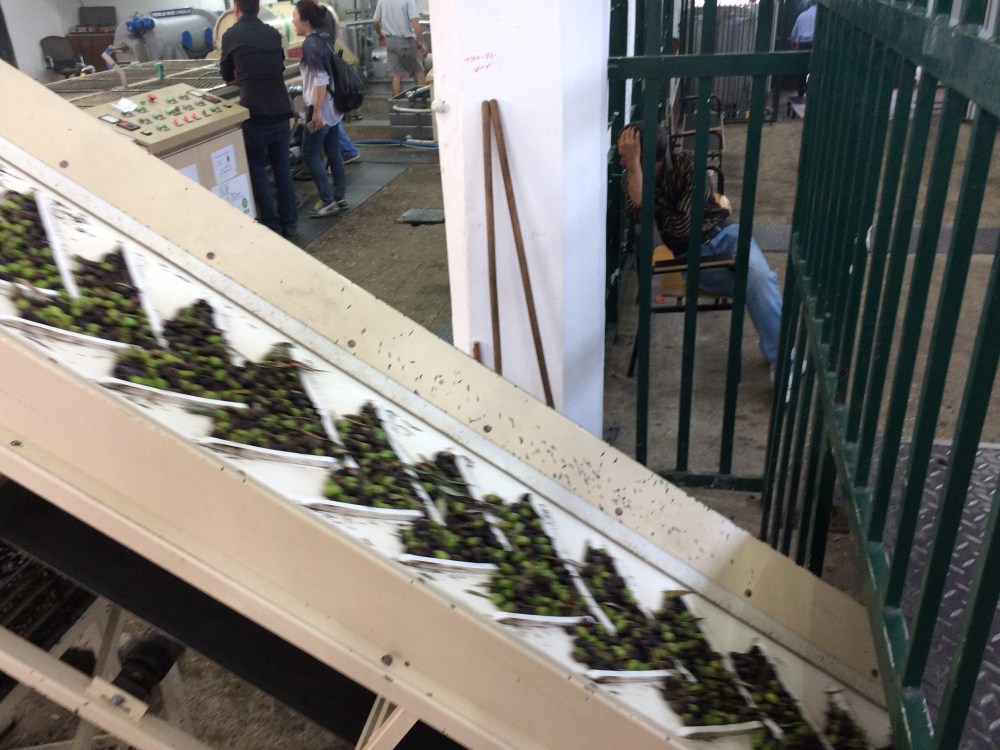
To end the day, we visited the local cooperative olive press where the farmers bring there crop to be rendered into fresh, delicious olive oil.


IMG_1217IMG_1218

Dirty business

Picking  olives and apartheid policies are both dirty businesses. I’ll start with the olives. Our second day of picking was for a farmer on the edge of a new colony under construction. We could see and hear back hoes at work as the new buildings sat high looming down over the grove. Because of the proximity to the new colony, the farmer’s property had been fenced off and access to the olive field was restricted except  for a couple of weeks in October for the harvest. How kind of the Israeli government to allow these few weeks of access to his rightfully owned property in order to grant “security” to the illegally erected colony.

It bears noting that the illegal colonies in the West Bank now house around 700,000 settlers. This is up from some 500,000 the last time I was here. Everyone with any knowledge of this situation now  acknowledges that this means the idea of a two state solution is dead. It is also noteworthy that in recent years, there have been over  a million settlers from  Russia and USSR satellite states. While Palestinians are being systematically squeezed out of their ancestral lands, people with no connection with the land  are welcomed with open arms and subsidies if they can satisfy the authorities that they have just one Jewish grandparent. That could be me.

The picking this day proved to be much more difficult than the first day. The trees were higher, the branches more scraggly and the olives smaller and less abundant. After someone had mentioned that it was probably due to the fact that the trees hadn’t been properly pruned, it hit me why. The farmer had no access to the trees for most of the year. Whatever the draconian, life crushing  restriction placed on Palestinians is, the reason  is always “security.” How it inconveniences and demoralizes the Palestinians effected is of no concern, or perhaps one wonders, if that wasnt the aim; in other word, making life so unbearable, as to drive them out.

Adding to the gravitas was the news that the farmer had just lost his son a week or so ago. Our group coordinators had told the mother Minot to worry about providing lunch – that they would arrange it. She insisted all the same, and provided us a beautiful lunch that we shared on the field. Once again, the heartfelt gratitude we received for our help brought many of us to tears. We left the farm covered in dust and  oil stained on the surface, but deeply affected.

FullSizeRender
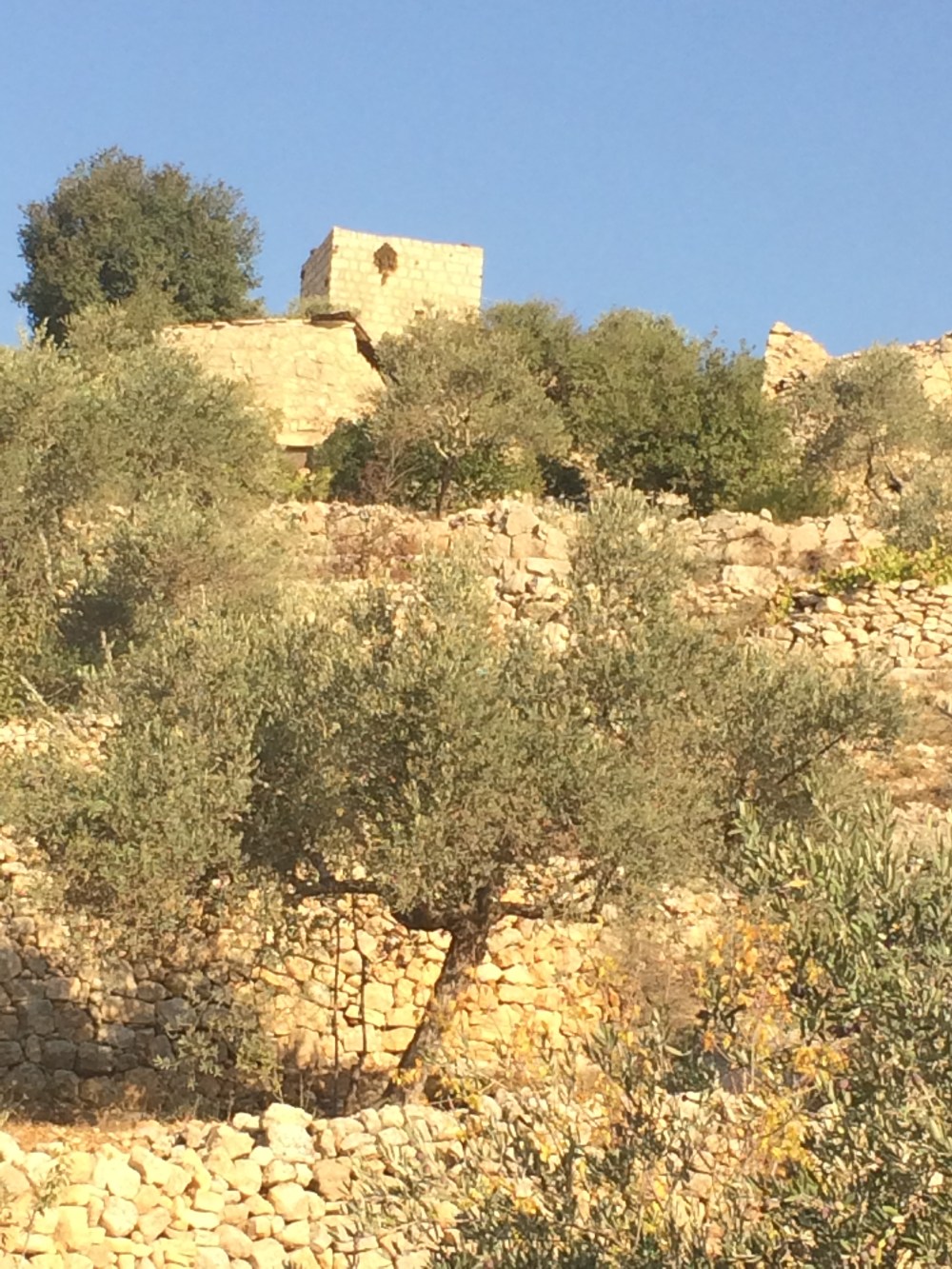
We had to walk a bit to get to the olive grove. The ancient terraced fields from another farm are in the background.

IMG_1107


IMG_1111
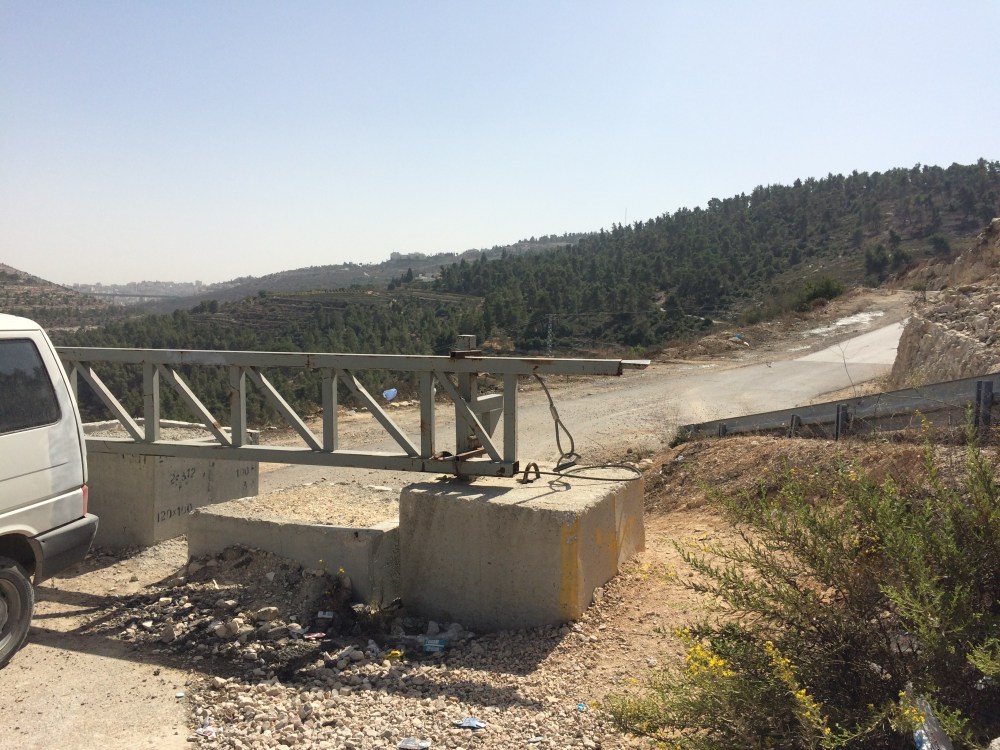
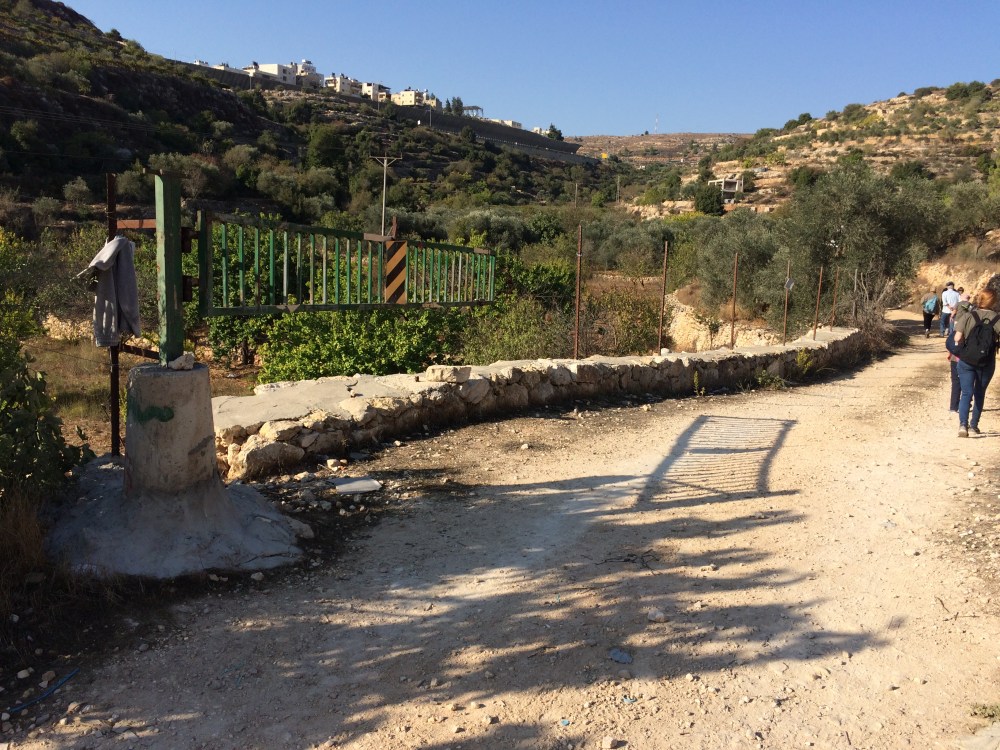
This is the gate that Israel erected a few years ago to restrict the farmer access to his own fields except with their permission.


IMG_1116

This is my friend Bob Schaible, past president of Maine Voices for Palestinian Rights and never one to go for the low hanging fruit.

FullSizeRender 2Our reward after a hard morning’s labor.

Aida means returning

IMG_1074
This is the entrance to the Aida refugee camp, the smallest of the 3 UN controlled refugee camps within the City of Bethlehem. Many of the refugees still hold the keys to the homes from which they were expelled, hence the key as a poignant symbol of the struggle.

After going to that part of the apartheid  wall that blockades Bethlehem from Jerusalem, we visited the Aida refugee camp. This is the smallest of the three UN run camps in Bethlehem with around 6,000 refugees. Dheishe, the largest, houses nearly 15,000. The camps were opened in the late 1940s to temporarily shelter some of the 750,000 to 1,000,000 Palestinians expelled from their homes by Israeli forces in the late 1940s.  Israeli historian, Ilan Pappe refers to this as the ethnic cleansing of Palestine.

These camps  initially consisted of tents, but. after around two years, it became clear that more permanent structures were needed.  They remain today, nearly 70 years later, ghettos of closely packed stuctures separated by tiny alleyways, with barely a speck of green space.

Many in the camps are now third generation, probably fourth or even fifth.  I’ve heard it  asked, often with contempt, why are they still there? Why don’t they leave? Why don’t other countries absorb them?

First of all, it has to be understood that Palestinians have a very deep connection with the land, and the initial refugees always thought they they would be able to return to their homes. This is a hope that is still alive  – even in the later generations.

Second, the neighboring countries, and particularly Jordan HAVE absorbed 100,000s of thousands of Palestinian refugees. When I visited 3 1/2 years ago, 1/3 of Jordan’s population were Palestinian, and the country was straining to provide for them. Now with the Syrian crisis, the situation is even more dire.

img_1072-e1508356050302.jpg
This wall mural lists all of the Palestinian villages from which the camp’s refugees were expelled.

Finally, the camp refugees are mired in such extreme poverty, that they simply don’t have the option of mobility.  So, the situation is entrenched and generational. This is what is wrought by forced expulsions and ethnic cleansing.

A couple personal notes on camp life bear mentioning. One of our guides was distraught on our bus ride to the olive field. He is a resident of the Dheishe camp. The previous night, the camp was raided by Israeli soldiers. This is always done in the dark of night, doors kicked in,everyone, including terrified children pulled from beds, houses torn apart in searches and people, usually young men, dragged out in handcuffs. I can’t  tell you how many times I’ve heard such stories.  This night, three of his close friends had been taken away.

Under  Israeli law, there is this thing called administrative detention. This euphemism means that one can be held for up to 5 months without any charges filed and without access to a lawyer, family or the outside world. Doe process of law? No such thing for Palestinians. Reasons for detention might be throwing a rock at a soldier, being a journalist writing criticisms of the occupation, an activist of any kind or a union member protesting Israel – who knows. And it almost always involves extreme abuse if not torture’ and very often minor children being detained. And each 5 month period can be extended, extended and extended. A friend of mine recently welcomed his son-in law home after 30 months of detention and fruitless money scraped together by the family spent on legal fees, finally  to see his 2 year old daughter for the first time. His crime – writing about the occupation.

Another incident  involved my friend Leila, the vender of women’s needlework cooperative from Hebron. I was delighted to reconnect with her the other day. But saddened to learn that just two days earlier her son had been arrested, purportedly for the crime of trying to work without a permit in Israel. Who knows when she will see him again.

Finally, the other story that touched me was from the same guide from the Dheishe camp.  We were picking olives in an area surrounded by new Israeli settlements. Their construction involved confiscation of huge tracts of land in the West Bank. The area of olive trees in which we were picking bordered the camp  and was the de facto playground of the camp children who otherwise had no green areas to play in. Well, with the construction of the settlements came the walling off of the entire area, further closing in and ghettoizing the camp. He ruefully described how this was his childhood playground which, alas was now out of bounds for the camp because of the grotesque wall.

Children comprise over 50% of the camps’ population. How will life under occupation form them?

IMG_1068IMG_1066

IMG_1076
While at the camp, we heard an explosion. It was a sound bomb tossed into the camp by an Israeli soldier. At the top of the street, to the left, you can see the figure of a soldier menacing with his gun as emboldened children run to the street to face the threat head on.

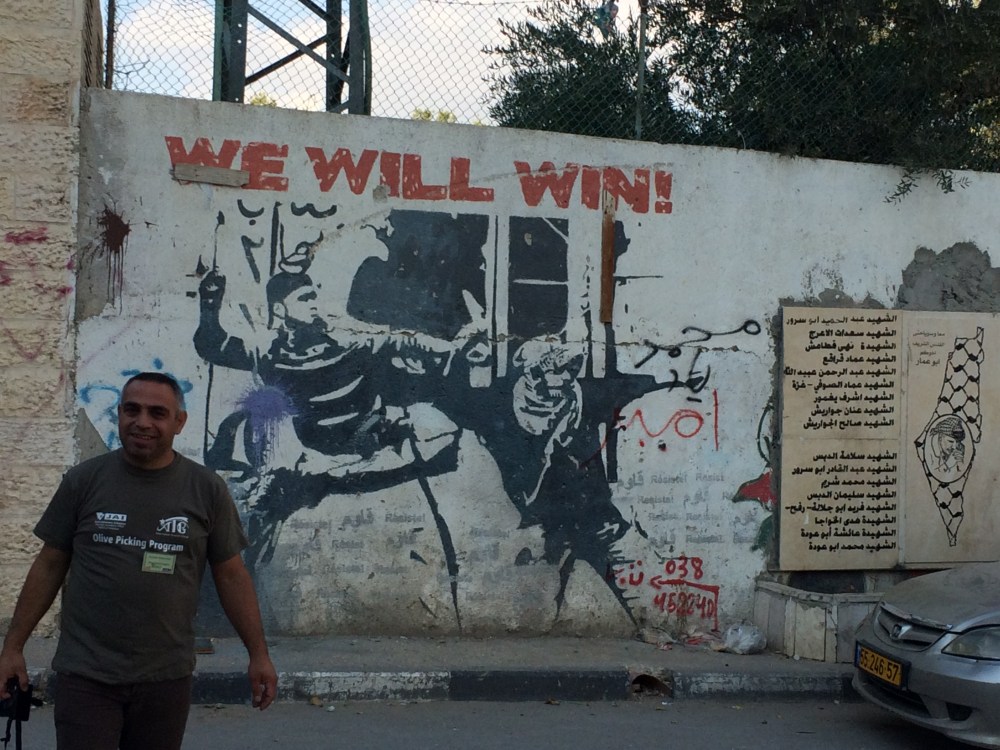
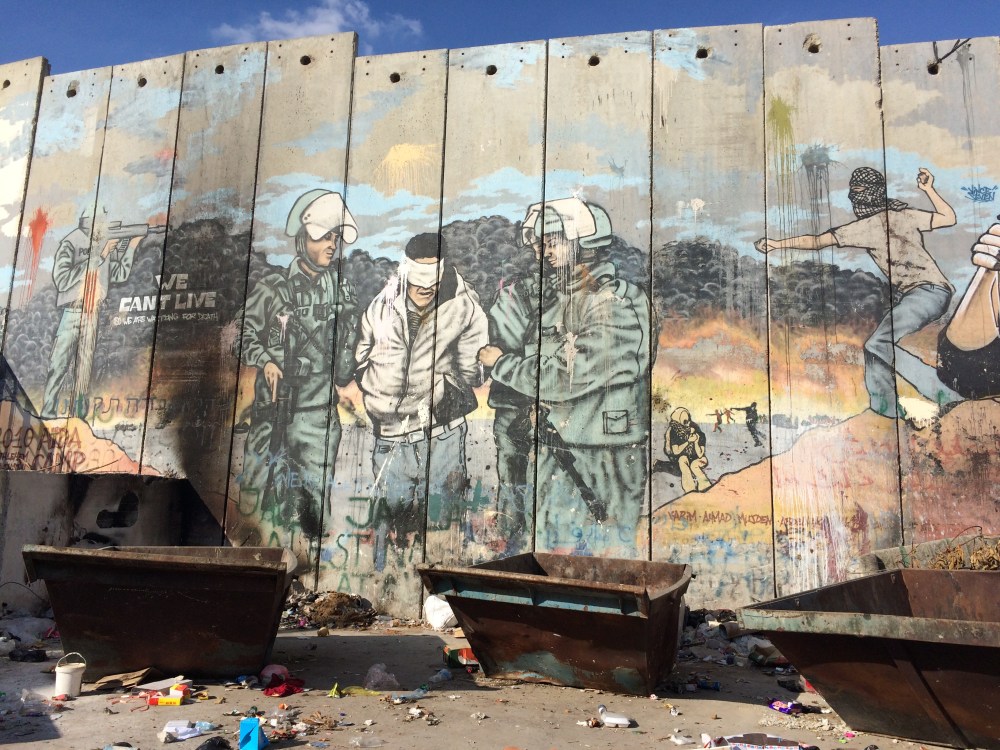
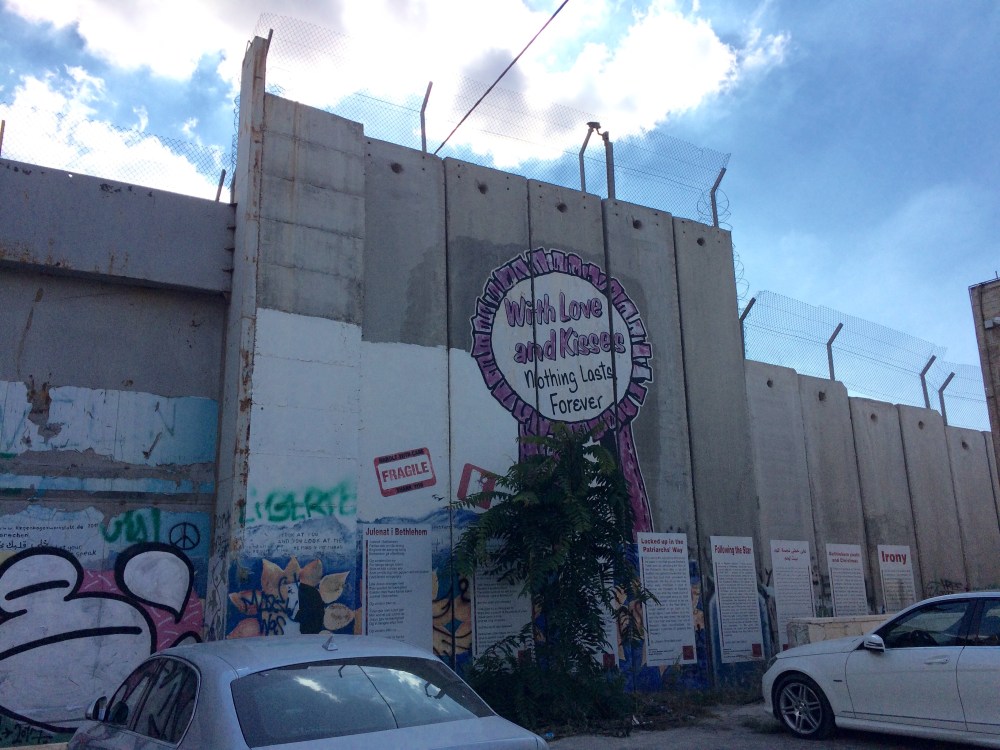
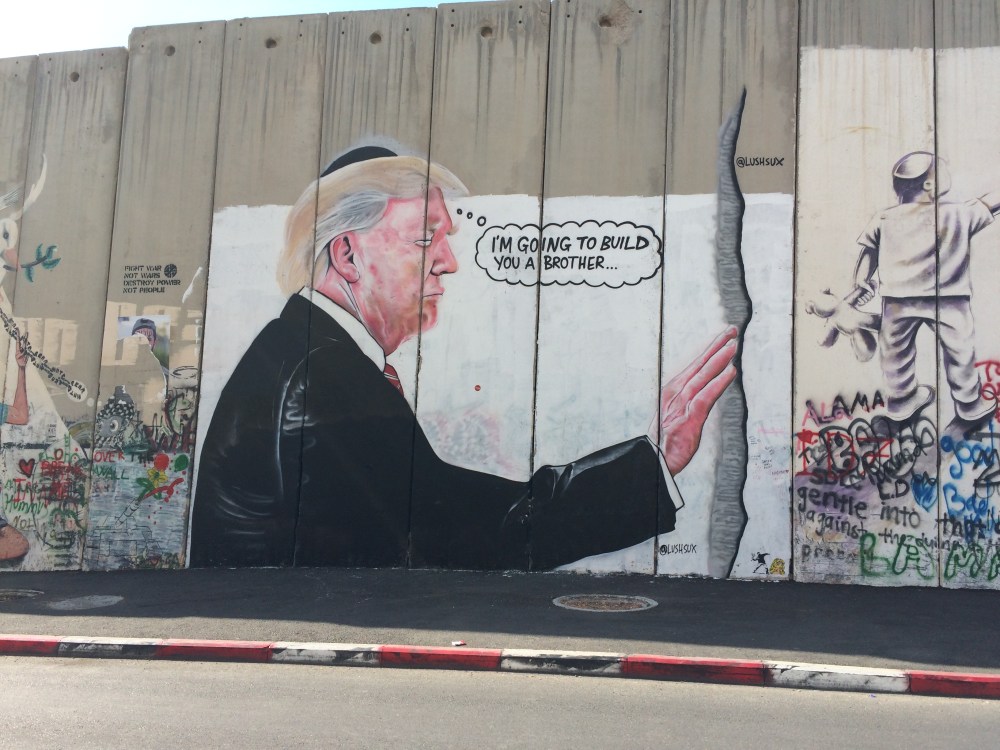
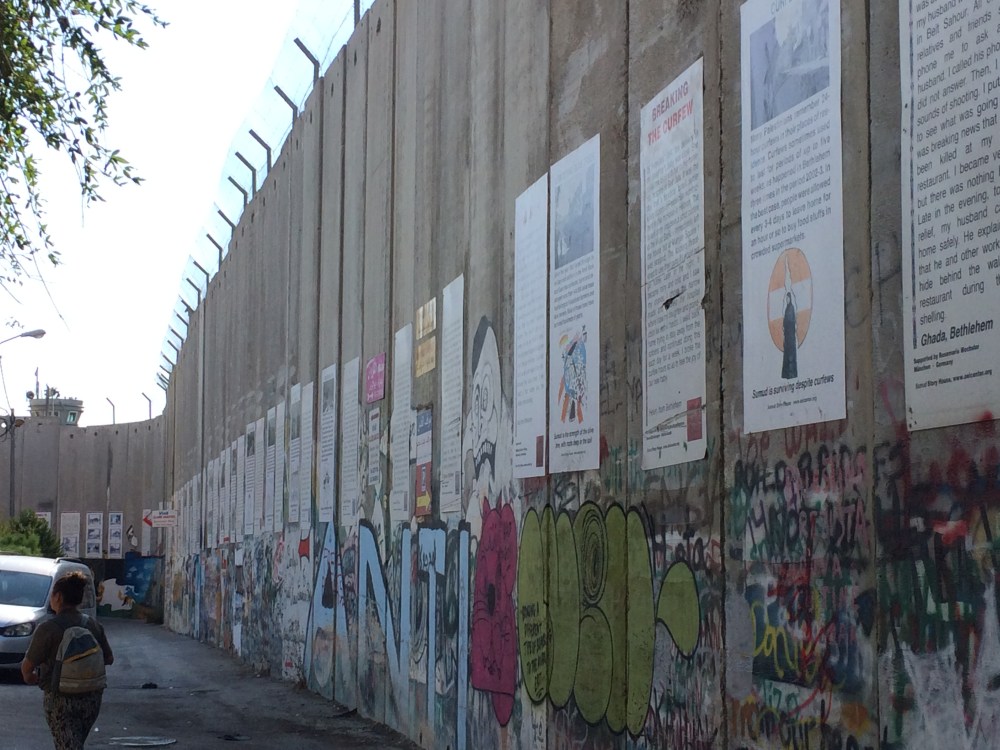
The graffitti in the camp bears a stark contrast to the graffiti on the apartheid wall. While the wall is a formidable reminder to all of the grave injustice of this colonialist, racist regime, the messages are largely of irony  and hope. The camp graffiti is much starker. suggesting a primal struggle for existence.

IMG_1075IMG_1056

The Wall and Humor, the Best Antidote to Wailing

After the morning of olive picking, we were given a tour of the wall blocking the way from Bethlehem to Jerusalem. Prior to the 2nd intifada, people passed freely between the two cities which are adjacent. Now, Israel has virtually blockaded all traffic into Jerusalem from Bethlehem or the West Bank. In order to go into Jerusalem from here, you have to go through one of a few check points and Palestinians are absolutely barred without getting special permits. There are many sad examples of people missing funerals of loved ones and families torn apart because of these restrictions. In the meantime, Israeli settlements (colonies) are being systematically built all around the parameter of East Jerusalem (the Palestinian quarter) so as to make movement next to impossible and life harder and harder. Israel insists that ALL of Jerusalem shall be its undivided capital ignoring the original UN partition plan and many subsequent UN resolutions

FullSizeRender 3FullSizeRenderIMG_1052

IMG_1042

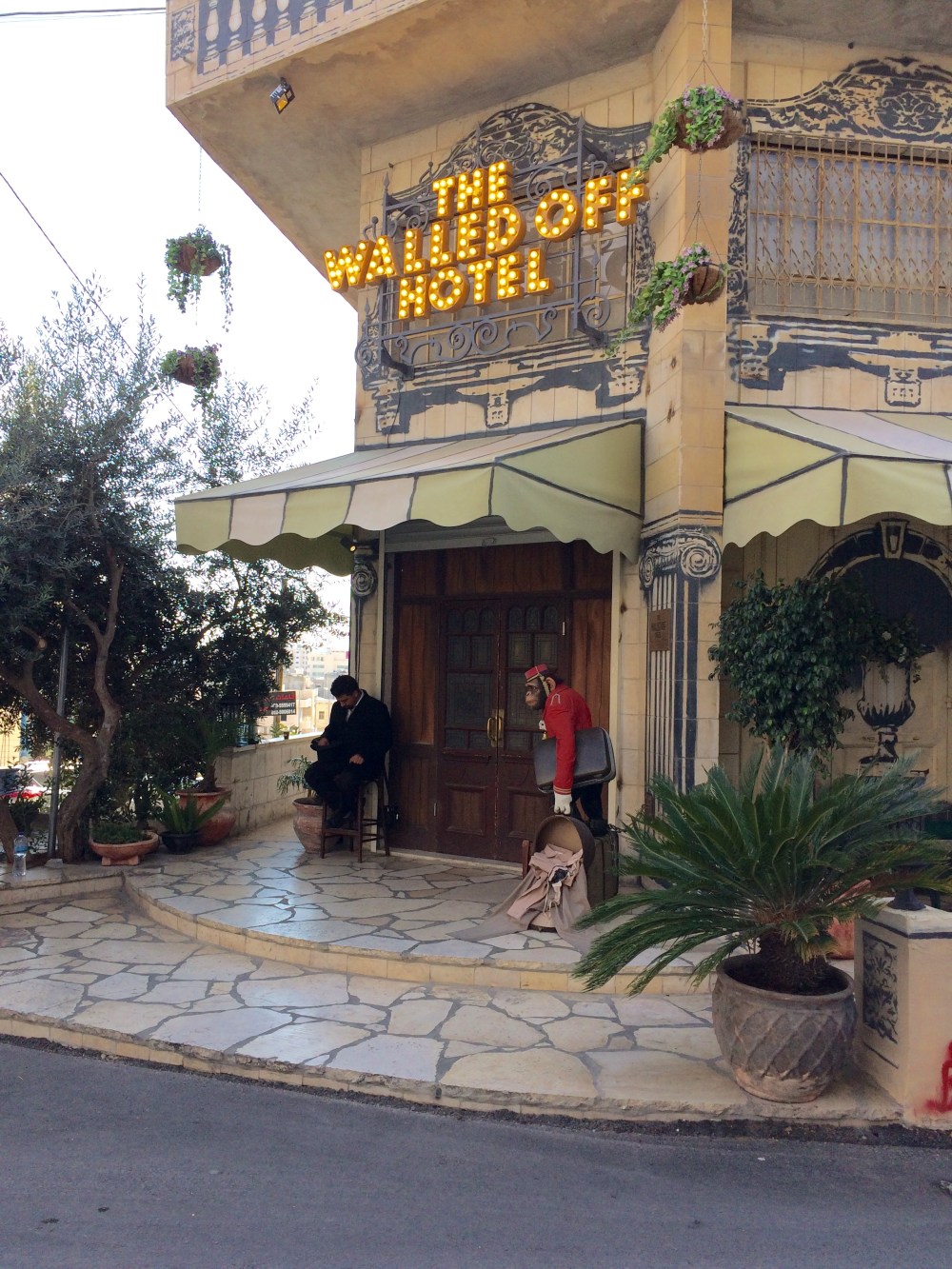
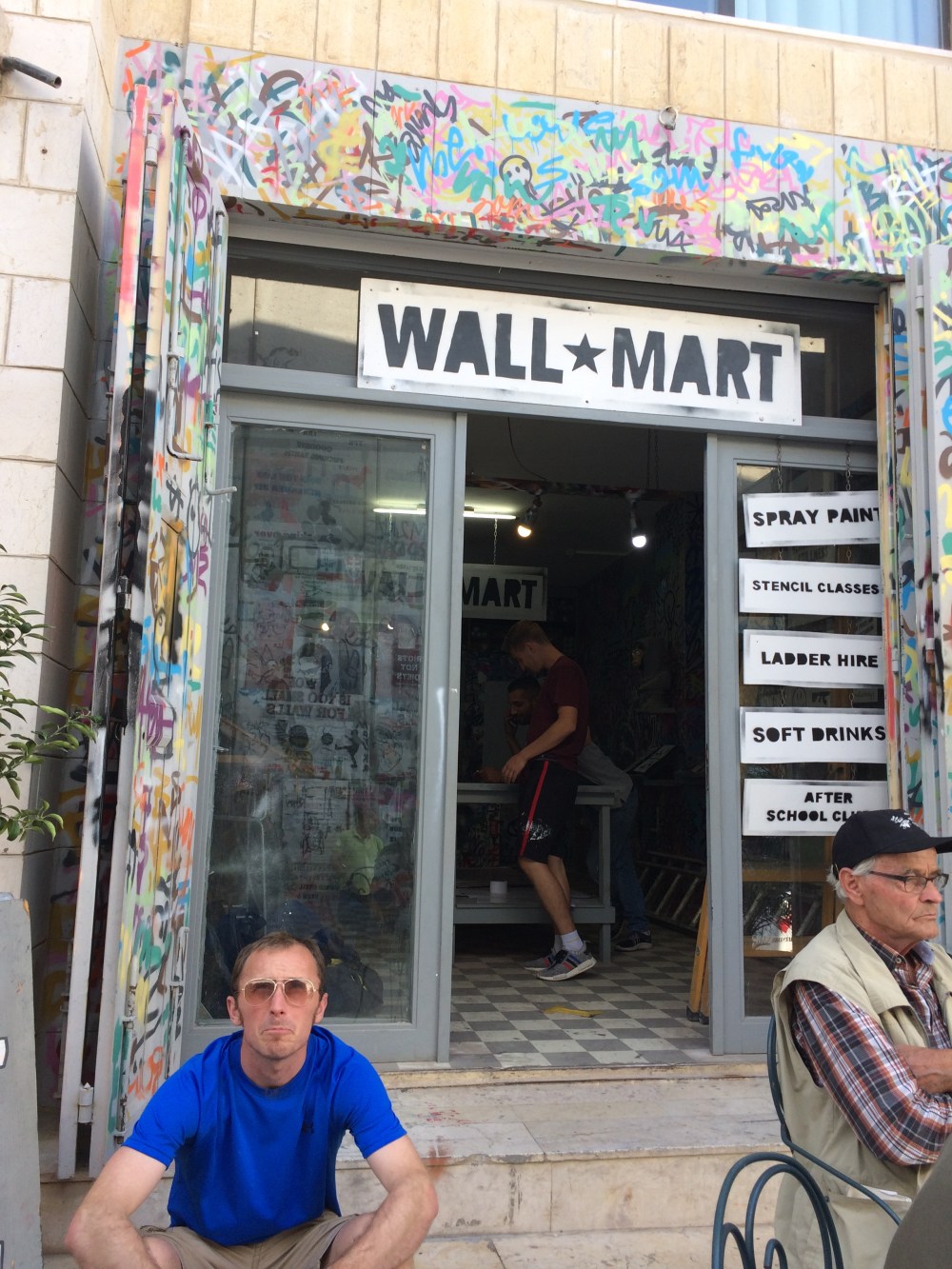
In spite of the seeming hopelessness of the situation, Palestinians maintain an amazing resiliency, optimism and even humor. The apartheid wall has served as a great canvas for expression, much of it quite clever. I’ve posted previously about the famous artist, Banksy’s wall art. It was interesting to see some of the new art since my last visit.  The Walled Off Hotel and Wall Mart where one can buy painting supplies were also new.

FullSizeRender 2IMG_1055

Olives are calling

I find myself back in Palestine after 2 1/2 years for the olive harvest partly because the urge to return never leaves and partly because I wanted to share the experience with my sidekick, Payne. We signed on to  the Olive Campaign sponsored by the Alternative Tour Group (ATG) and Joint Alliance Initiative (JAI). ATG is the Palestinian tour group that had arranged the 1st tour I had here. JAI is a group sponsored by the YMCA and the YWCA of Palestine with a mission of spreading awareness of the occupation  and its effects on the lives of Palestinians. Olive picking? More on that in a bit.

After a brief orientation at our hotel on Saturday evening, our group of 70 or so was divided into two picking groups and sent off on buses the following morning to separate fields. In other words – we were put right to work. What a motley bunch are we ranging in age from early 20s to 70s (perhaps +) and from France, Germany, Belgium, Norway, England, Sweden, Ireland, Korea, my little group of 6 from the US and probably others I’ve overlooked. Many in the group had done it several times before. For others, like Payne, it was their first time in Palestine.

Olive picking is labor intensive and the harvest season is short. Having  a swarm of worker bees like us would be welcomed by anyone who owns a grove. Our assistance isn’t elicited, however, for the sheer labor force. Rather, the farmers we help are selected because of  particular hardships they face under occupation. Our first farm was situated in a valley between two illegal settlements, one of them very new and continuing to expand. It would be bad enough to have one settlement looming over your farm, watching Palestinian land being gobbled up. It is not uncommon for  extremist, gun toting settlers to harass their neighboring Palestinian neighbors. There have been many instances of ancient trees being cut down and burnt and new trees being uprooted in the dark  of the night in addition to more overt menacing and harassing behavior. And the Israeli police and military do nothing to protect  the Palestinians – the ones who are there legally! The presence of a swarm of internationals on the fields has proven to be very effective deterrent from settler harassment and interference.

IMG_1022
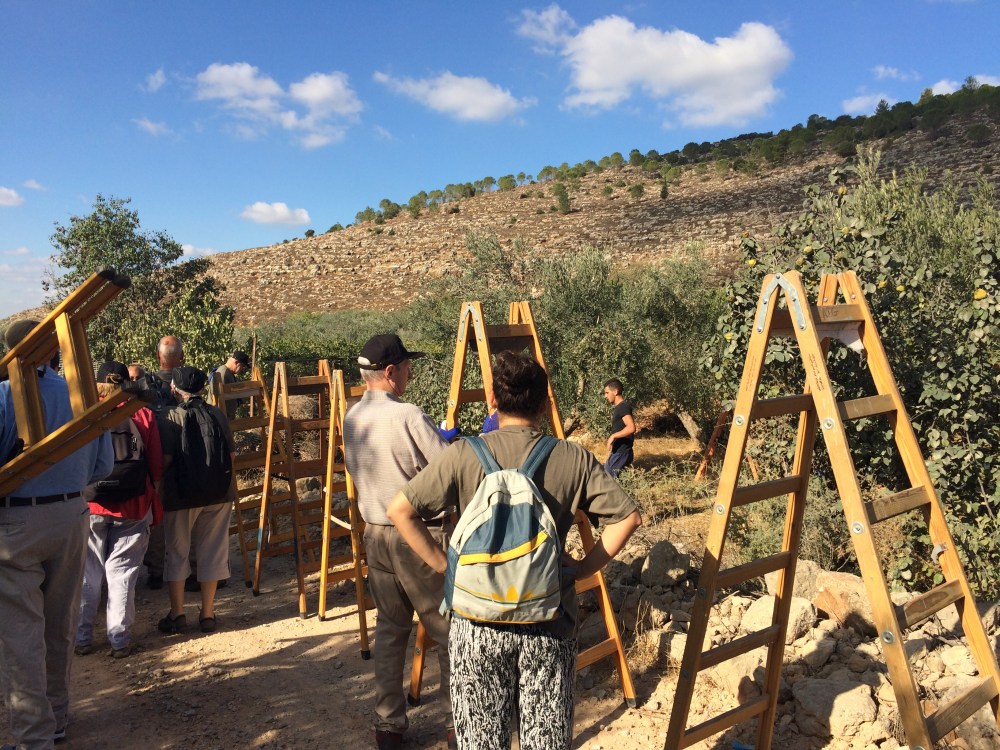
Carrying our gear into the field
IMG_1028
A happy picker
IMG_1031
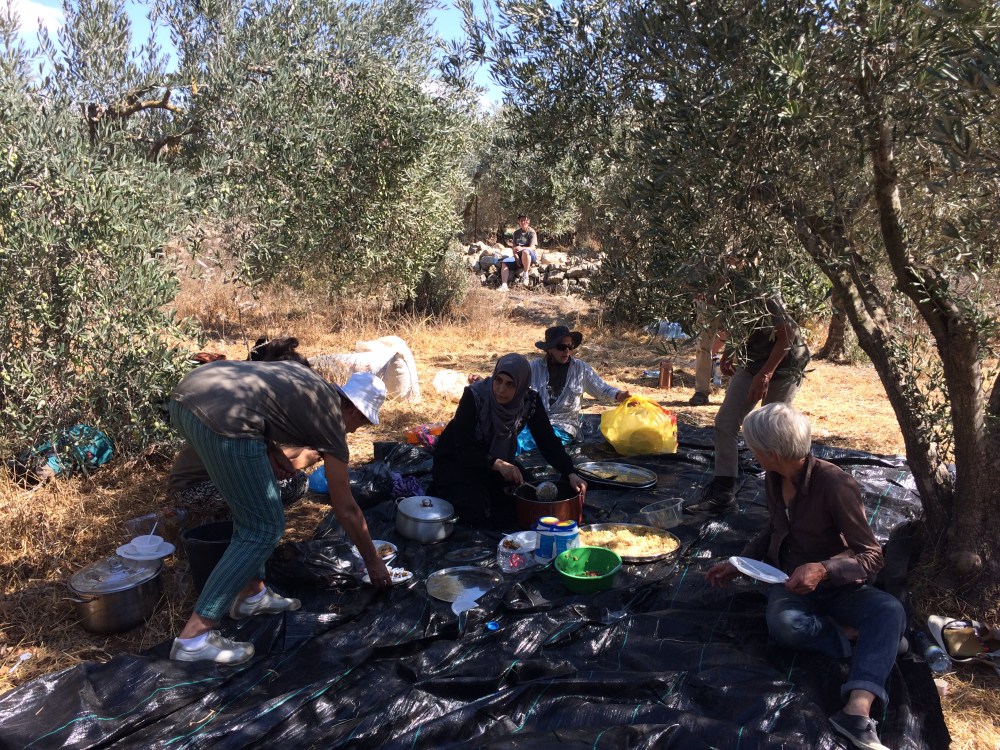
Enjoying lunnh provided by the farmer on site
IMG_1032
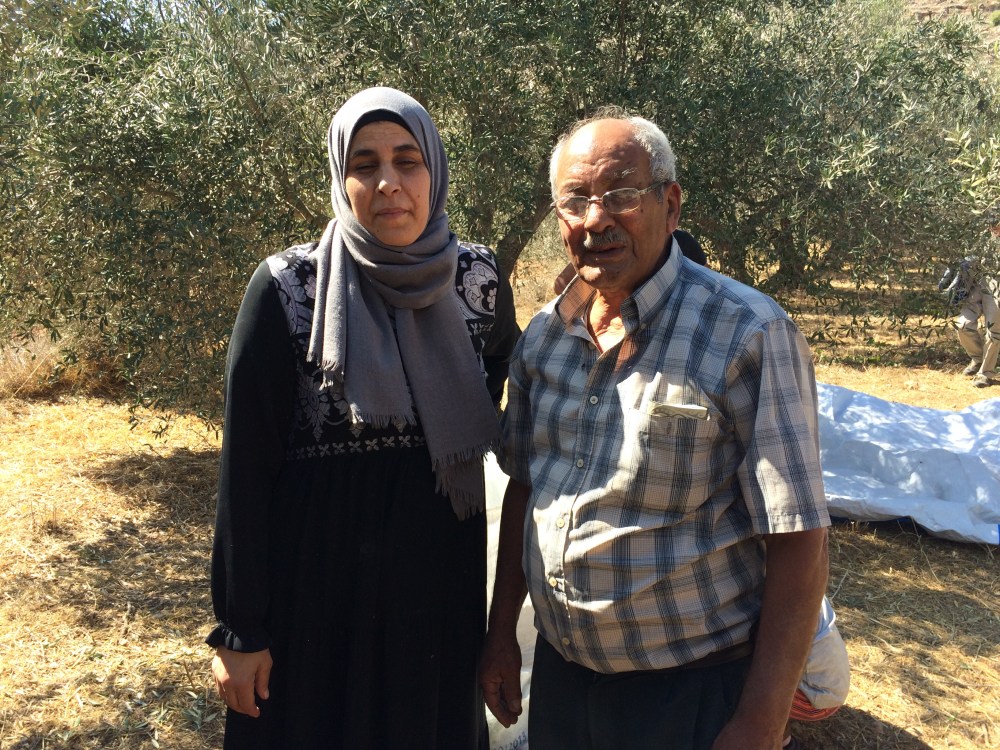
The very grateful farmer and his wife