Pressed

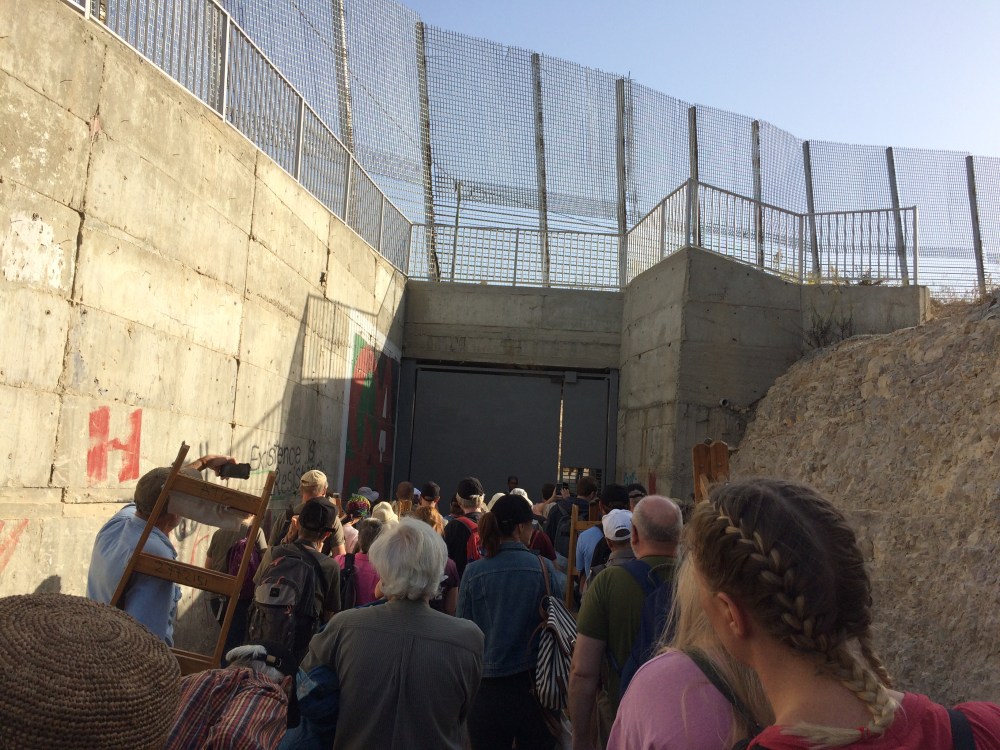
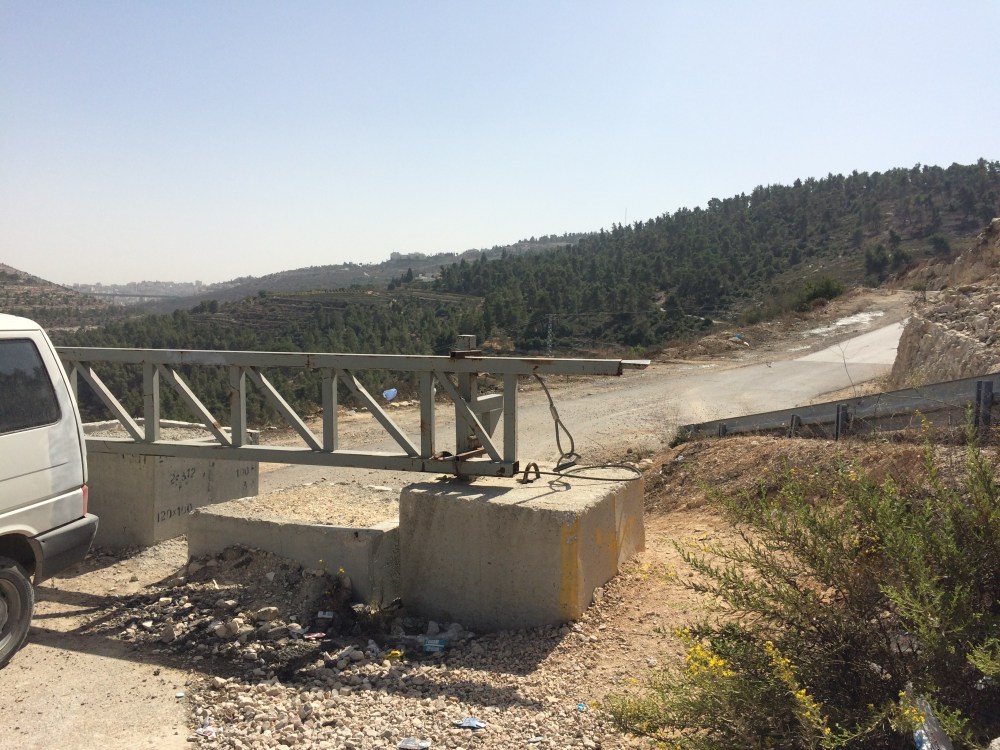
Our final day of picking was the most dramatic in several respects. It was on a farm just outside of Bethlehem on land that has been slowly and systematically being scooped up as part of the strategic plan to encircle Bethlehem with colonies of Jewish settlements to choke off access to Jerusalem. Mind you, this is all being done on land which was to have constituted the state of Palestine, in contravention of international. The farmer in question has held out on letting go of his farm against all odds. He is one of the fortunate ones who has rock solid proof of ownership. Israel has offered him a huge sum for his land and he has been harassed to no end, including having been mysteriously poisoned which put him in a coma for three months. Speculation is that Israel has designs to use it for airport. In short, he could be very wealthy and live a carefree life just about anywhere he might choose, but there is no price he would accept for the land which has sustained him and his family for generations. This has not stopped Israel’s expansionist plans in his area. Israeli colonies are being erecting on all sides of his farm. Although they have not been able to seize his farm, they  haveliterally closed him in by building the wall around him. In the name of security on this land to which they have no legal claim, they have created one of the most absurd and invidious strictures placed on Palestinian land that I have as of yet witnessed.


IMG_1144
This show part of the barrier fence that surrounds the entire farm. He now has access through this specially created, huge metal gate through which only the family has free access. If he has guests, he must first get permission from the Israeli authorizes.
IMG_1143
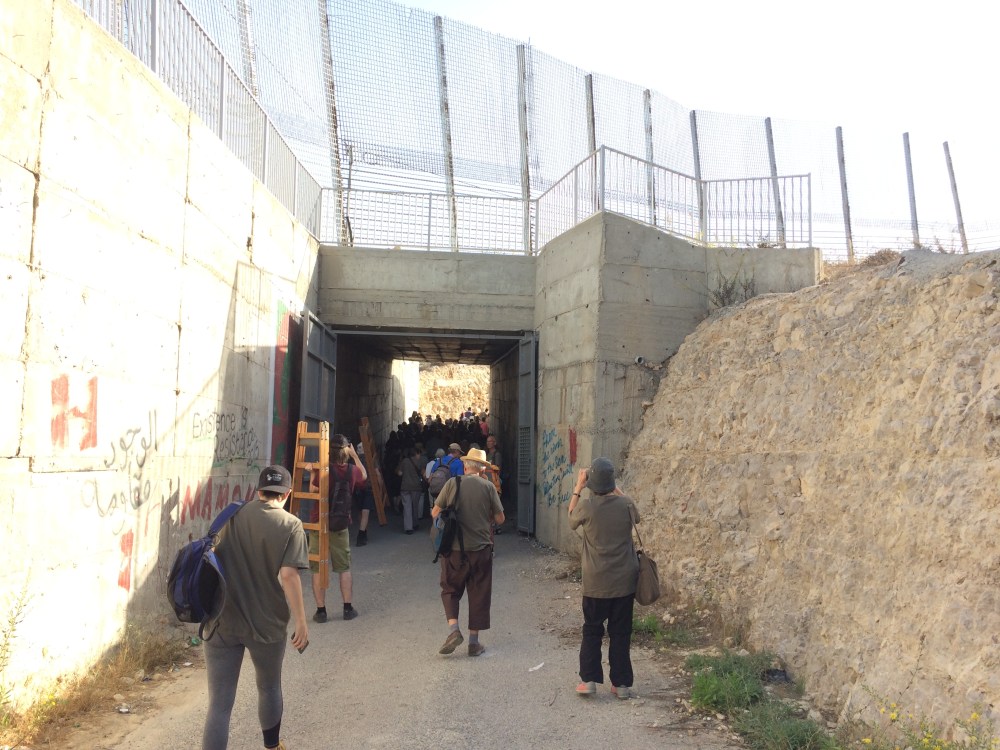
Here is our group entering the gate under the apartheid wall which closes off the farm from the rest of his Bethlehem suburb surrounds. We were allowed entry as the authorities allowed him help to harvest his olives. I guess we should all be grateful.
I
This shows one side of the huge steel gate with some words of hope

.

IMG_1169
This gate blocks entrance to the farm from the road which leads to it, the access to the farm that has been in place for generations. Now the only access is through the new steel gated tunnel under the apartheid wall.

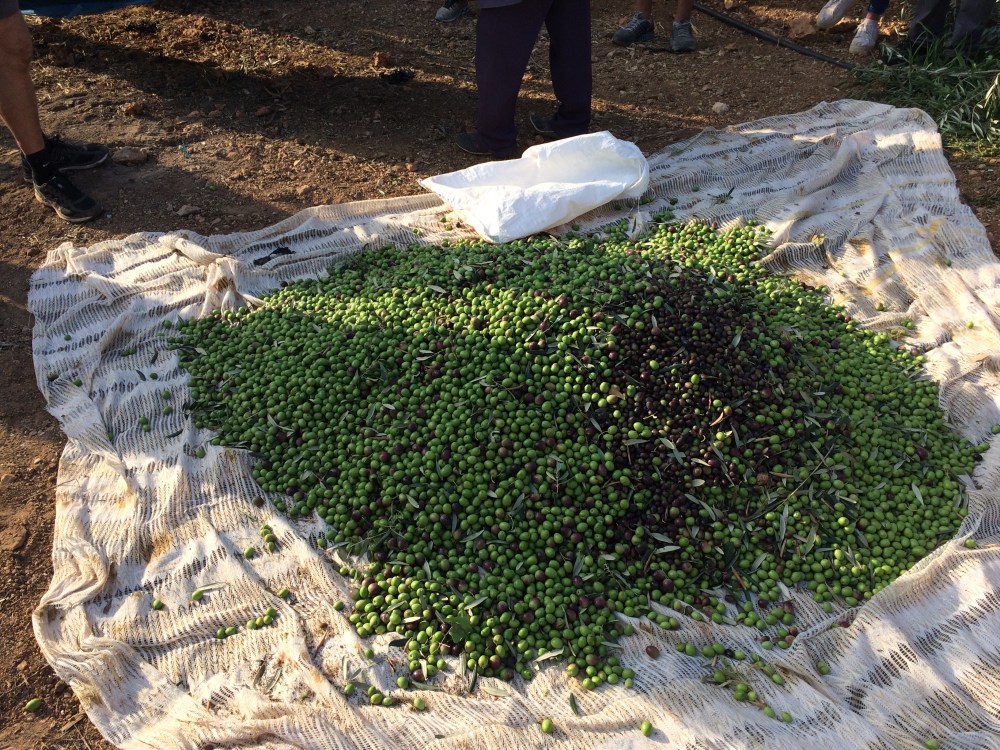
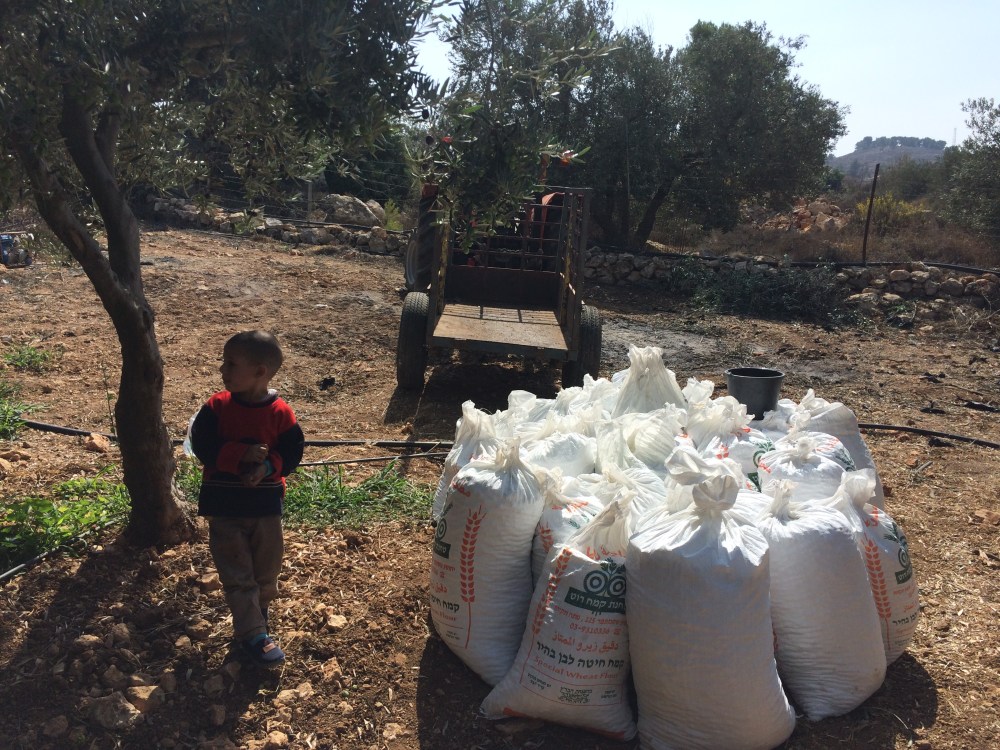
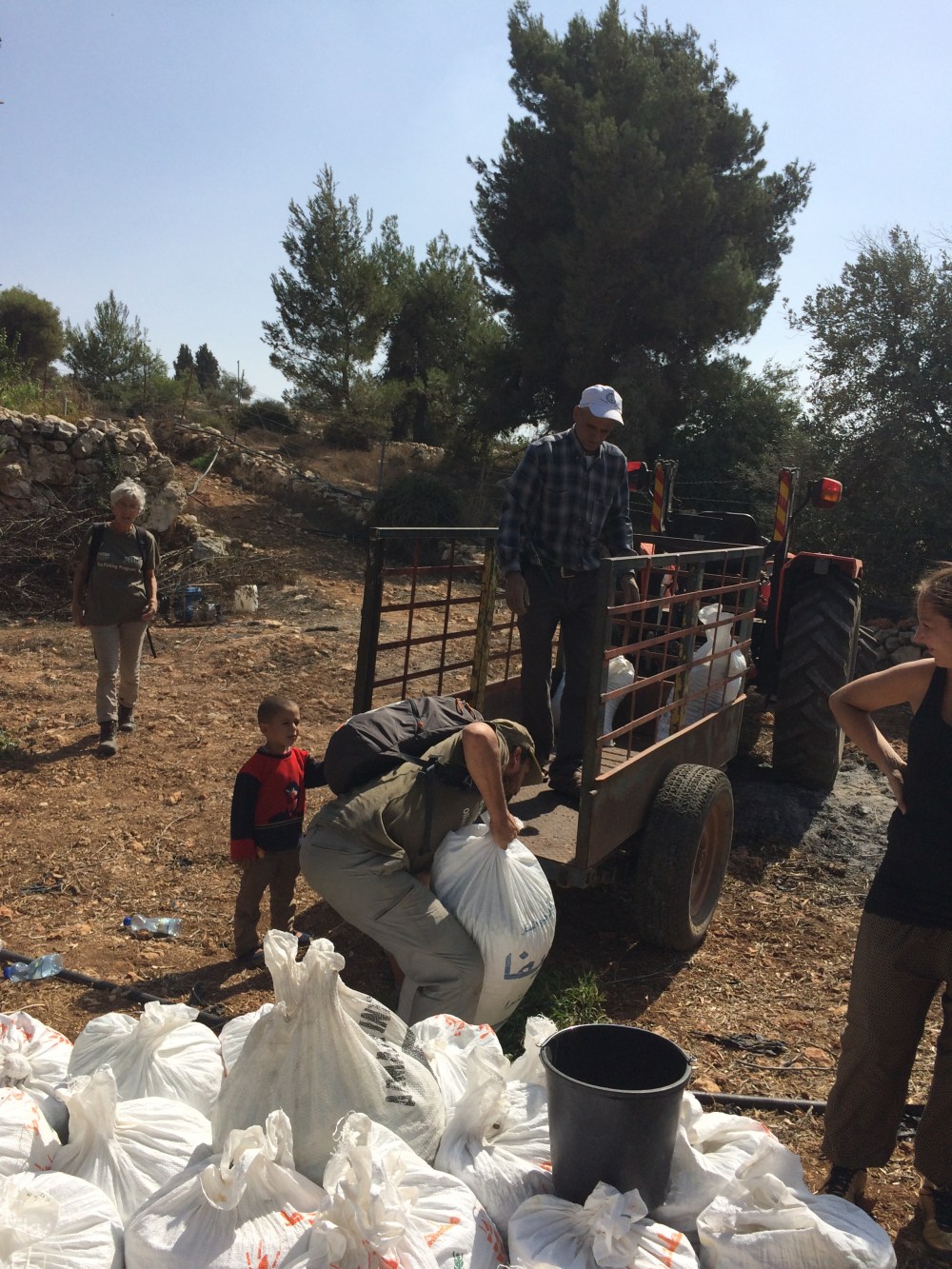
After  the incredulousness of the experience of this draconian barrier to the farm, we experienced the lushest, most satisfying picking of the trip. We were there for entire day, a swarm of worker bees milking the huge, copious olives weighing heavily on the trees. This farmer had the good fortune of the continued use of the well on his farm for irrigation, a luxury that most Palestinians are denied. It made a huge difference in the yield. We picked 105 trees and filled around 80 huge sacks.

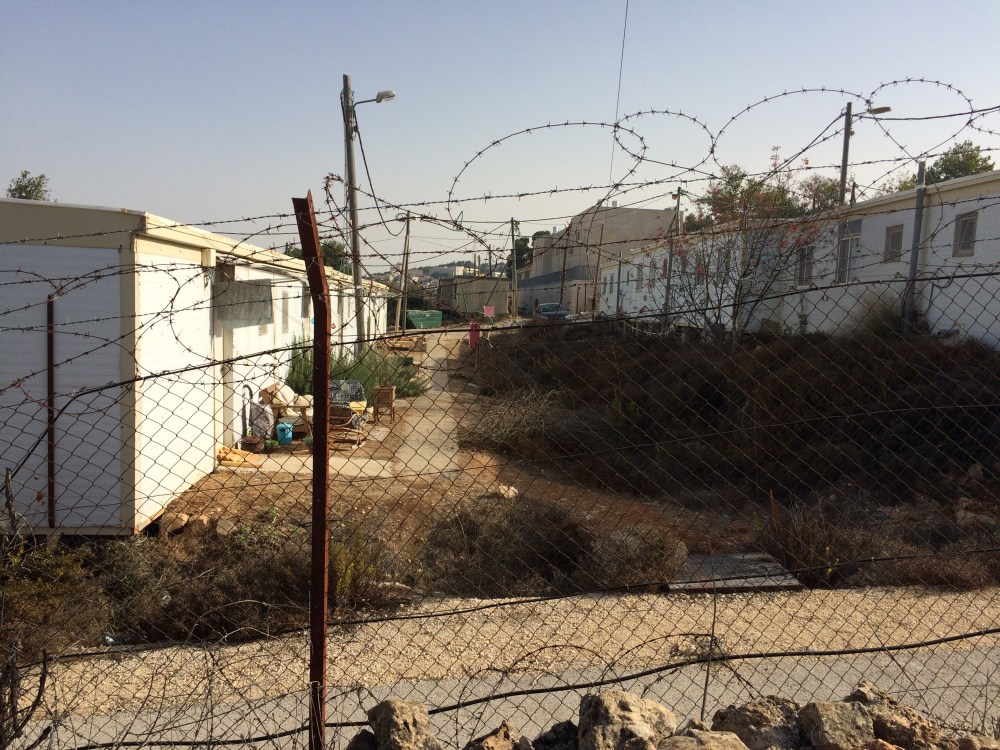
we started at the back of the grove which was just feet away from a colonist outpost of mobile units. This is how many of the illegal settlements begin – with temporary structures that are eventually replaced with a quickly erected monolithic suburb.

IMG_1187

IMG_1200

IMG_1216
The four women from our six person Maine contingent.
IMG_1192
The four women from our Maine contingent. The six of us were the only Americans in our group of around 70.
IMG_1194
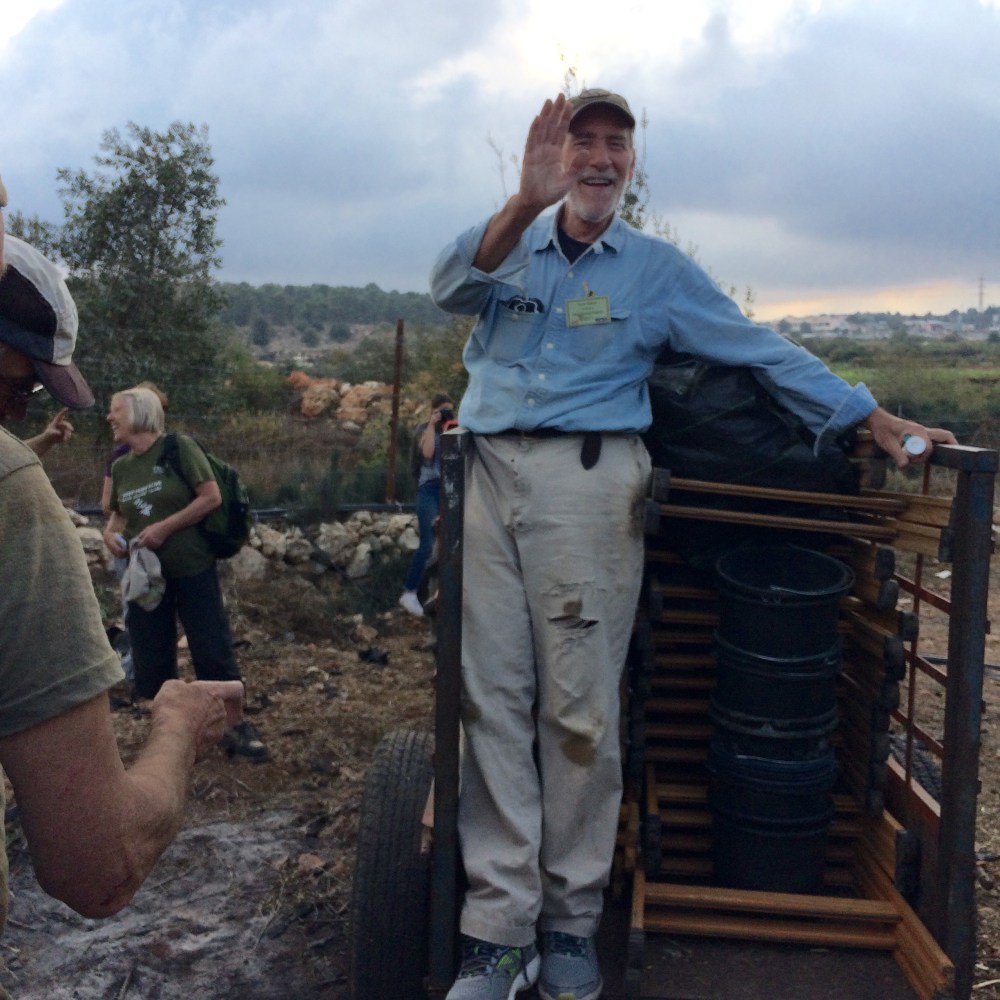
Our farmer on the wagon as bags of olives are being loaded
FullSizeRender
After a whole day of picking, we suffered only one casualty. Payne sprained his ankle when his ladder toppled. But he got a great send off on the wagon.                                                      

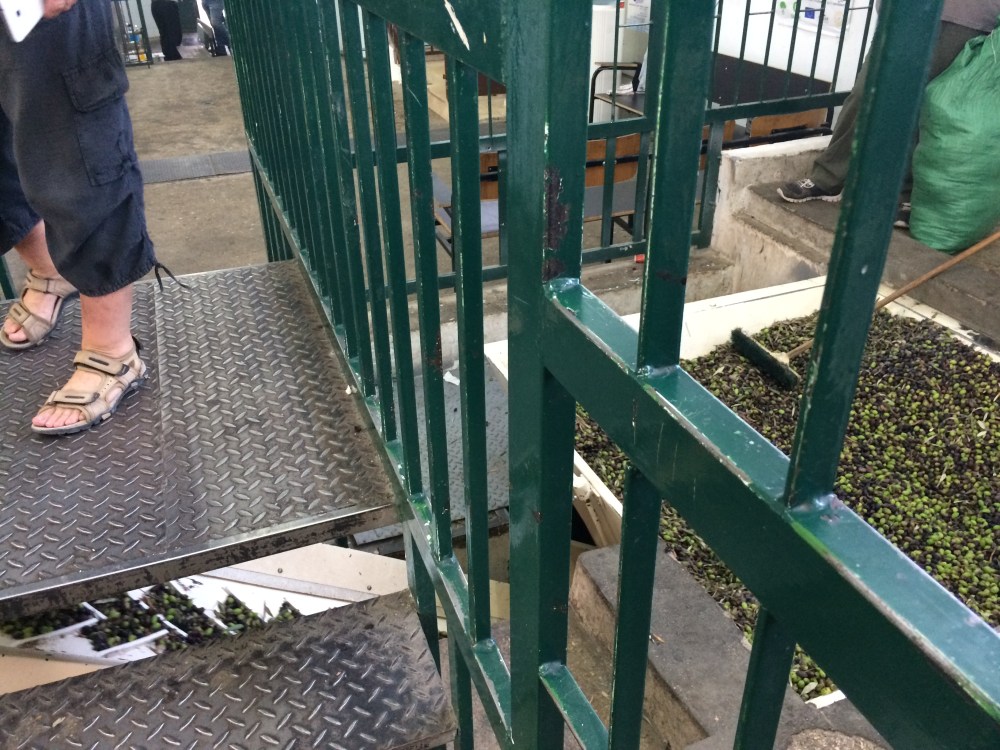
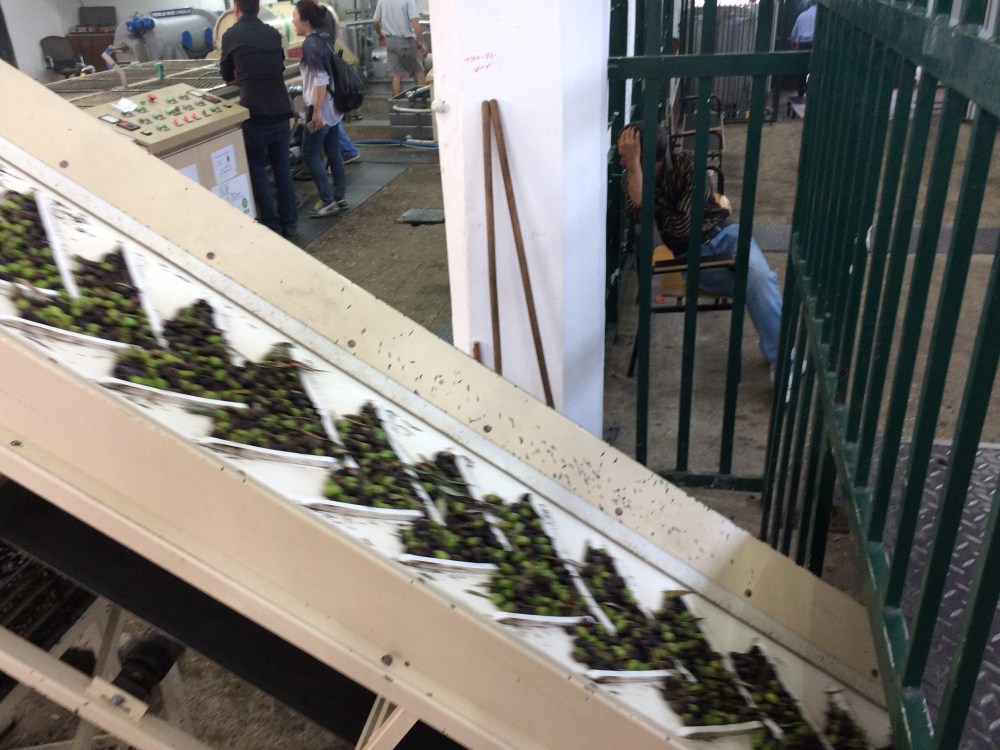
To end the day, we visited the local cooperative olive press where the farmers bring there crop to be rendered into fresh, delicious olive oil.


IMG_1217IMG_1218

Dirty business

Picking  olives and apartheid policies are both dirty businesses. I’ll start with the olives. Our second day of picking was for a farmer on the edge of a new colony under construction. We could see and hear back hoes at work as the new buildings sat high looming down over the grove. Because of the proximity to the new colony, the farmer’s property had been fenced off and access to the olive field was restricted except  for a couple of weeks in October for the harvest. How kind of the Israeli government to allow these few weeks of access to his rightfully owned property in order to grant “security” to the illegally erected colony.

It bears noting that the illegal colonies in the West Bank now house around 700,000 settlers. This is up from some 500,000 the last time I was here. Everyone with any knowledge of this situation now  acknowledges that this means the idea of a two state solution is dead. It is also noteworthy that in recent years, there have been over  a million settlers from  Russia and USSR satellite states. While Palestinians are being systematically squeezed out of their ancestral lands, people with no connection with the land  are welcomed with open arms and subsidies if they can satisfy the authorities that they have just one Jewish grandparent. That could be me.

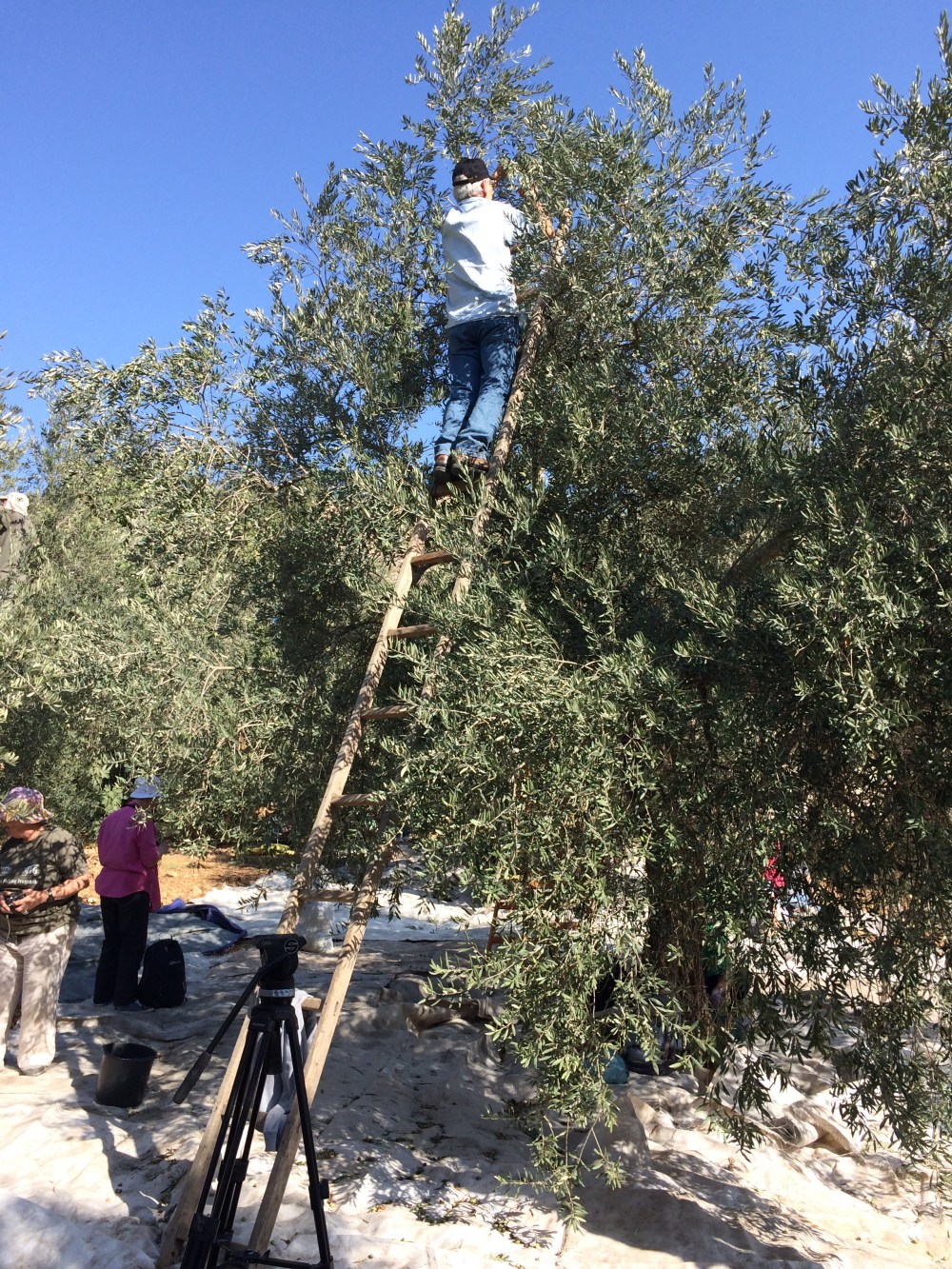
The picking this day proved to be much more difficult than the first day. The trees were higher, the branches more scraggly and the olives smaller and less abundant. After someone had mentioned that it was probably due to the fact that the trees hadn’t been properly pruned, it hit me why. The farmer had no access to the trees for most of the year. Whatever the draconian, life crushing  restriction placed on Palestinians is, the reason  is always “security.” How it inconveniences and demoralizes the Palestinians effected is of no concern, or perhaps one wonders, if that wasnt the aim; in other word, making life so unbearable, as to drive them out.

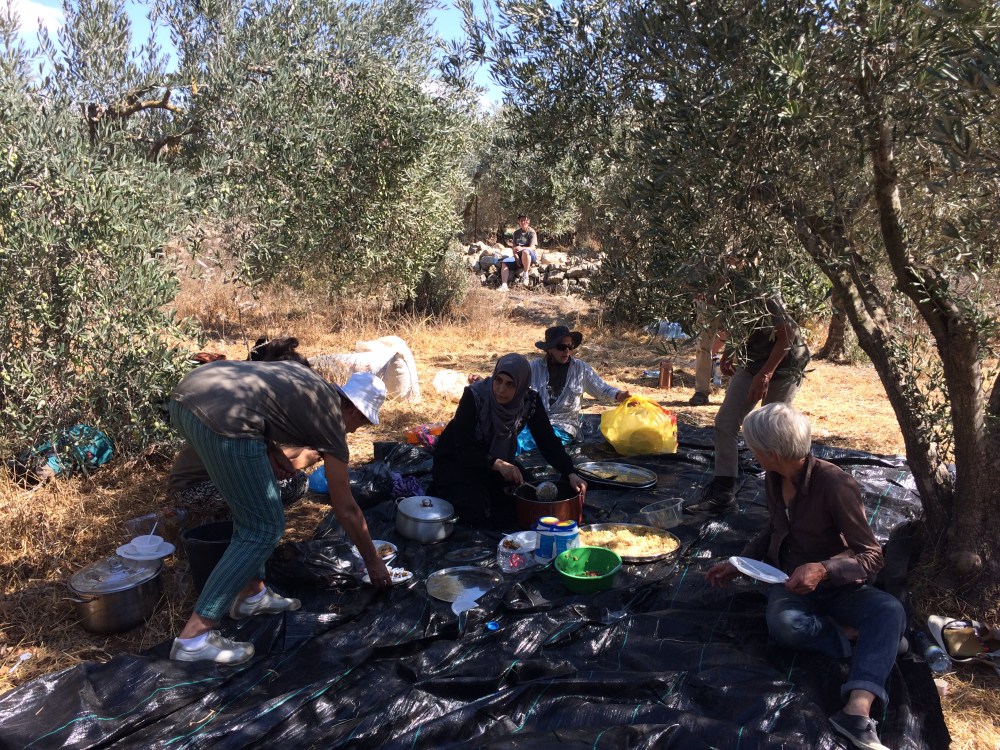
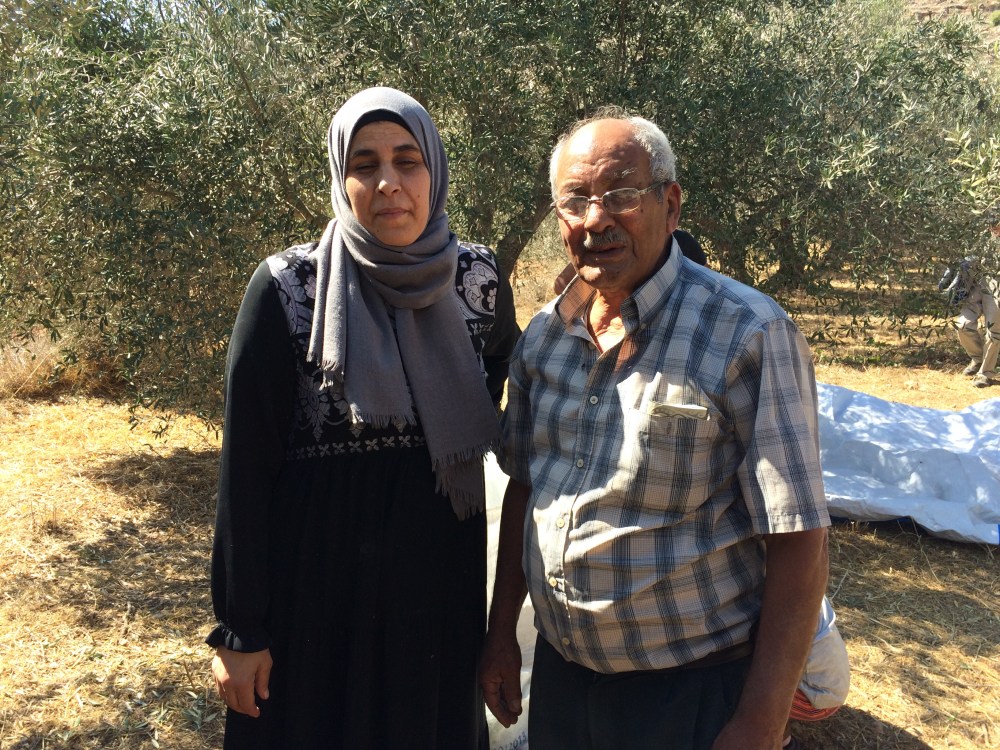
Adding to the gravitas was the news that the farmer had just lost his son a week or so ago. Our group coordinators had told the mother Minot to worry about providing lunch – that they would arrange it. She insisted all the same, and provided us a beautiful lunch that we shared on the field. Once again, the heartfelt gratitude we received for our help brought many of us to tears. We left the farm covered in dust and  oil stained on the surface, but deeply affected.

FullSizeRender
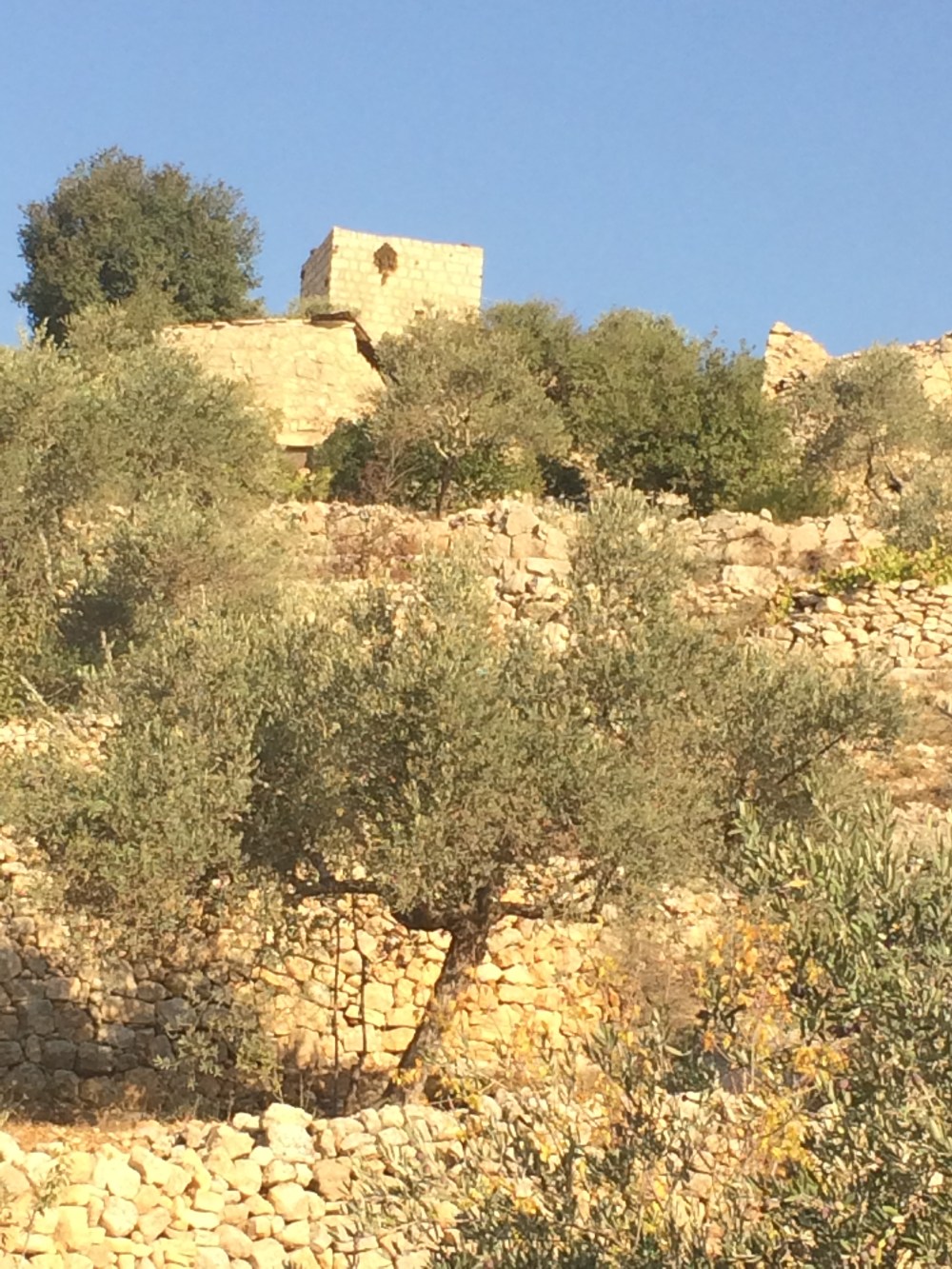
We had to walk a bit to get to the olive grove. The ancient terraced fields from another farm are in the background.

IMG_1107


IMG_1111
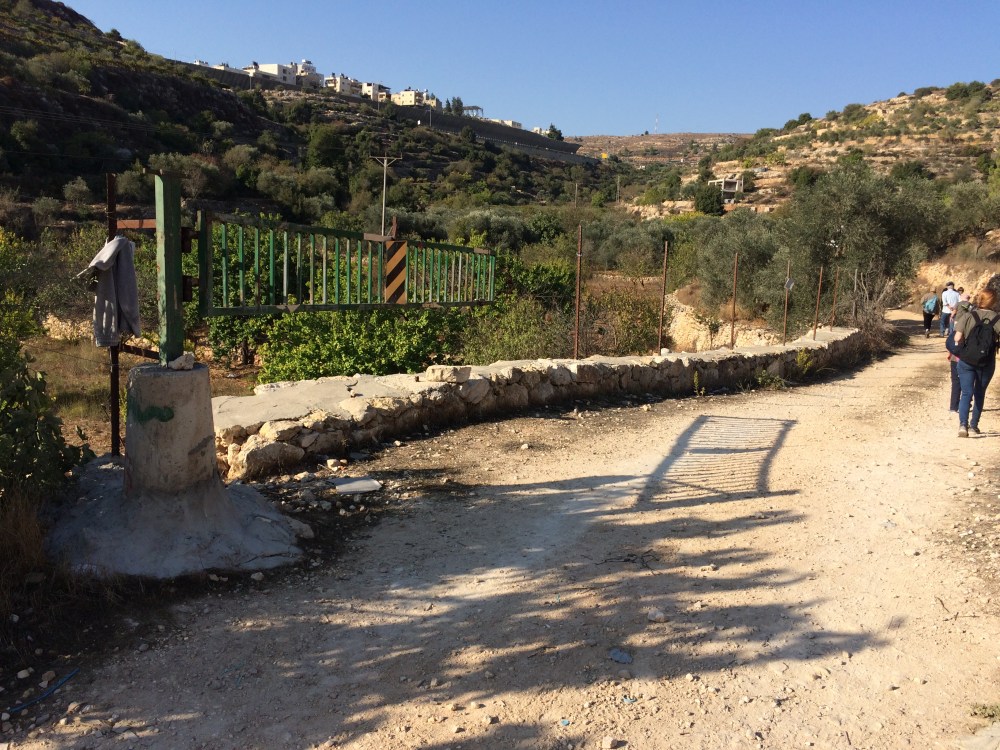
This is the gate that Israel erected a few years ago to restrict the farmer access to his own fields except with their permission.


IMG_1116

This is my friend Bob Schaible, past president of Maine Voices for Palestinian Rights and never one to go for the low hanging fruit.

FullSizeRender 2Our reward after a hard morning’s labor.

Aida means returning

IMG_1074
This is the entrance to the Aida refugee camp, the smallest of the 3 UN controlled refugee camps within the City of Bethlehem. Many of the refugees still hold the keys to the homes from which they were expelled, hence the key as a poignant symbol of the struggle.

After going to that part of the apartheid  wall that blockades Bethlehem from Jerusalem, we visited the Aida refugee camp. This is the smallest of the three UN run camps in Bethlehem with around 6,000 refugees. Dheishe, the largest, houses nearly 15,000. The camps were opened in the late 1940s to temporarily shelter some of the 750,000 to 1,000,000 Palestinians expelled from their homes by Israeli forces in the late 1940s.  Israeli historian, Ilan Pappe refers to this as the ethnic cleansing of Palestine.

These camps  initially consisted of tents, but. after around two years, it became clear that more permanent structures were needed.  They remain today, nearly 70 years later, ghettos of closely packed stuctures separated by tiny alleyways, with barely a speck of green space.

Many in the camps are now third generation, probably fourth or even fifth.  I’ve heard it  asked, often with contempt, why are they still there? Why don’t they leave? Why don’t other countries absorb them?

First of all, it has to be understood that Palestinians have a very deep connection with the land, and the initial refugees always thought they they would be able to return to their homes. This is a hope that is still alive  – even in the later generations.

Second, the neighboring countries, and particularly Jordan HAVE absorbed 100,000s of thousands of Palestinian refugees. When I visited 3 1/2 years ago, 1/3 of Jordan’s population were Palestinian, and the country was straining to provide for them. Now with the Syrian crisis, the situation is even more dire.

img_1072-e1508356050302.jpg
This wall mural lists all of the Palestinian villages from which the camp’s refugees were expelled.

Finally, the camp refugees are mired in such extreme poverty, that they simply don’t have the option of mobility.  So, the situation is entrenched and generational. This is what is wrought by forced expulsions and ethnic cleansing.

A couple personal notes on camp life bear mentioning. One of our guides was distraught on our bus ride to the olive field. He is a resident of the Dheishe camp. The previous night, the camp was raided by Israeli soldiers. This is always done in the dark of night, doors kicked in,everyone, including terrified children pulled from beds, houses torn apart in searches and people, usually young men, dragged out in handcuffs. I can’t  tell you how many times I’ve heard such stories.  This night, three of his close friends had been taken away.

Under  Israeli law, there is this thing called administrative detention. This euphemism means that one can be held for up to 5 months without any charges filed and without access to a lawyer, family or the outside world. Doe process of law? No such thing for Palestinians. Reasons for detention might be throwing a rock at a soldier, being a journalist writing criticisms of the occupation, an activist of any kind or a union member protesting Israel – who knows. And it almost always involves extreme abuse if not torture’ and very often minor children being detained. And each 5 month period can be extended, extended and extended. A friend of mine recently welcomed his son-in law home after 30 months of detention and fruitless money scraped together by the family spent on legal fees, finally  to see his 2 year old daughter for the first time. His crime – writing about the occupation.

Another incident  involved my friend Leila, the vender of women’s needlework cooperative from Hebron. I was delighted to reconnect with her the other day. But saddened to learn that just two days earlier her son had been arrested, purportedly for the crime of trying to work without a permit in Israel. Who knows when she will see him again.

Finally, the other story that touched me was from the same guide from the Dheishe camp.  We were picking olives in an area surrounded by new Israeli settlements. Their construction involved confiscation of huge tracts of land in the West Bank. The area of olive trees in which we were picking bordered the camp  and was the de facto playground of the camp children who otherwise had no green areas to play in. Well, with the construction of the settlements came the walling off of the entire area, further closing in and ghettoizing the camp. He ruefully described how this was his childhood playground which, alas was now out of bounds for the camp because of the grotesque wall.

Children comprise over 50% of the camps’ population. How will life under occupation form them?

IMG_1068IMG_1066

IMG_1076
While at the camp, we heard an explosion. It was a sound bomb tossed into the camp by an Israeli soldier. At the top of the street, to the left, you can see the figure of a soldier menacing with his gun as emboldened children run to the street to face the threat head on.

The graffitti in the camp bears a stark contrast to the graffiti on the apartheid wall. While the wall is a formidable reminder to all of the grave injustice of this colonialist, racist regime, the messages are largely of irony  and hope. The camp graffiti is much starker. suggesting a primal struggle for existence.

IMG_1075IMG_1056

The Wall and Humor, the Best Antidote to Wailing

After the morning of olive picking, we were given a tour of the wall blocking the way from Bethlehem to Jerusalem. Prior to the 2nd intifada, people passed freely between the two cities which are adjacent. Now, Israel has virtually blockaded all traffic into Jerusalem from Bethlehem or the West Bank. In order to go into Jerusalem from here, you have to go through one of a few check points and Palestinians are absolutely barred without getting special permits. There are many sad examples of people missing funerals of loved ones and families torn apart because of these restrictions. In the meantime, Israeli settlements (colonies) are being systematically built all around the parameter of East Jerusalem (the Palestinian quarter) so as to make movement next to impossible and life harder and harder. Israel insists that ALL of Jerusalem shall be its undivided capital ignoring the original UN partition plan and many subsequent UN resolutions

FullSizeRender 3FullSizeRenderIMG_1052

IMG_1042

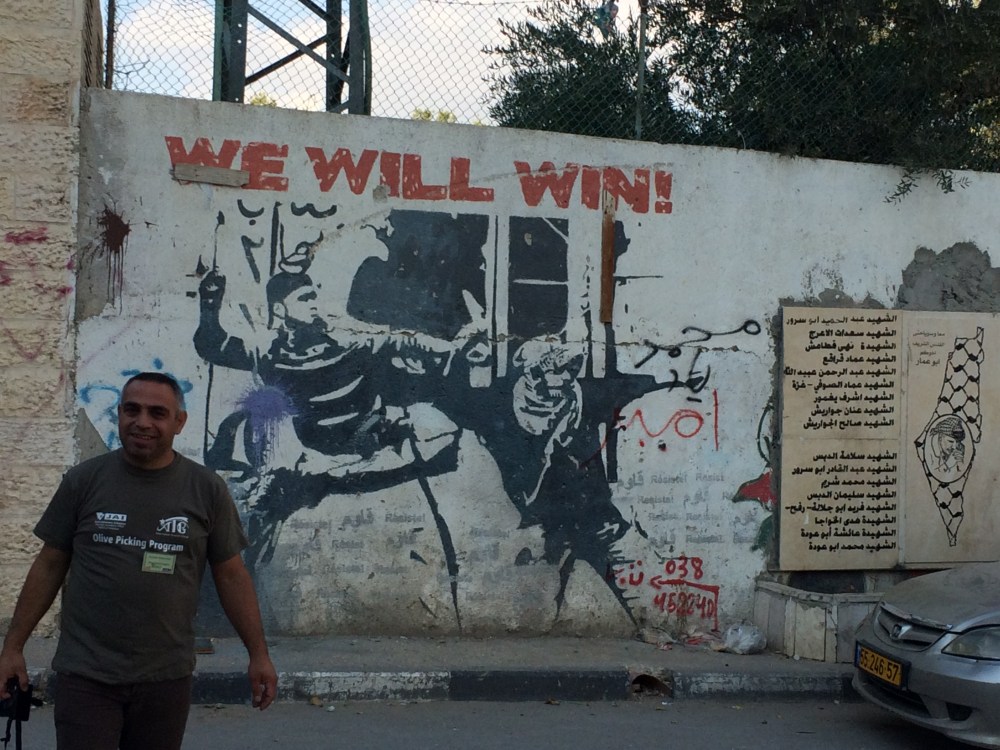
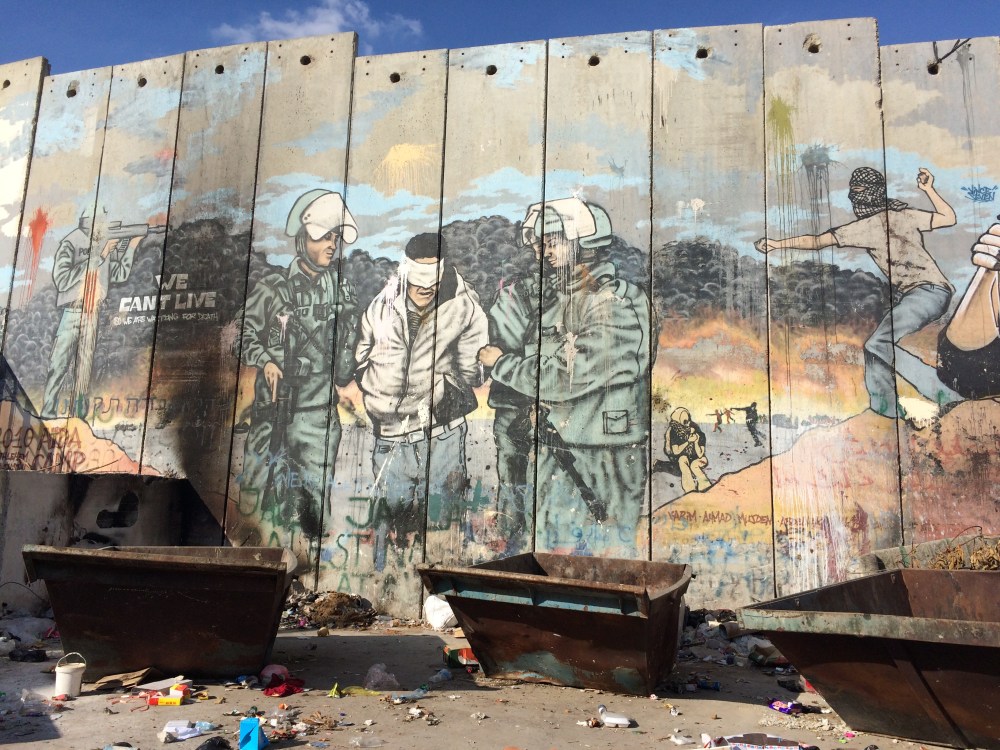
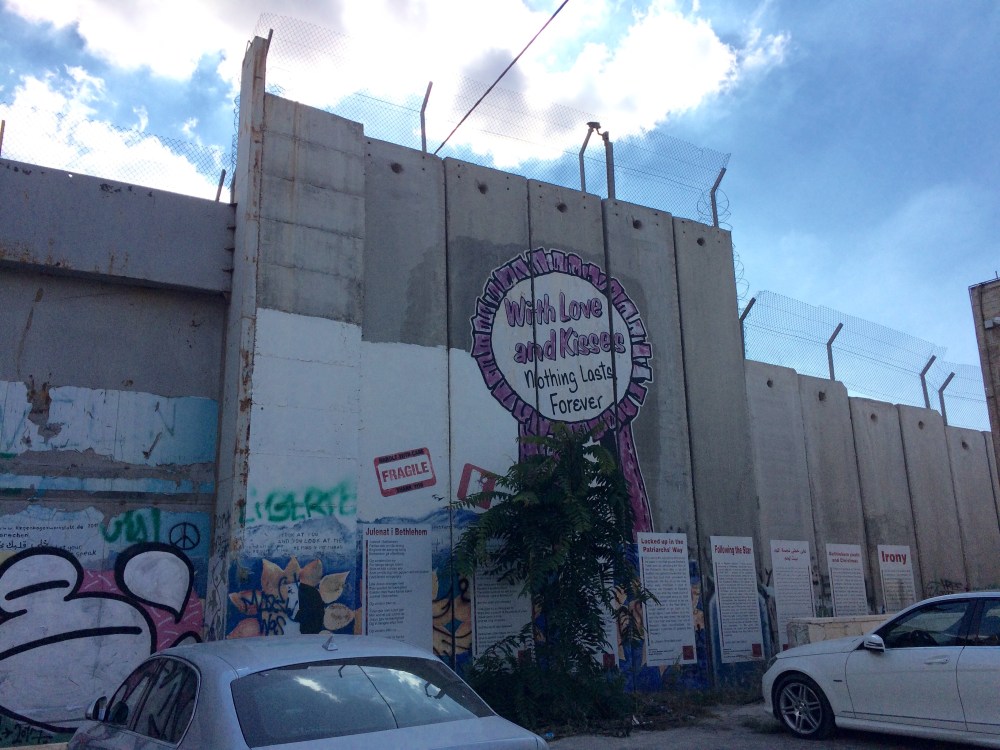
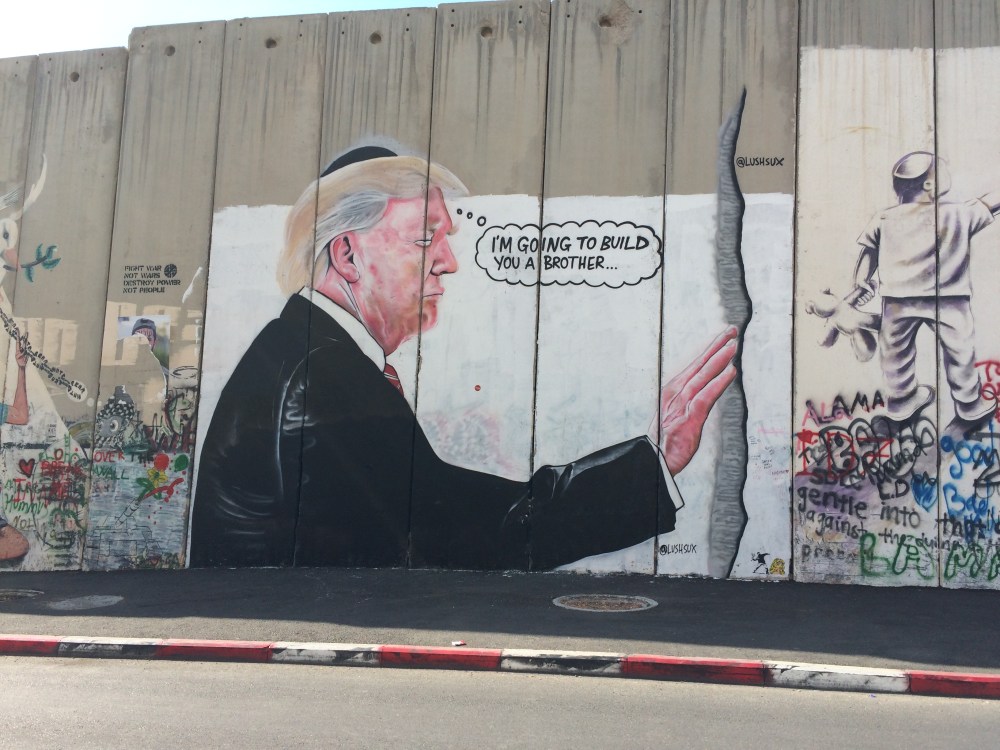
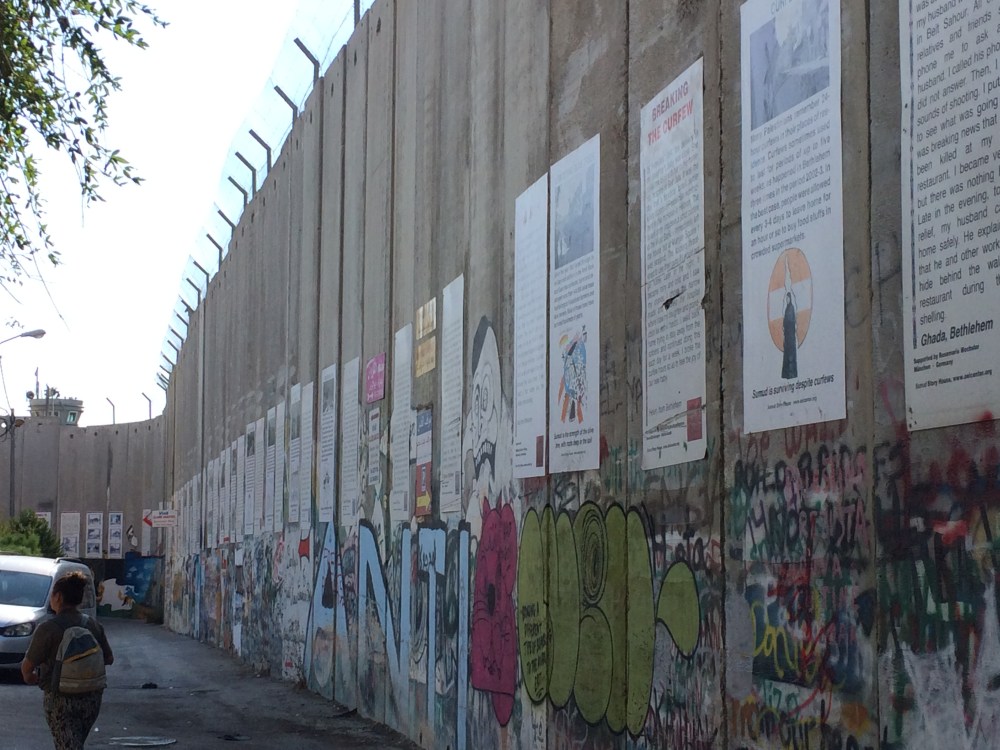
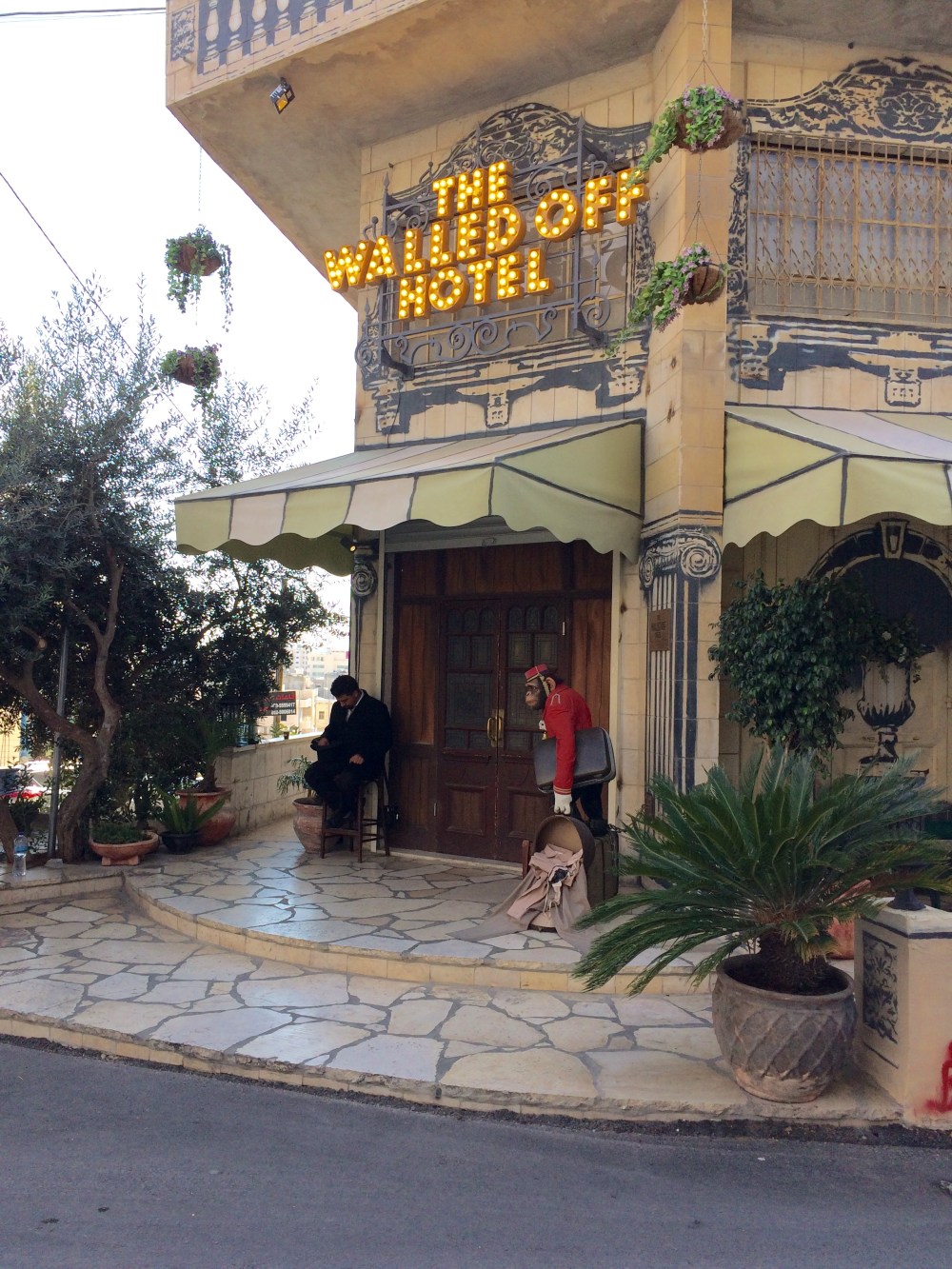
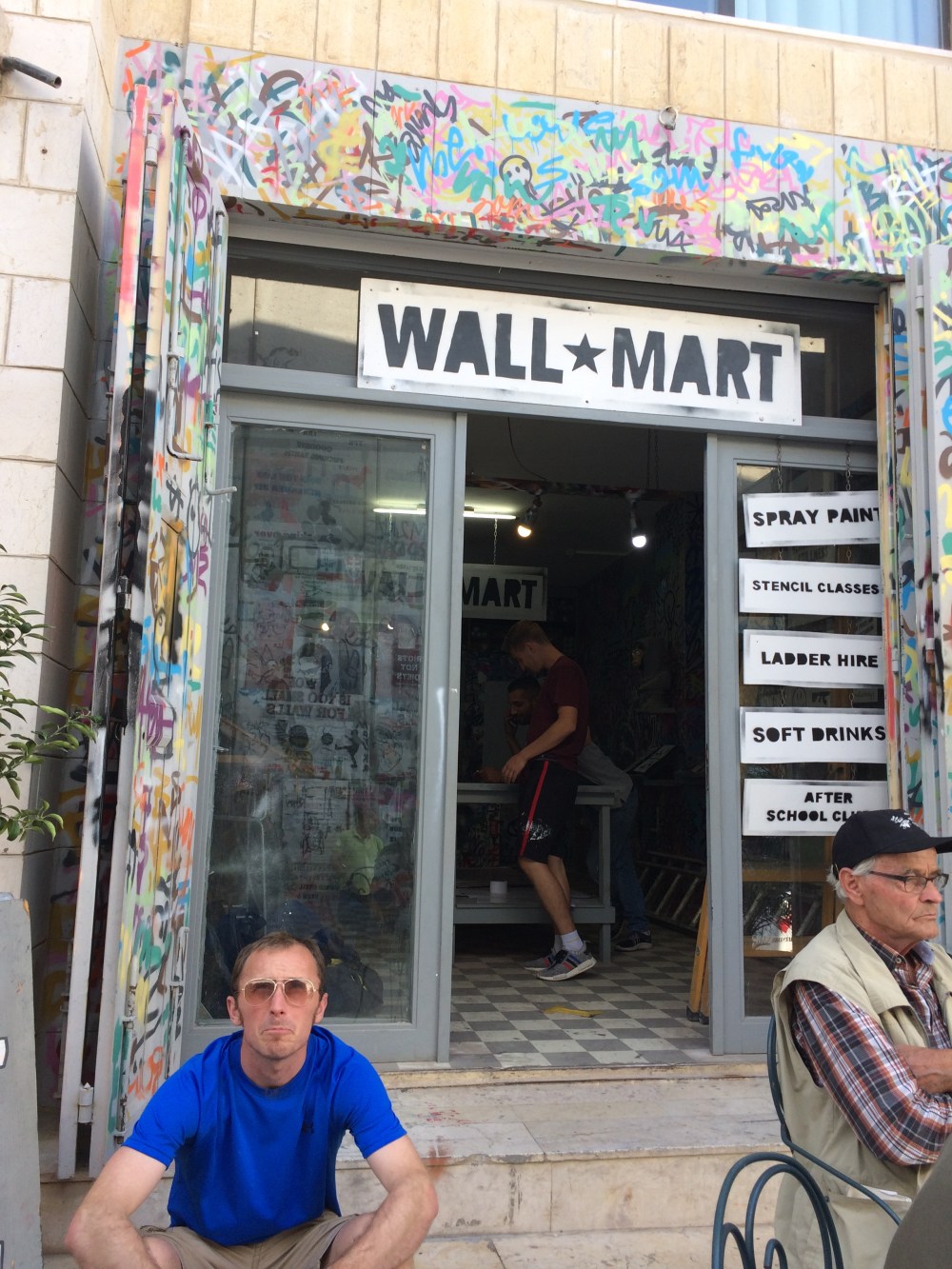
In spite of the seeming hopelessness of the situation, Palestinians maintain an amazing resiliency, optimism and even humor. The apartheid wall has served as a great canvas for expression, much of it quite clever. I’ve posted previously about the famous artist, Banksy’s wall art. It was interesting to see some of the new art since my last visit.  The Walled Off Hotel and Wall Mart where one can buy painting supplies were also new.

FullSizeRender 2IMG_1055

Olives are calling

I find myself back in Palestine after 2 1/2 years for the olive harvest partly because the urge to return never leaves and partly because I wanted to share the experience with my sidekick, Payne. We signed on to  the Olive Campaign sponsored by the Alternative Tour Group (ATG) and Joint Alliance Initiative (JAI). ATG is the Palestinian tour group that had arranged the 1st tour I had here. JAI is a group sponsored by the YMCA and the YWCA of Palestine with a mission of spreading awareness of the occupation  and its effects on the lives of Palestinians. Olive picking? More on that in a bit.

After a brief orientation at our hotel on Saturday evening, our group of 70 or so was divided into two picking groups and sent off on buses the following morning to separate fields. In other words – we were put right to work. What a motley bunch are we ranging in age from early 20s to 70s (perhaps +) and from France, Germany, Belgium, Norway, England, Sweden, Ireland, Korea, my little group of 6 from the US and probably others I’ve overlooked. Many in the group had done it several times before. For others, like Payne, it was their first time in Palestine.

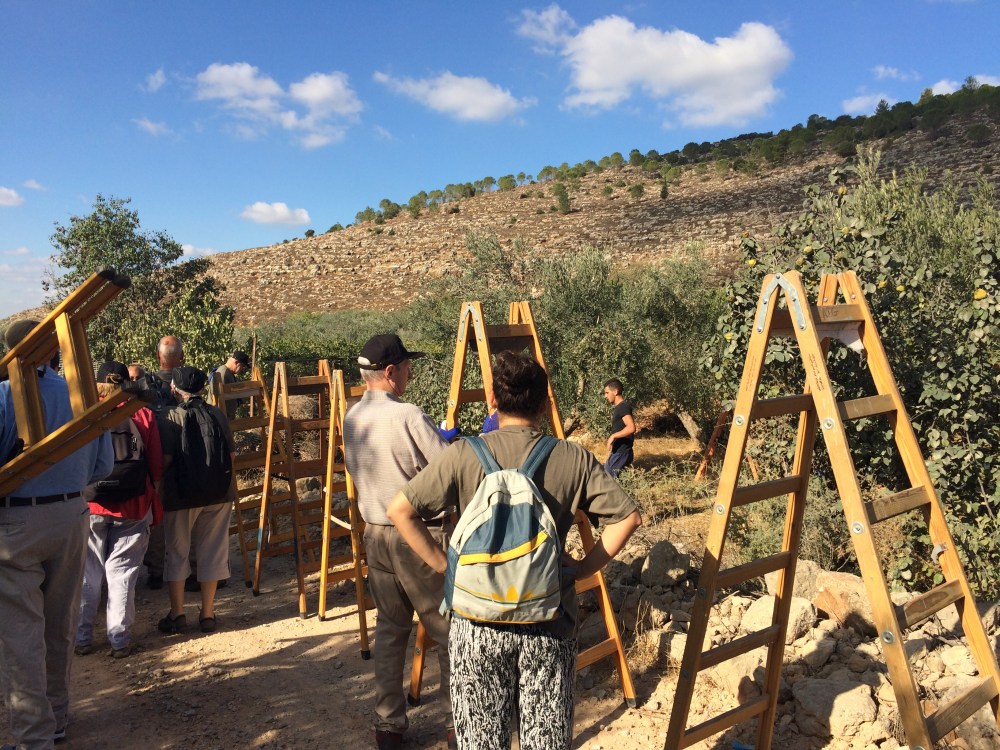
Olive picking is labor intensive and the harvest season is short. Having  a swarm of worker bees like us would be welcomed by anyone who owns a grove. Our assistance isn’t elicited, however, for the sheer labor force. Rather, the farmers we help are selected because of  particular hardships they face under occupation. Our first farm was situated in a valley between two illegal settlements, one of them very new and continuing to expand. It would be bad enough to have one settlement looming over your farm, watching Palestinian land being gobbled up. It is not uncommon for  extremist, gun toting settlers to harass their neighboring Palestinian neighbors. There have been many instances of ancient trees being cut down and burnt and new trees being uprooted in the dark  of the night in addition to more overt menacing and harassing behavior. And the Israeli police and military do nothing to protect  the Palestinians – the ones who are there legally! The presence of a swarm of internationals on the fields has proven to be very effective deterrent from settler harassment and interference.

IMG_1022
Carrying our gear into the field
IMG_1028
A happy picker
IMG_1031
Enjoying lunnh provided by the farmer on site
IMG_1032
The very grateful farmer and his wife


It’s the children, stupid!

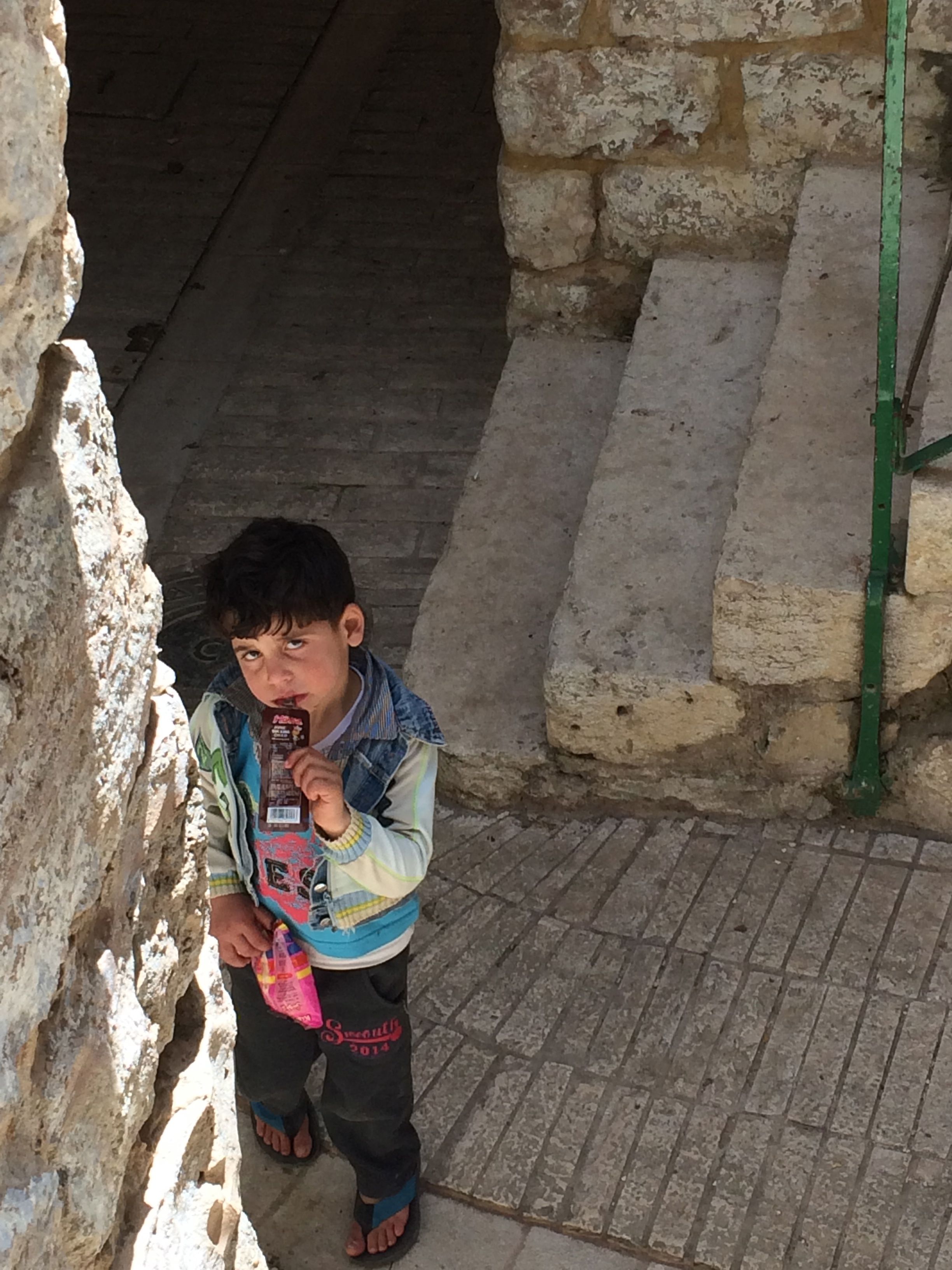
One of the things that impressed on me indelibly were the faces of the many, many Palestinian children I saw during my stay there. I am an amateur photographer who has a little bit of an eye for a good shot,but beyond that, no skill and I am also impeded by an intrinsic shyness that makes me ever aware that my pointing a camera might offend. In spite of my shortcomings, I managed to get a few shots of children who captivated me for a moment – albeit blurry and probably not well framed. My goal in posting this, however, is to underscore the beautiful resilience and optimism of the Palestinian people in the face of decades of oppression.  Oh yes, the Palestinians have a much higher birth rate than their occupiers, much to the consternation of the latter. I had a Jewish friend who argued that the conflict between Israel and the Palestinians would not be so entrenched if the Palestinians didn’t “breed like rabbits.” Her point was that the refugee camps stemming from those who were expelled from their homes and villages in the mid-1900s have only exacerbated the problem by continuing to reproduce. Oh, and that was punctuated by her contention that the neighboring Arab countries should have given them homes; never mind the fact that they did to the tune of refugee camps in Syria holding some 500,000 Palestinian refugees, roughly the same number in Lebanon and a whopping 2 million plus in Jordan. But, those naughty, naughty Palestinians kept just popping out babies. This idea has become entrenched in an alarming trend of racism in Israel.  An Israeli politician recently referred to Palestinian children as “little snakes” in a blood curdling diatribe.   http://www.thedailybeast.com/articles/2014/07/07/israeli-politician-declares-war-on-the-palestinian-people.html

Well, I’ve already posted some pictures of beautiful Palestinian baby bunnies. The grandnieces  of my dear friend Hiam in Aboud totally enamored me (see my post Everyone Has a Story), but every time I walked the streets and backroads of Hebron, Bethlehem and the surround, I saw so many more beautiful, bright, happy, optimistic children, and these are the lucky ones. My heart breaks thinking of the children of Gaza.  A 14 year old there has witnessed 3 major assaults, financed in large part by Uncle Sam,  and is now living in a desolate, bombed out area(beyond the imagination of any of us Americans), whose reconstruction is impeded by Israeli occupation, apartheid policies (all in the name of their own, 1st world, high living standard security of course). By the way, of the 2.3 million Gazans, approximately 43% are children.  Does it take a brain scientist to surmise that this relentless bombardment and devastation of Gaza is going to impact these young minds in a negative manner? Is it any wonder that terrorists are born of this sort of strategy?

God save the children. So many beautiful children who are just getting by in the West Bank and who are totally traumatized in Gaza.  God bless them and save them from futures of violence and retribution. I am afraid, however, that this will only come to pass if the world recognizes that Israel must be condemned for its callous disregard for their human rights and its misguided perception that it can gain security with sheer military might. Fortunately, much of the world has already done so, but the US is the last bastion of unilateral support of Israel, and carries the largest coffers. It really rests, therefore, on our shoulders as US citizens to say, “enough.” End the occupation, end the oppression – yes, Israel we have your backs, but only if you do as South Africa did and embrace truth and reconciliation over the decades of wrongs you have done to the Palestinians.

IMG_1144IMG_0836

Both of these are shots from the walk up the hill to my apartment. I loved this little street. It was very much in the city, but had the lovely country landscape where children were free to roam and play freely, sort of like kids did when I was a kid.

IMG_1153

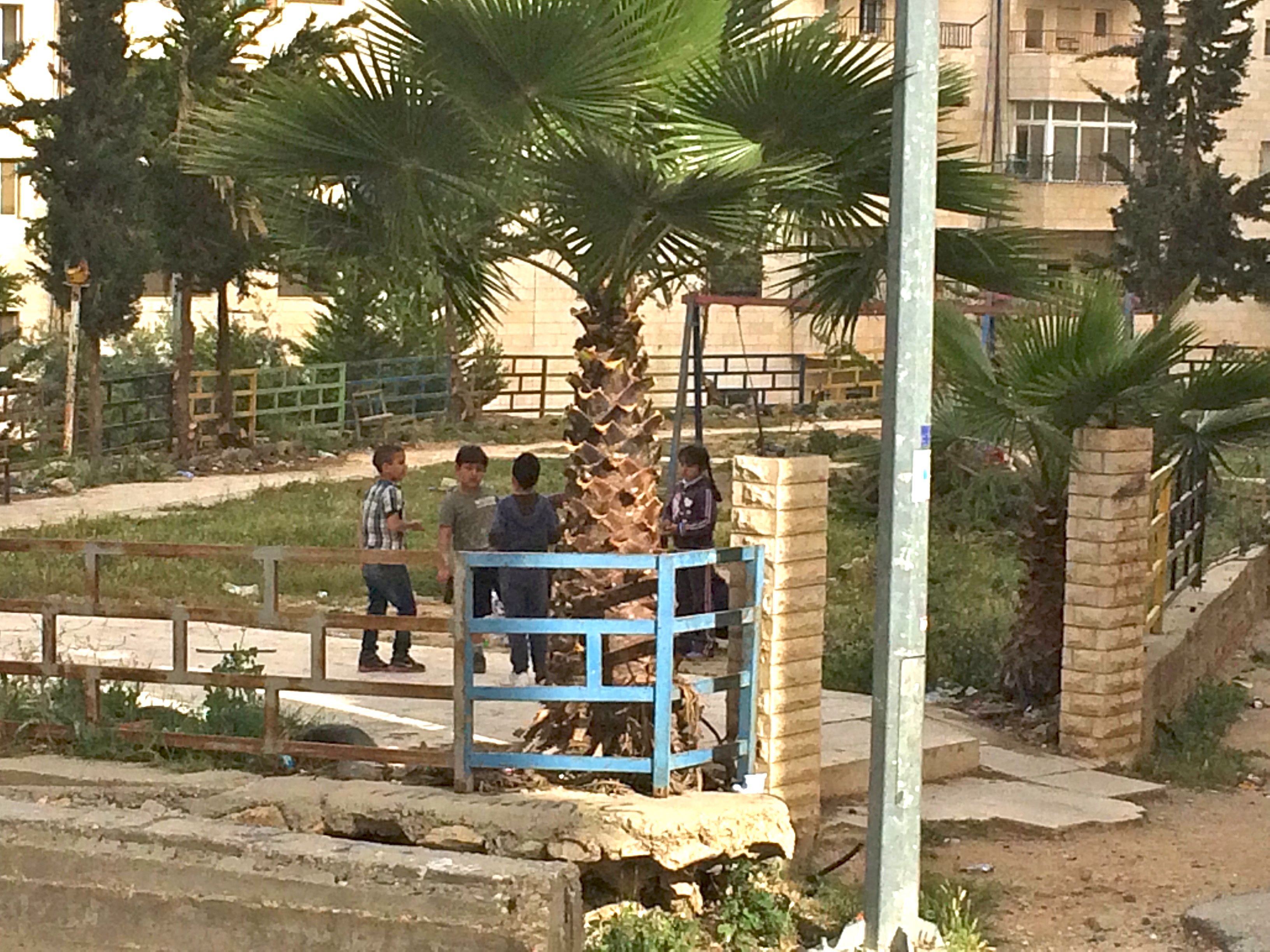
This was the little playground in the center of the apartment complex where I lived in Bethlehem.

IMG_1110

This beautiful little child was sitting in the seat in front of me on my bus ride into Jerusalem.

IMG_1060IMG_0861

Children in the old city of Hebron near the Hebron Rehabilitation Committee where I worked.

IMG_1066IMG_1067

Although there was always some trepidation in the eyes of these children who already faced many abuses at the hands of the radical Jewish settlers and soldiers protecting them, once they knew you were friendly, they were usually all smiles.

IMG_1094

This was at the excavation site near the home of Feryal Abu Haikal whom I wrote about in an earlier post whose home and family land is under threat of confiscation under the ruse of an archaelogical dig and upcoming Jewish biblical theme park.

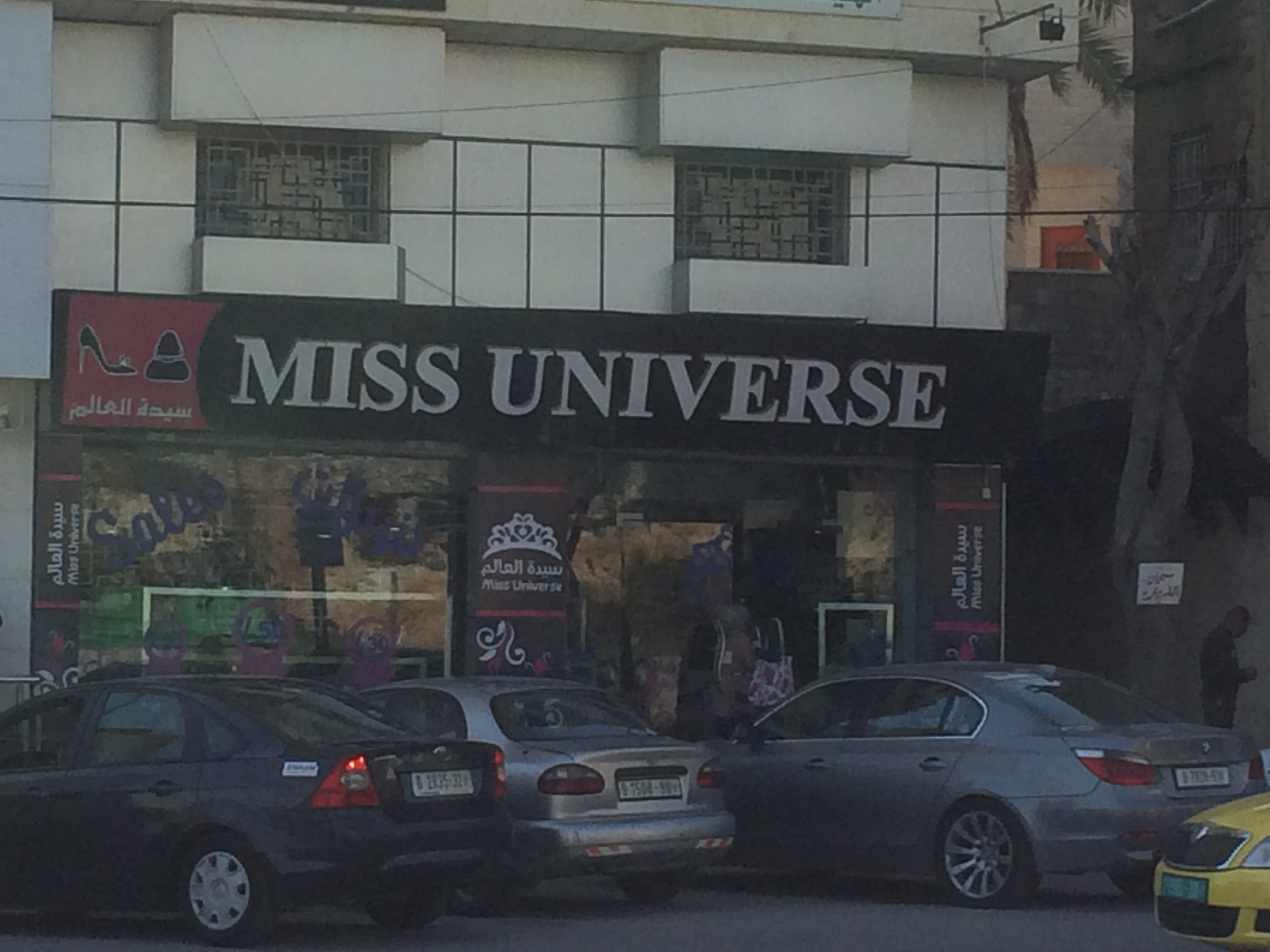
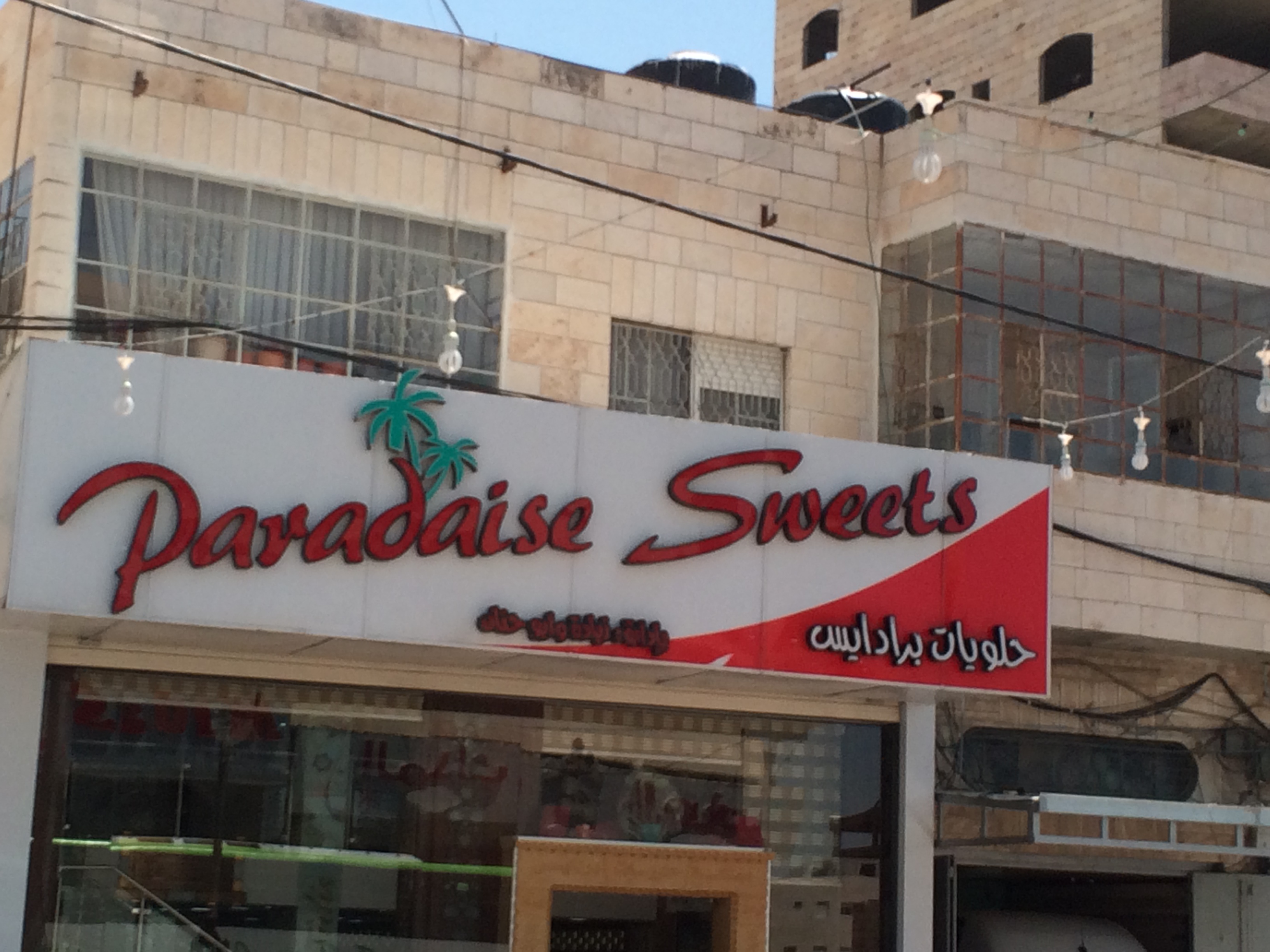
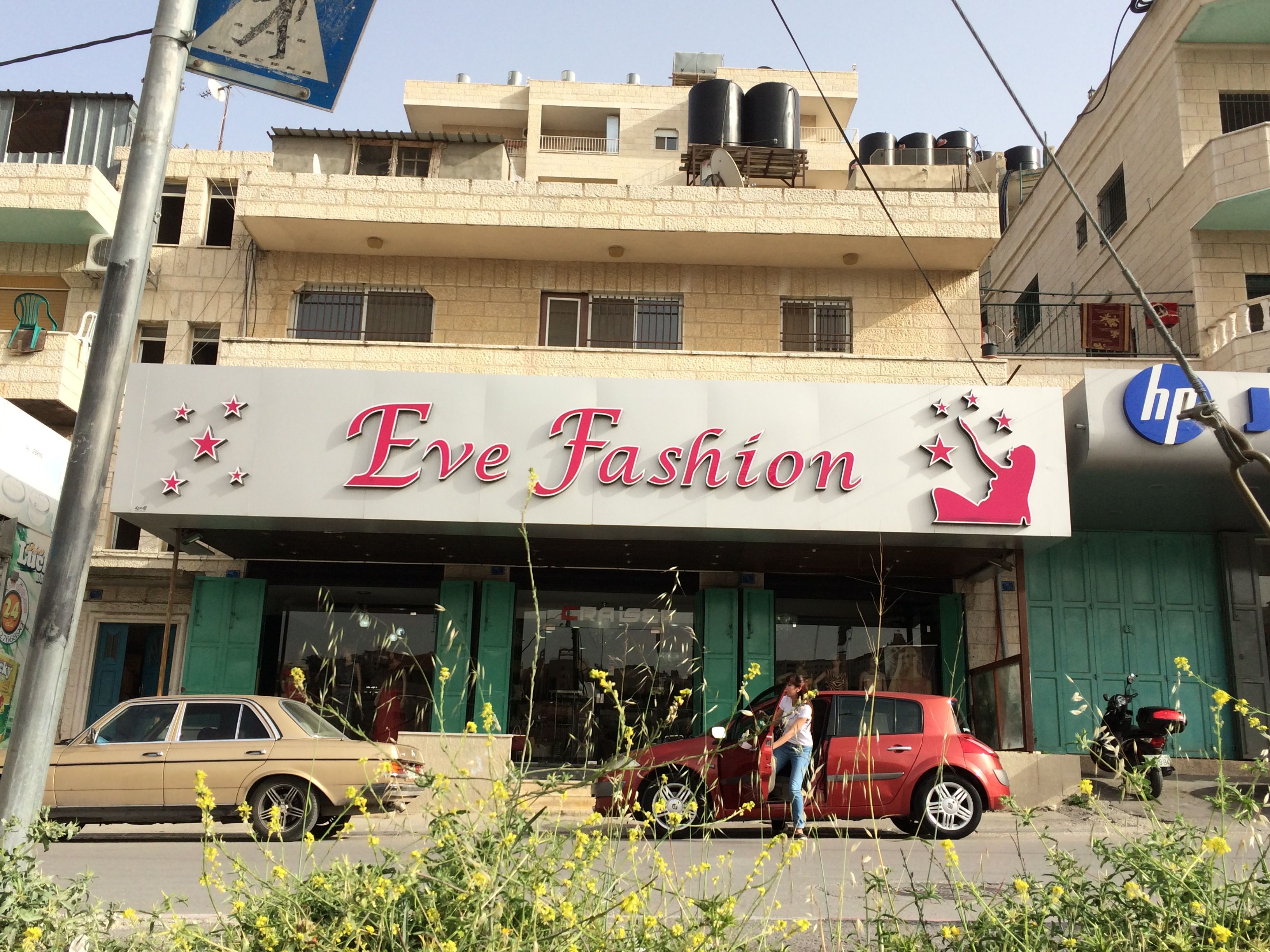
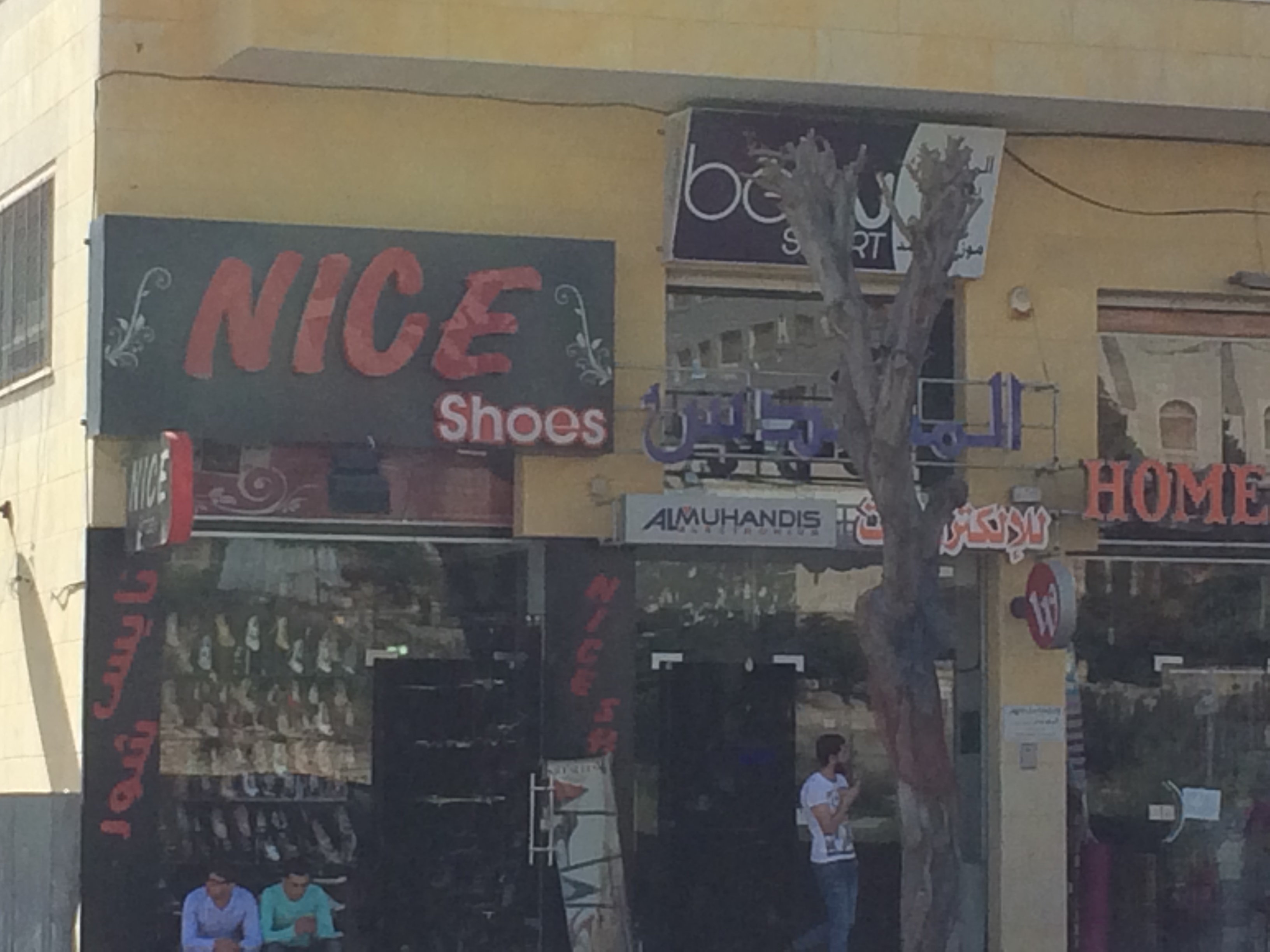
Commercial English Twists and Malaprops

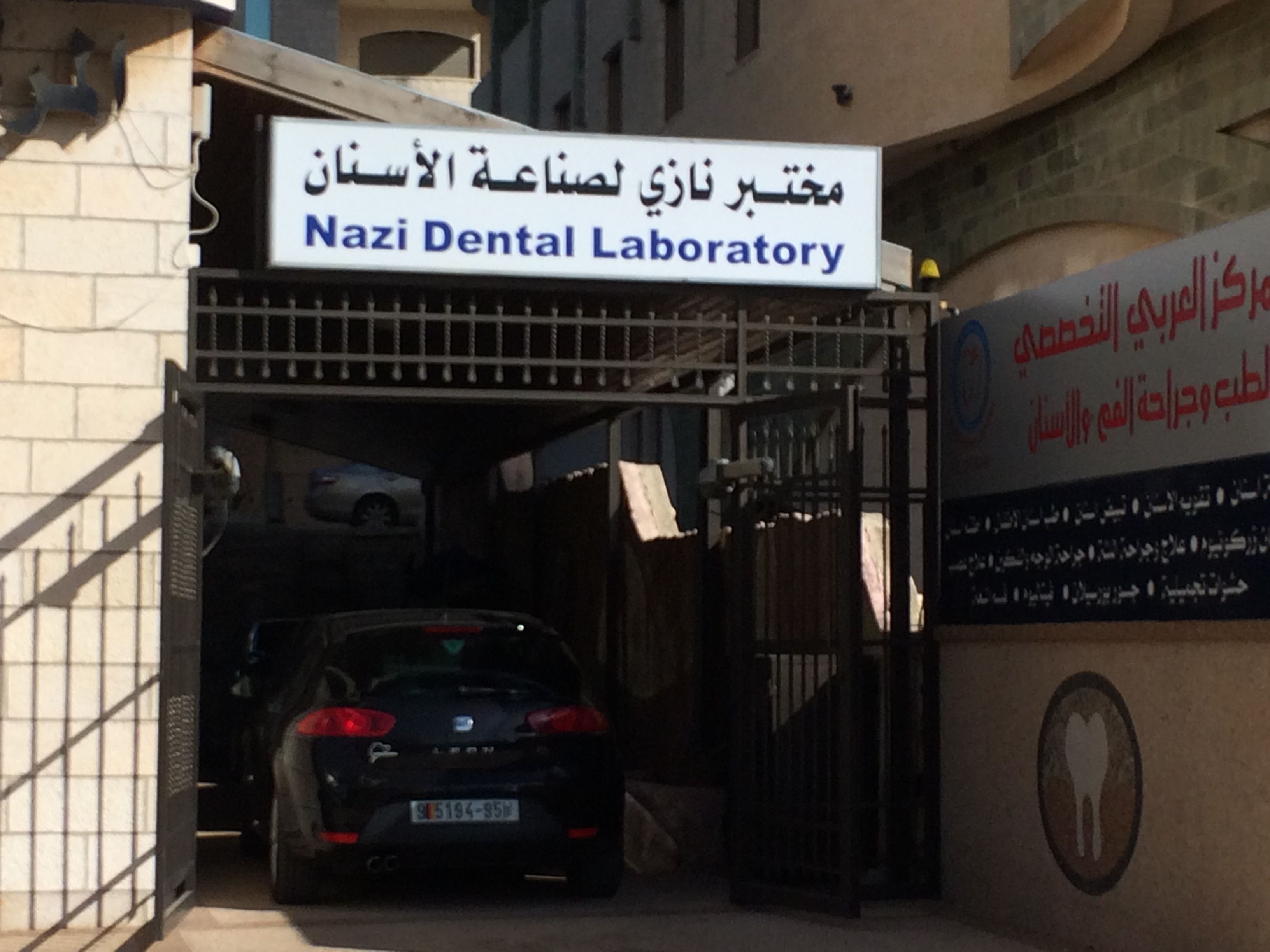
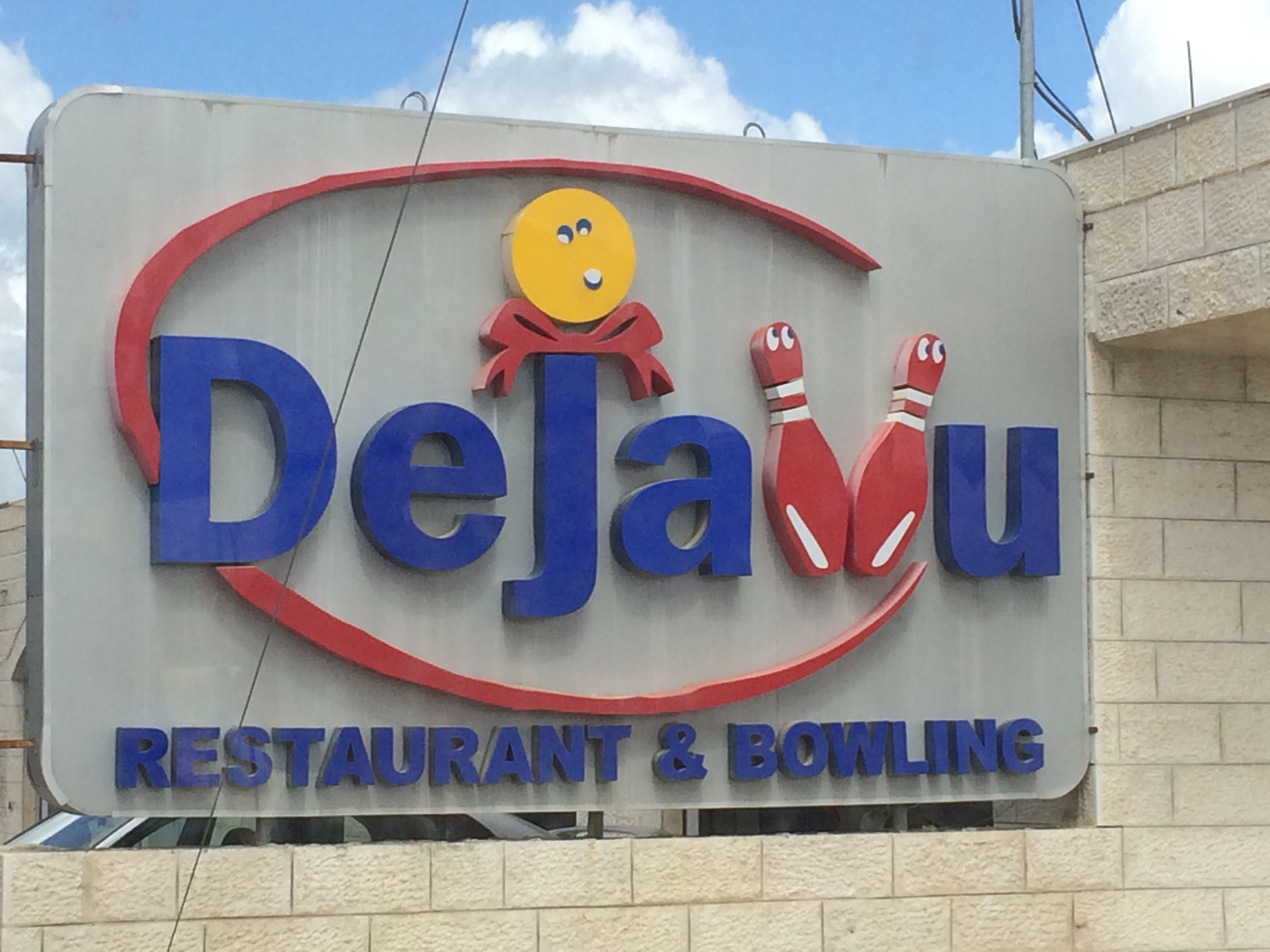
It’s always amusing to see how English is used in commerce in non-English speaking countries. This is just a fun collection of some of the signs that  caught my attention in the West Bank. I missed some really good ones on my rides to and fro Hebron and Bethlehem as the Service was faster than my camera. And in the interest of fairness, when I traveled in Taiwan, I could have compiled an equally absurd collection had I thought of it at the time – all in good fun.

IMG_1448IMG_1441

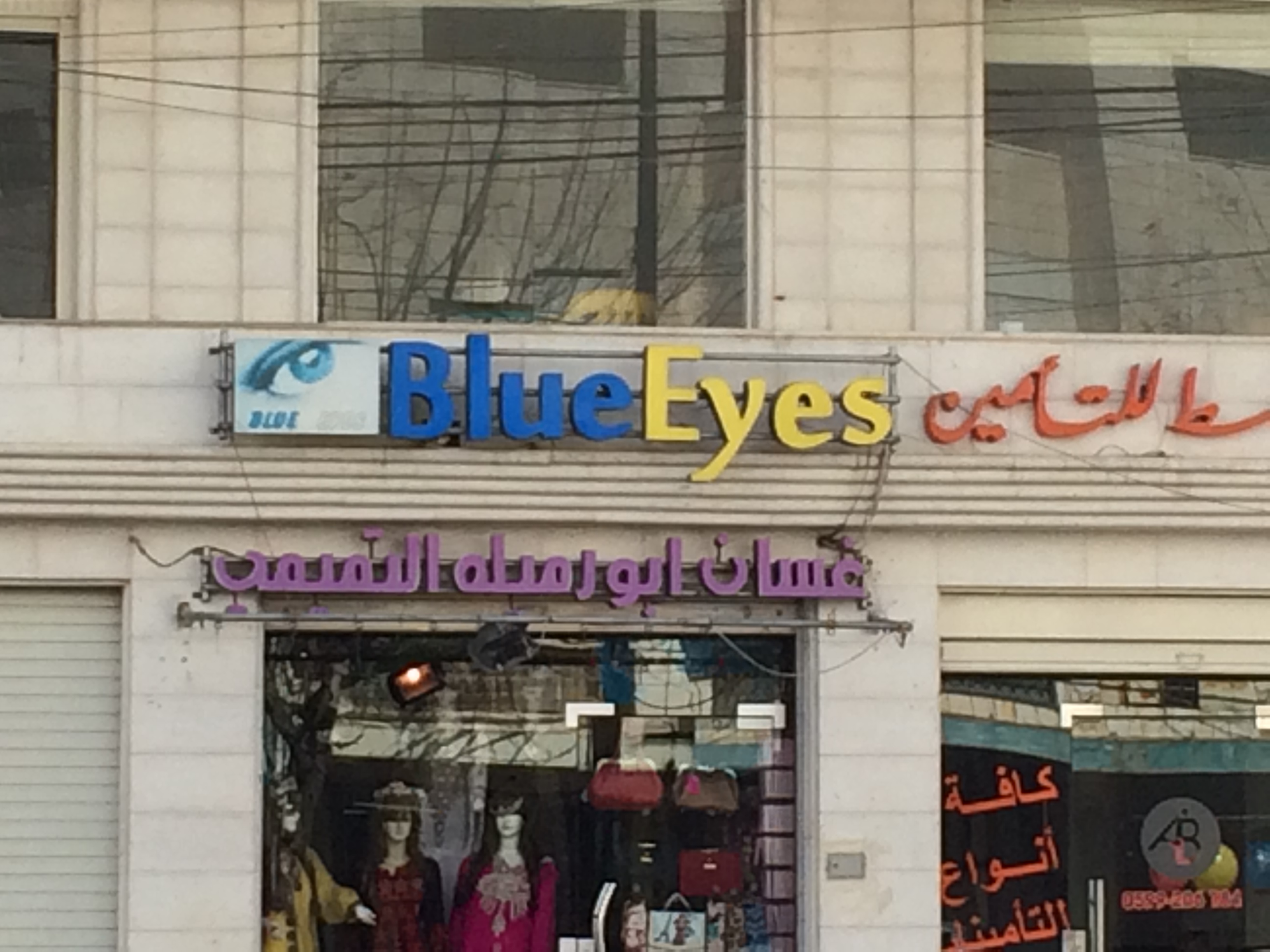
Coming from our American culture of political correctness, I found these two fashion-oriented store names in a society where dark complexions and coal brown eyes are the norm kind of amusing.

IMG_1445IMG_1186

You can aspire for the crown, or you can – well, never mind.

IMG_1399IMG_1134

Well, we *are* in the Holy Land

IMG_1449

Not exactly the big box version. I’m not sure what they were targeting here.

IMG_1187IMG_1443

You’ve got your shoes for boogying and then you’ve got the respectable ones

IMG_1446IMG_1404

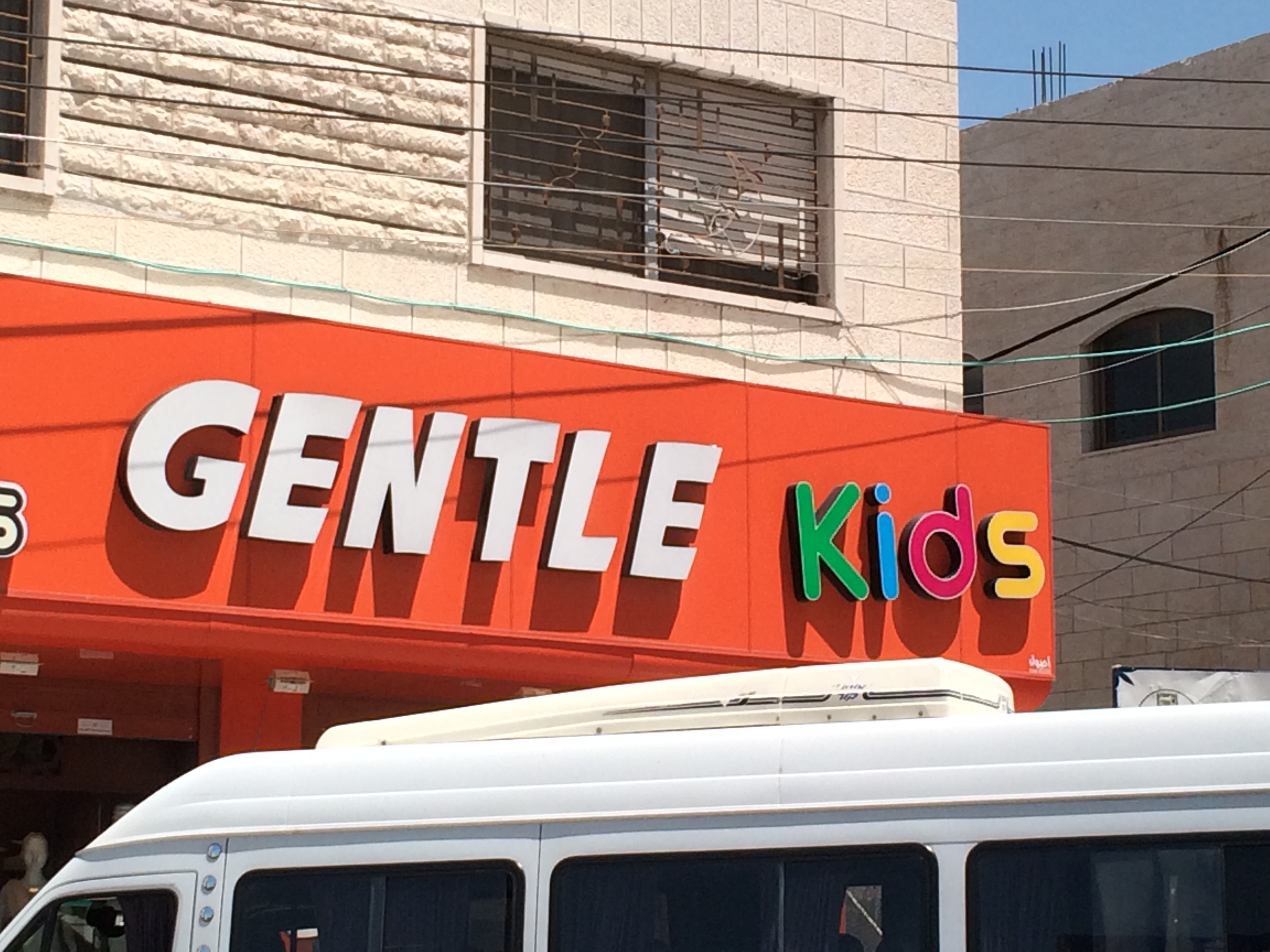
If four kids get a little too rambunctious, you can always go over to Gentle Kids

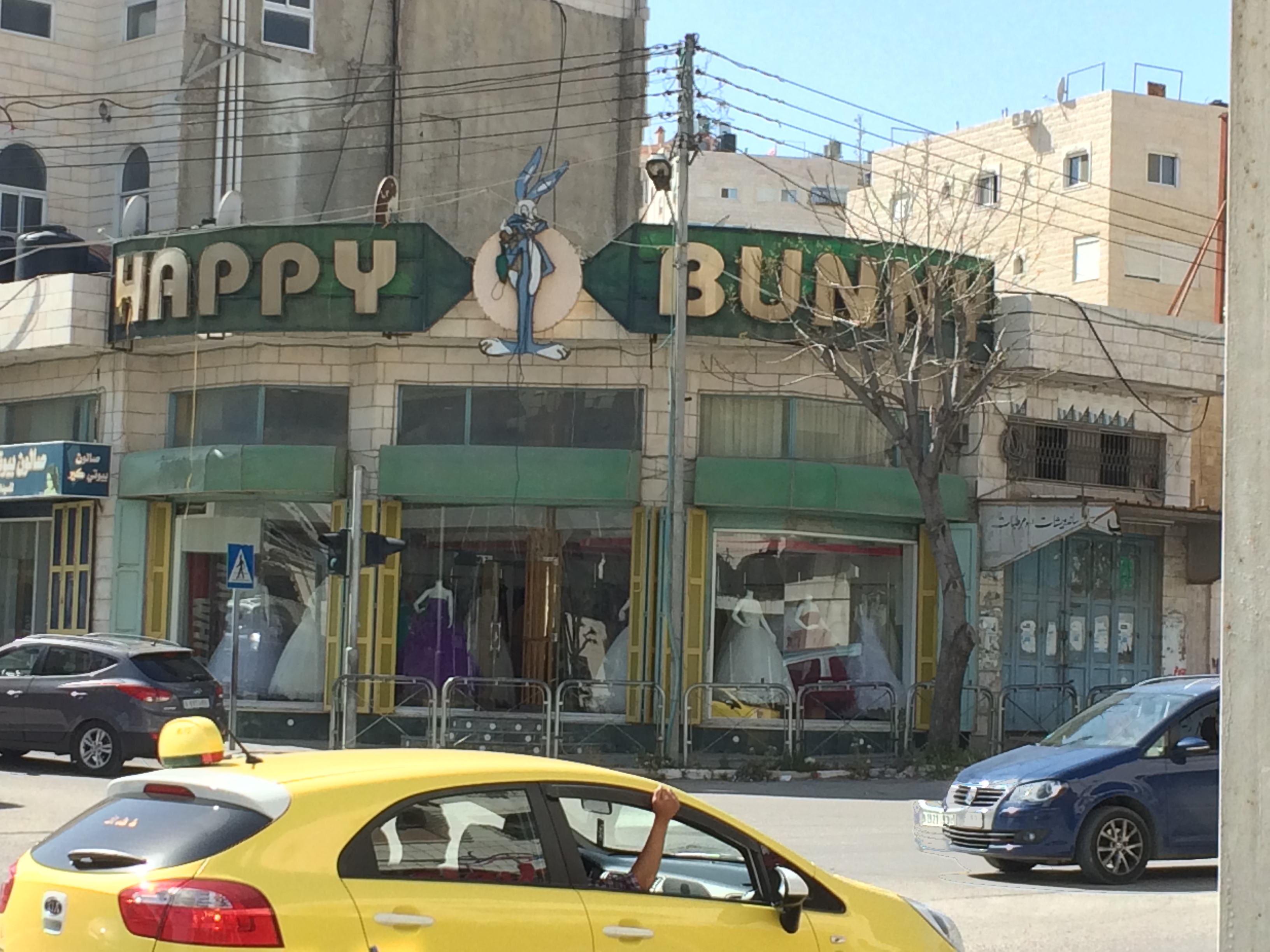
IMG_1401

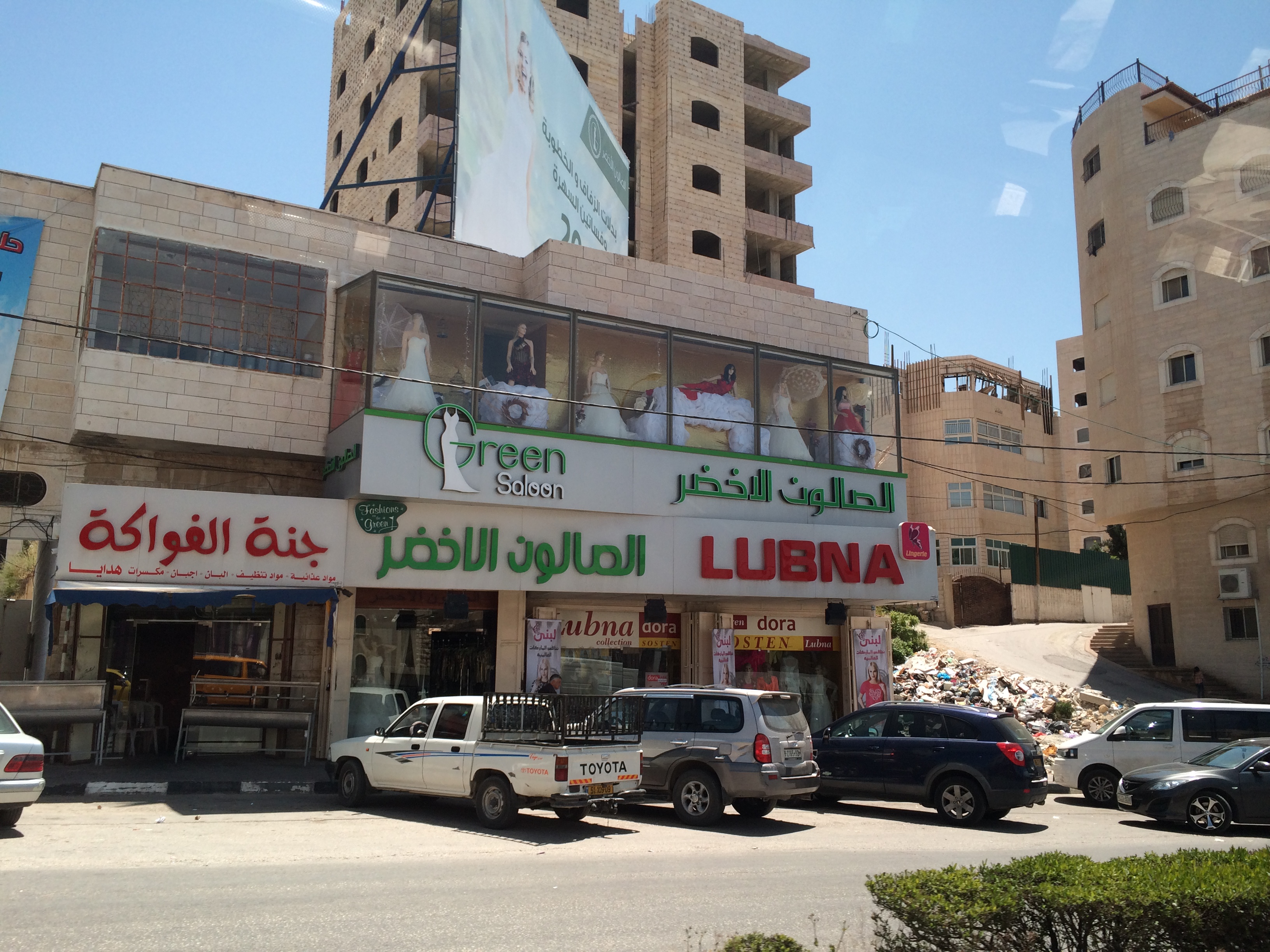
I’m not sure what this green saloon was selling. It looked like wedding dresses, but maybe that was a front.

IMG_1267

Every time I come here, I feel like I’ve been here before.

IMG_1405

Why stop with one turkey when you can have two

IMG_0888IMG_1116

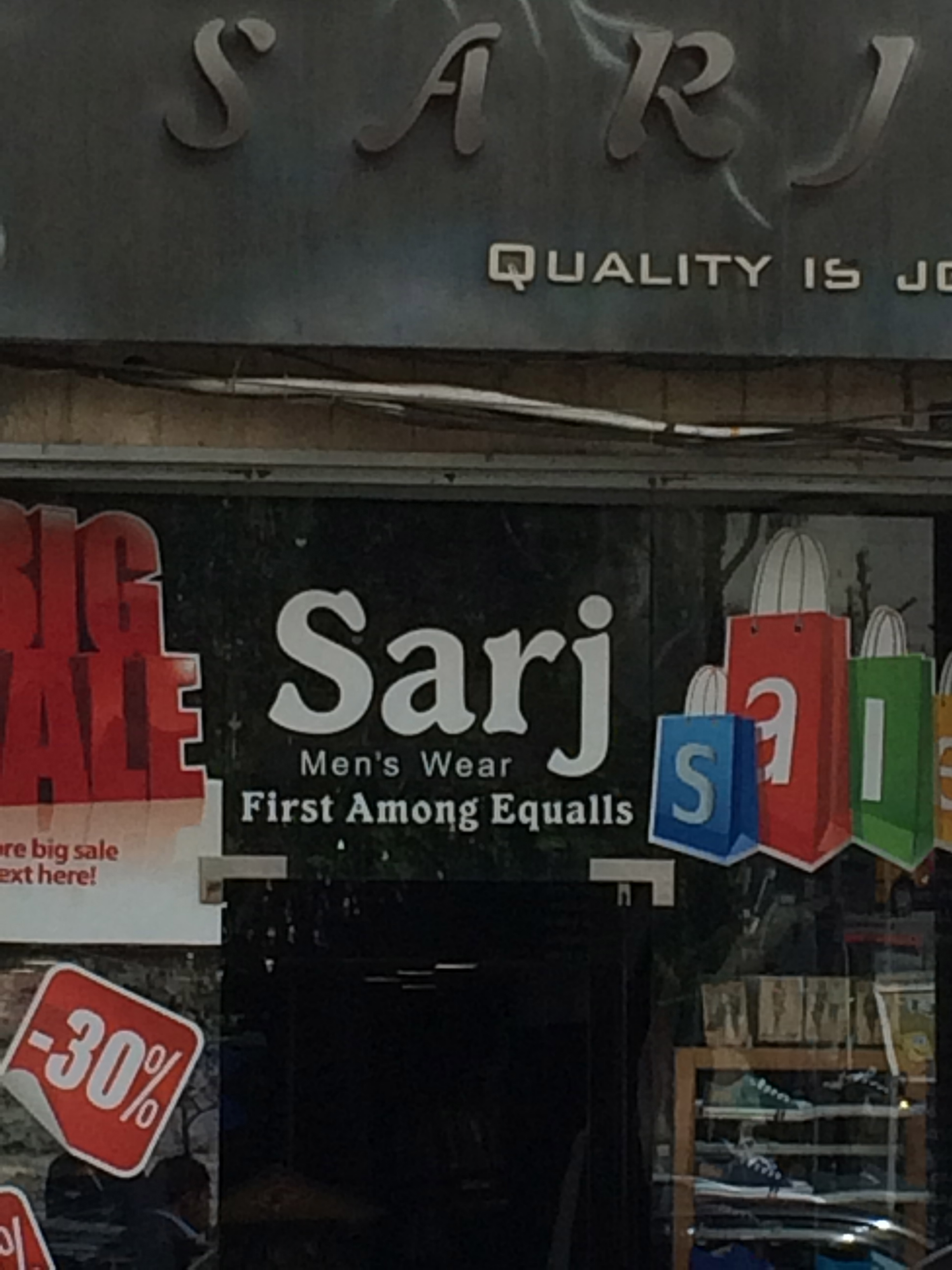
We don’t want to leave out the men.

IMG_0893

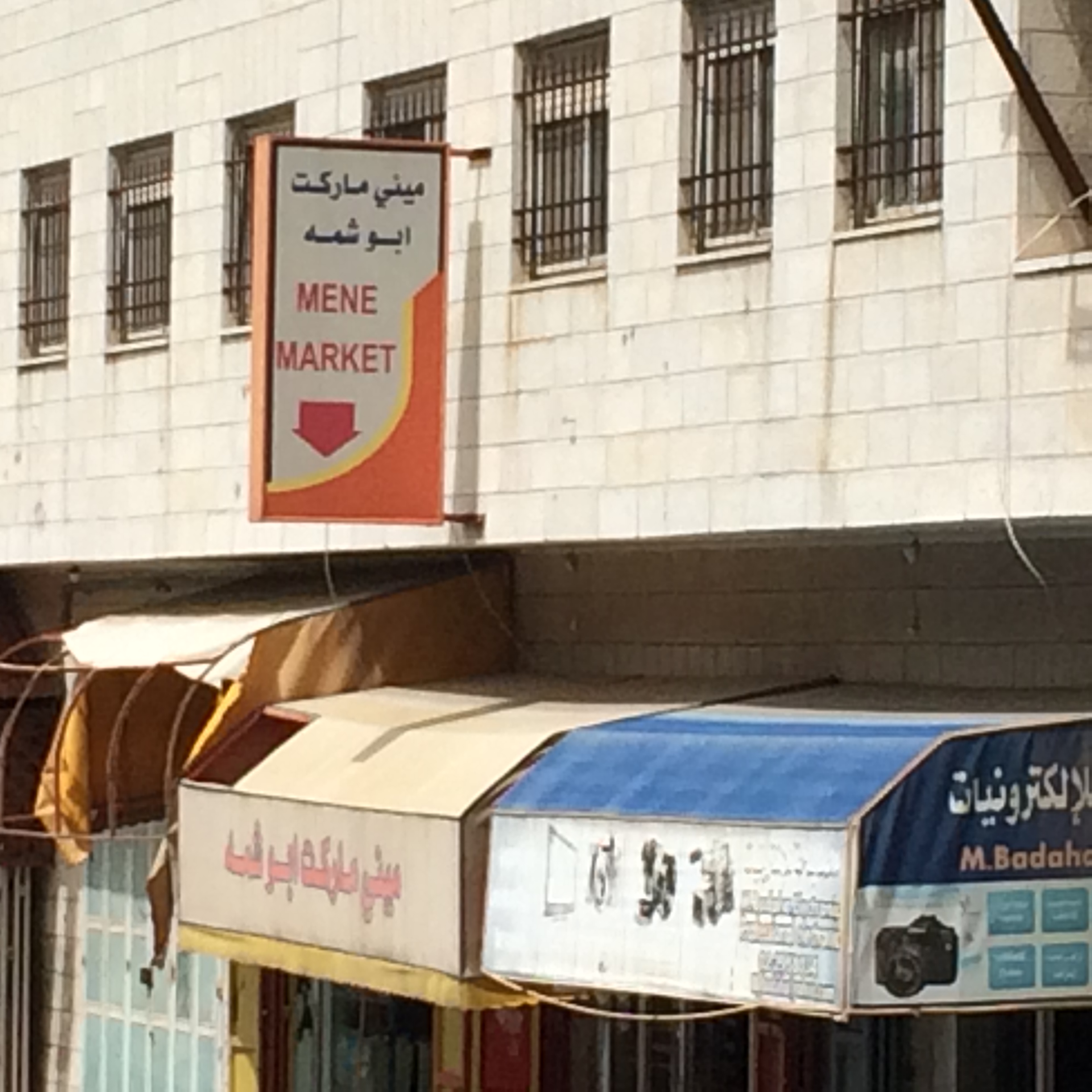
Meanie Market, Mini market, Mine Market ?

IMG_1438

This was one of my favorites. How can that not make you smile?

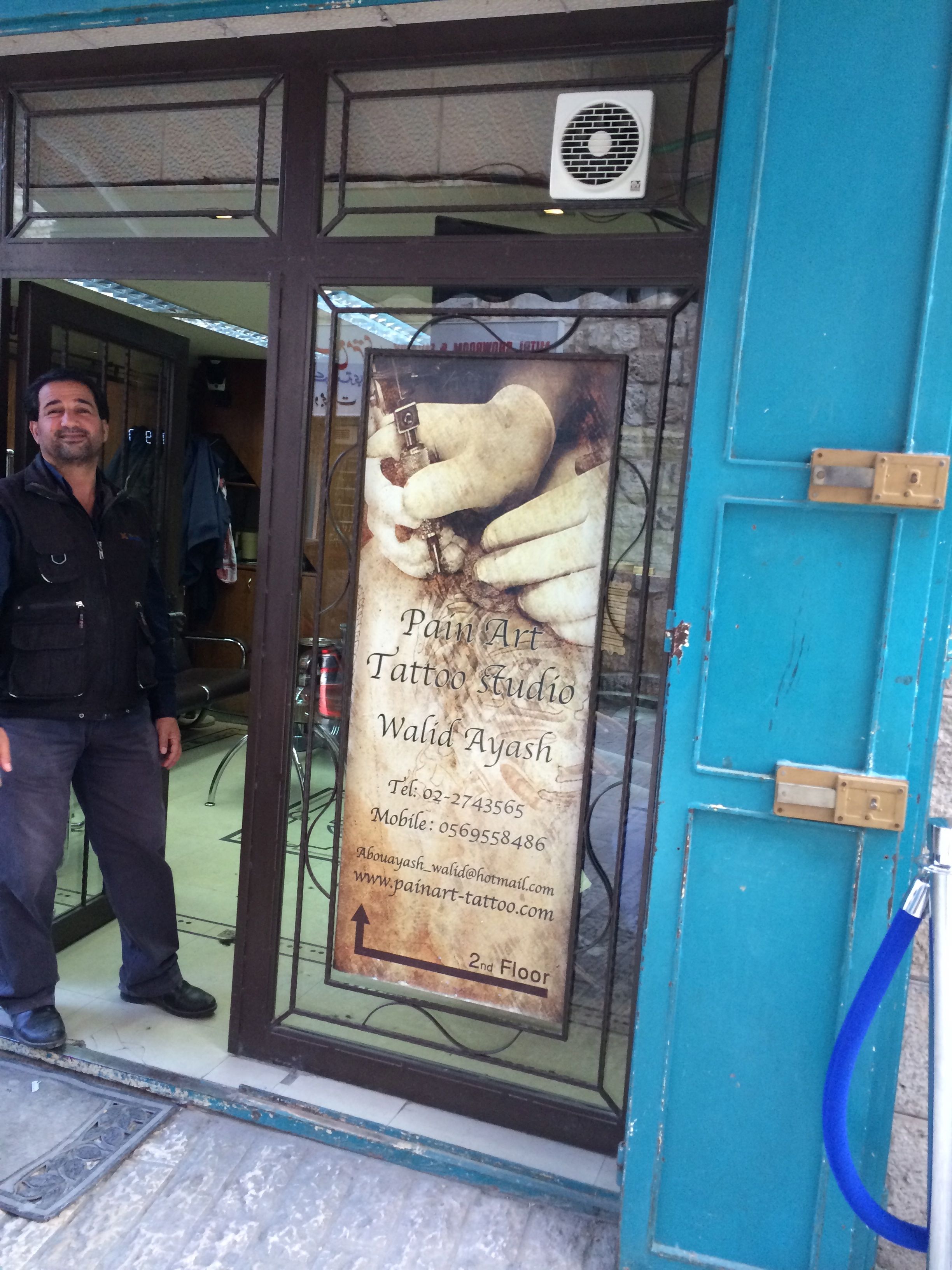
IMG_0874

This is one of the most aptly named tattoo parlors I’ve ever seen. If you’re straining to read it, yes it does say, “Pain Art.”

IMG_1156

And my all time favorite. No one would ever believe me if I hadn’t posted a photo.

HIKES AND KINDRED SPIRITS

I need to dedicate a couple posts to some of the other lovely people I chanced to meet during my month in the West Bank. Hijazi is a Palestinian guide whose specialty is walking tours of the West Bank. My group last year had done a day trip with Hijazi, but he often takes groups on tours of a week or more, with overnights in a variety of places, including hotels, Palestinian families and in Bedouin camps. He lives with his family in a village near Bethlehem, but he keeps an apartment in Bethlehem to accommodate guests. This was the apartment I rented for my month in Bethlehem. As my previous posts have indicated, I did a tremendous amount of walking in Bethlehem and Hebron, often getting lost in the process, but always discovering new and interesting things. Walking really can’t be beat when it comes to becoming intimately familiar with a place. If you should have the good fortune of travel to the West Bank, and if you want to experience the beauty and serenity of some of its most beautiful, natural spots (or the history of the cities and villages for that matter), I couldn’t imagine a better guide. https://hijazih.wordpress.com/ He will be able to take you and give you all the information you need and to make sure you are well fed and housed along the way. Part of the deal in my renting the apartment was that there would be a few nights in which I would be sharing it with some of Hijazi’s guests which turned out to be an added perk for me.

The first group came from Grenoble France. Pascale, Marie, Pierre and Joel were returnees to the West Bank and big proponents of Palestinian rights. They had not only toured previously with Hijazi, but he had spent some time visiting them in France. They were such good sports, struggling with English to accommodate my complete lack of French. They were there for a couple of evenings, and I felt a little lonely when they left. We exchanged contact info and I chalked it up to one of those “hope our paths will cross again” encounters. Well, our paths crossed again much sooner than any of us expected.

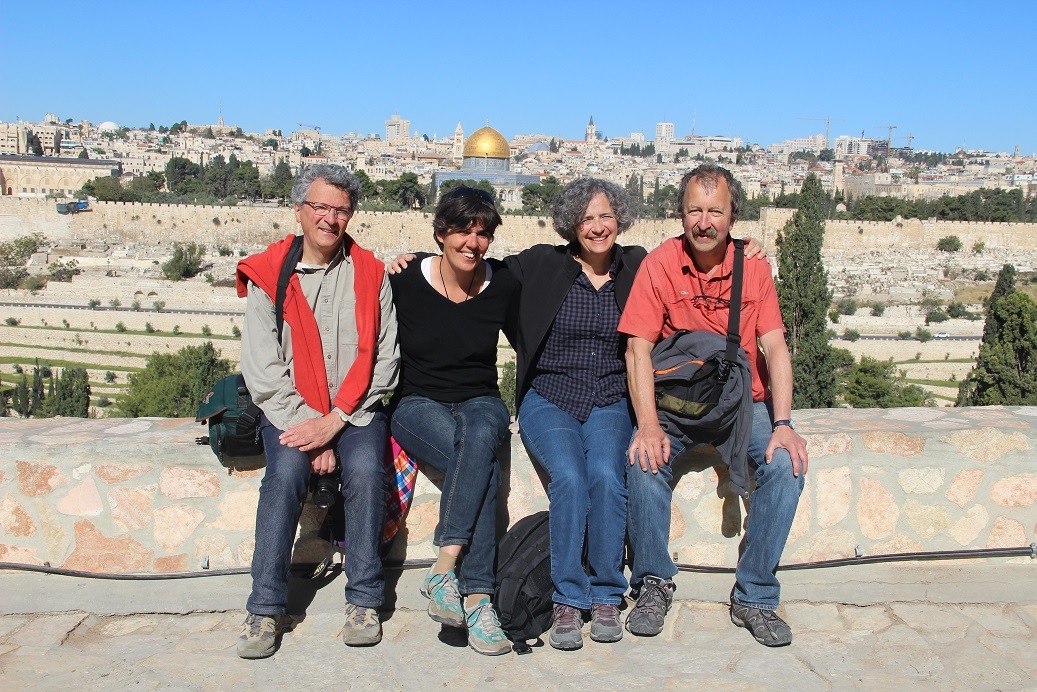
When I was in Jerusalem on my last Saturday before going home to meet with the lawyer from Diakonia, I spent some time after the meeting getting lunch and then wandering around East Jerusalem to enjoy the sights. I had written earlier about finding some quietude in Lutheran Church of the Redeemer. After I left and was trying to orient myself toward the bus station, I was walking past an outdoor café and out of the corner of my eye, I saw a person I recognized. On second glance, to my complete surprise and delight, I realized it was Pascale. They had left the apartment in Bethlehem a couple of nights earlier, and here they were sitting in Jerusalem, the day before departing back home to France. We all had a huge laugh over the complete coincidence of my running into them so randomly. Somehow, I failed to snap a picture of them, but Marie shared this with me.

Image

The second set of guests was a group from Wales and England, Janet, Paul and Monica.

IMG_1518

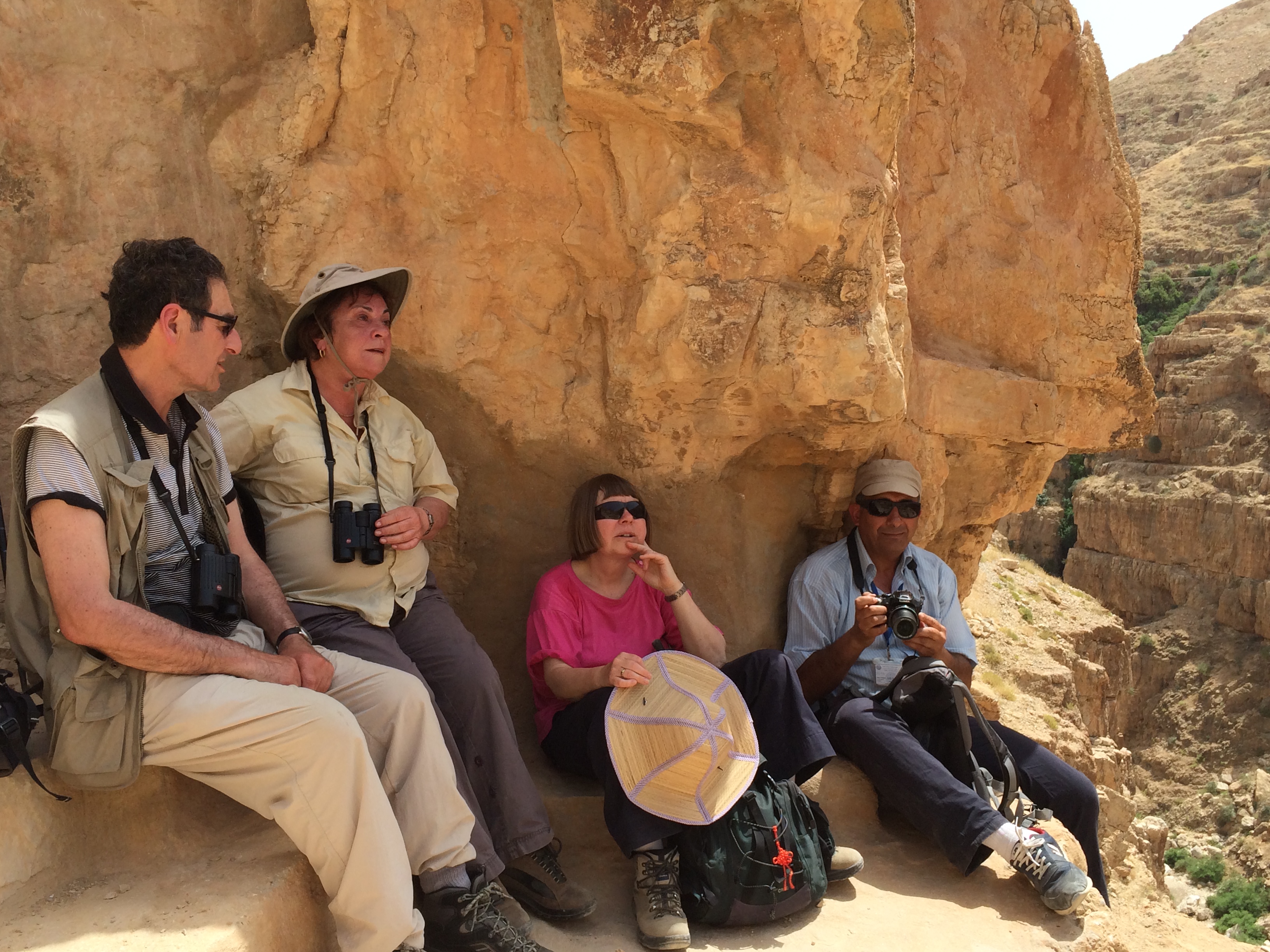
They only spent one night at the apartment, but we had a fun time scouting town for beer and good eats (a break from my routinely uninspired cooking for one) on the evening of their stay and I got to tag along with them the next day for a hike to Wadi Qelt and for a float in the Dead Sea. The extra perk here was that Paul is the most accomplished birder I have ever met apart from my brother-in-law, Dan Peak. I have a sneaking suspicious their paths will cross one day. Although I was inited to tag along on a couple of hikes, this was the only one I managed because I was so busy with work in Hebron.

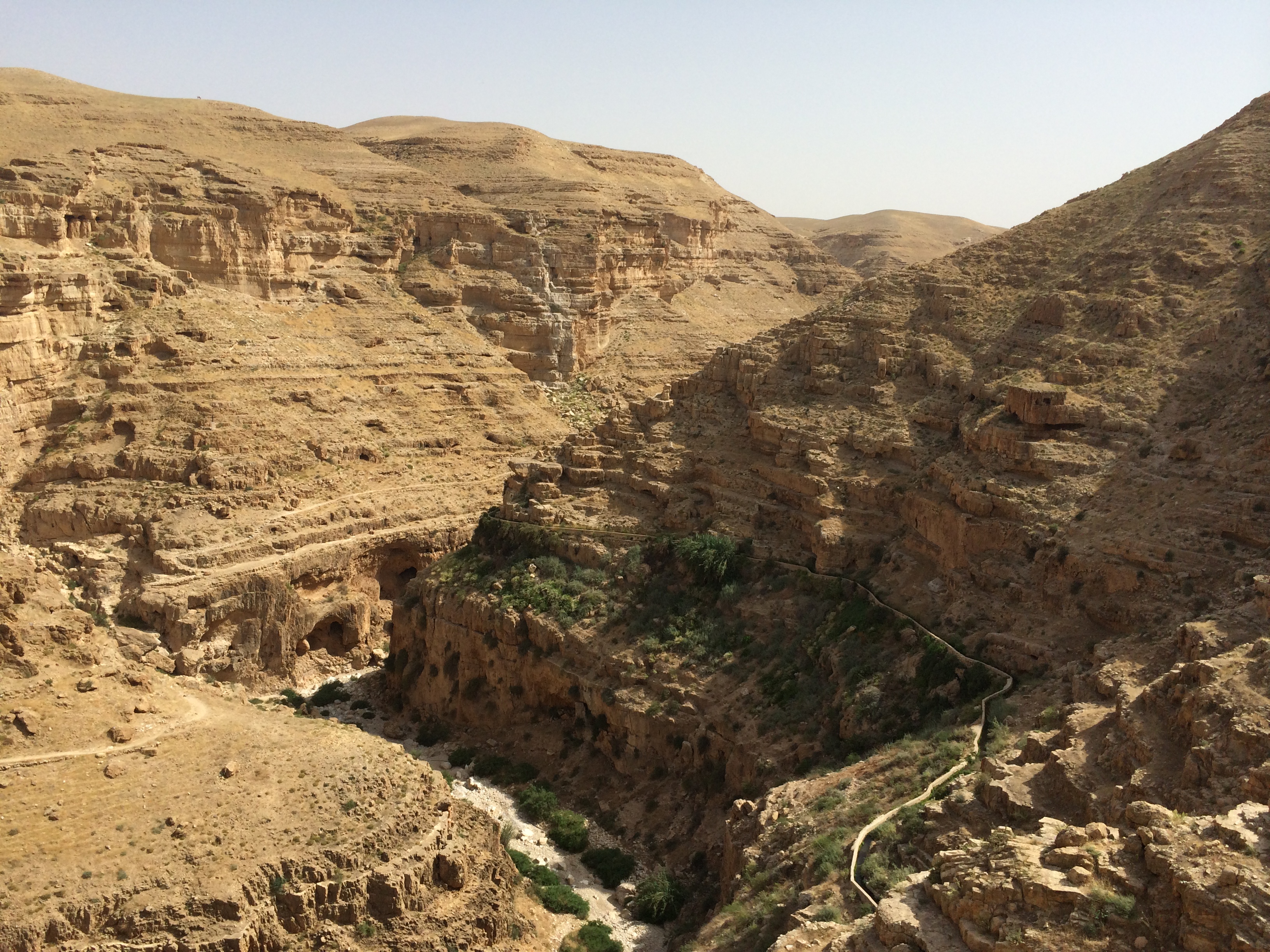
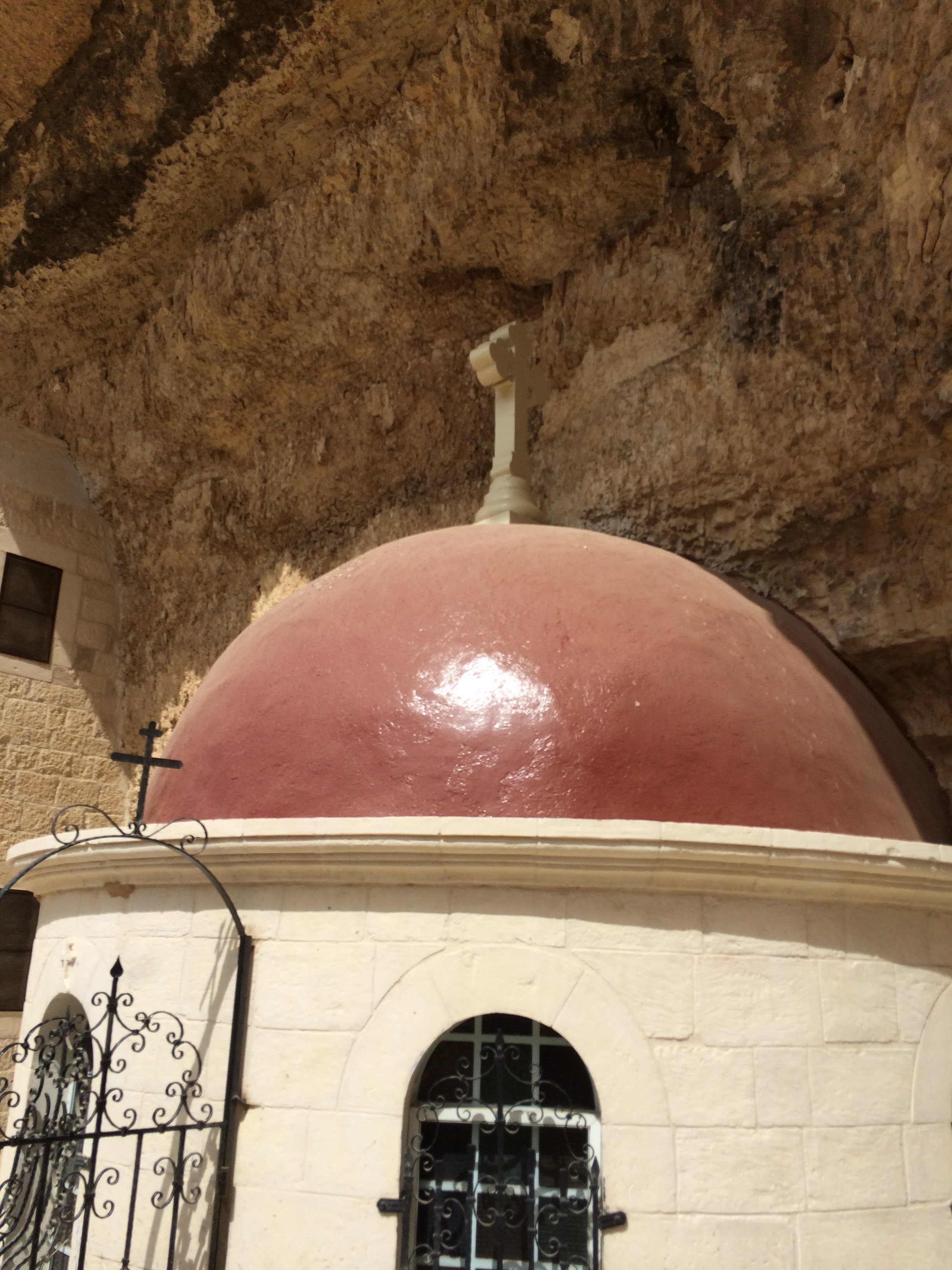
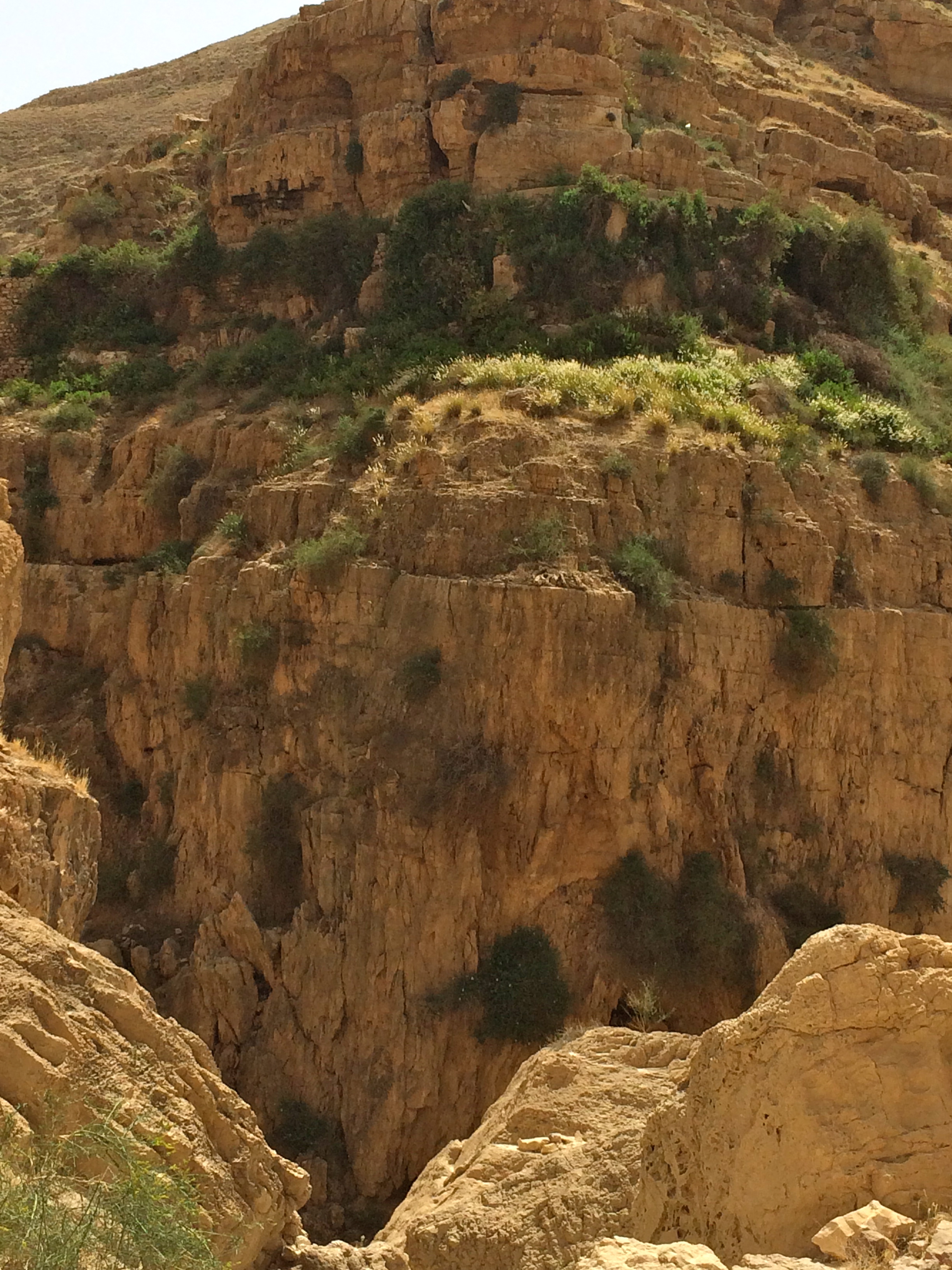
Wadi Qelt (Wadi means valley which is an understatement here as it is an enormously, deep gorge) is itself a worthy destination for a hike in its magnificent natural beauty. But, it is also the location of the St. George’s Monastery nestled into the cliffs about halfway down the gorge.

IMG_1456IMG_1463

Approaching the monastery.

IMG_1465IMG_1504

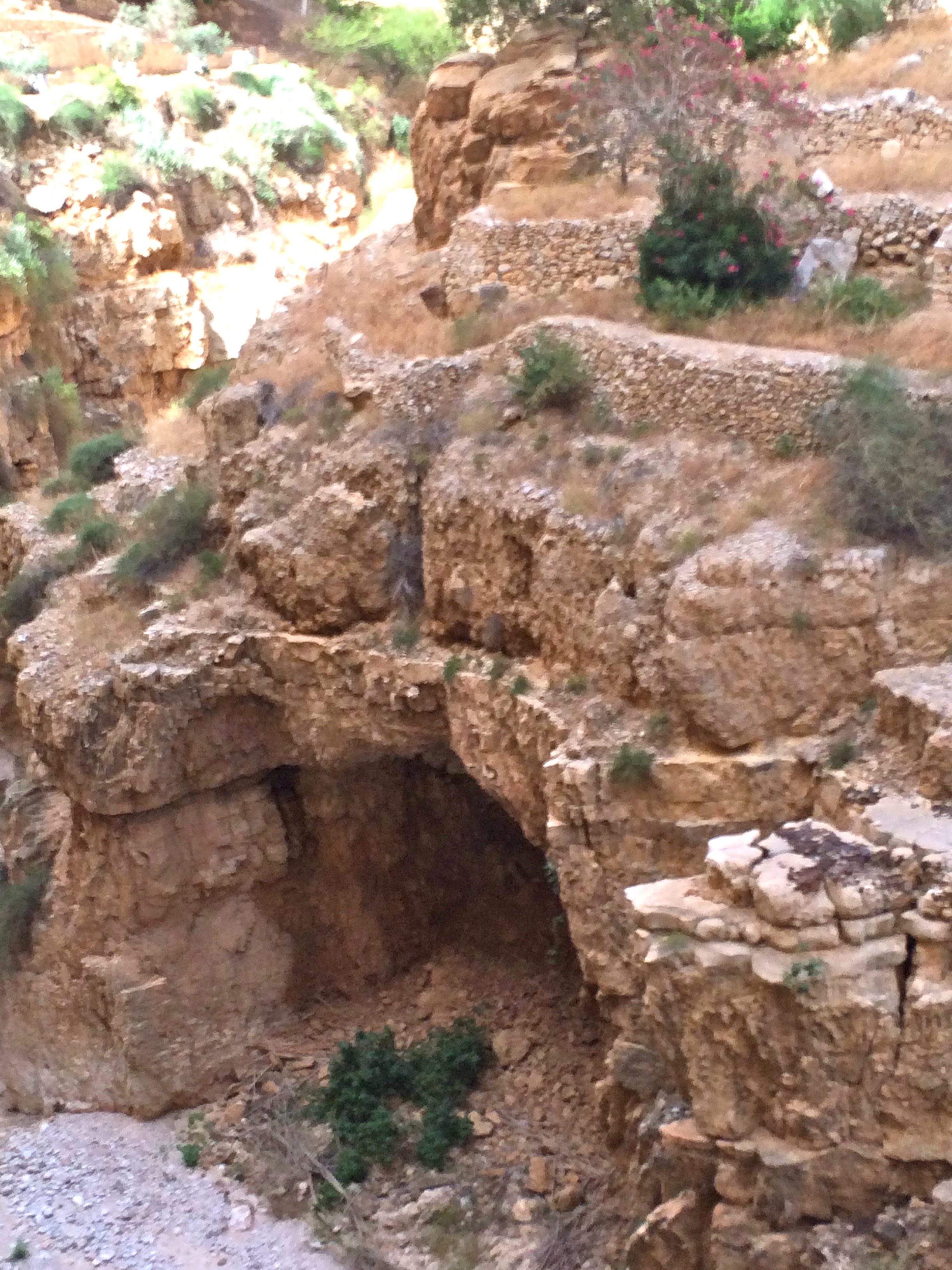
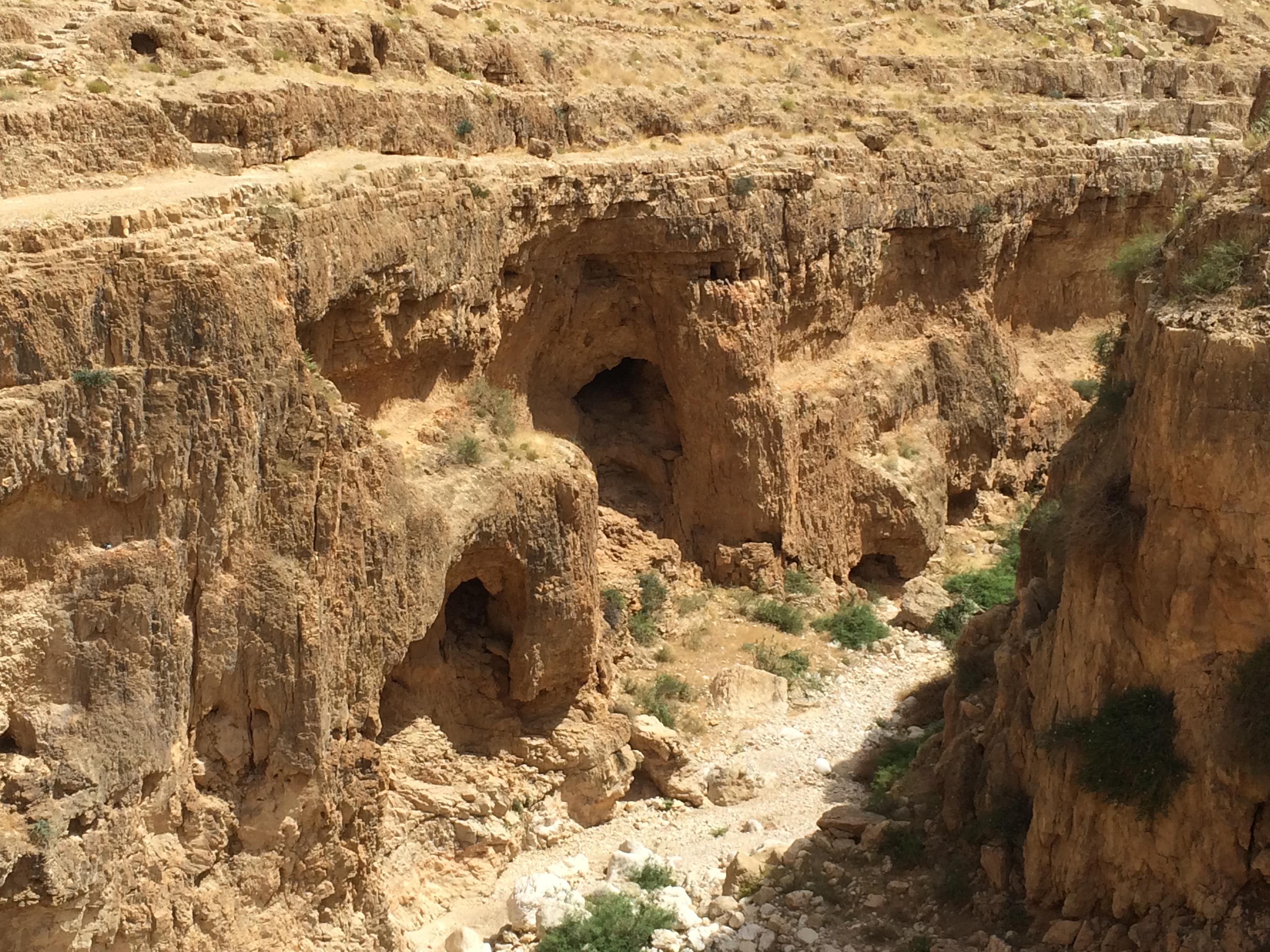
A cave down in the gorge. This area is full of caves and they were inhabited by monks through the centuries who were hiding from their persecutors.


IMG_1468

IMG_1474 IMG_1470

These two pictures are looking down on the easy approach to the monastery that starts from a parking lot.  The ant-like size of the people gives perspective of how deep the gorge is.

IMG_1475IMG_1477

A couple views of the monastery from on the premises.

IMG_1493

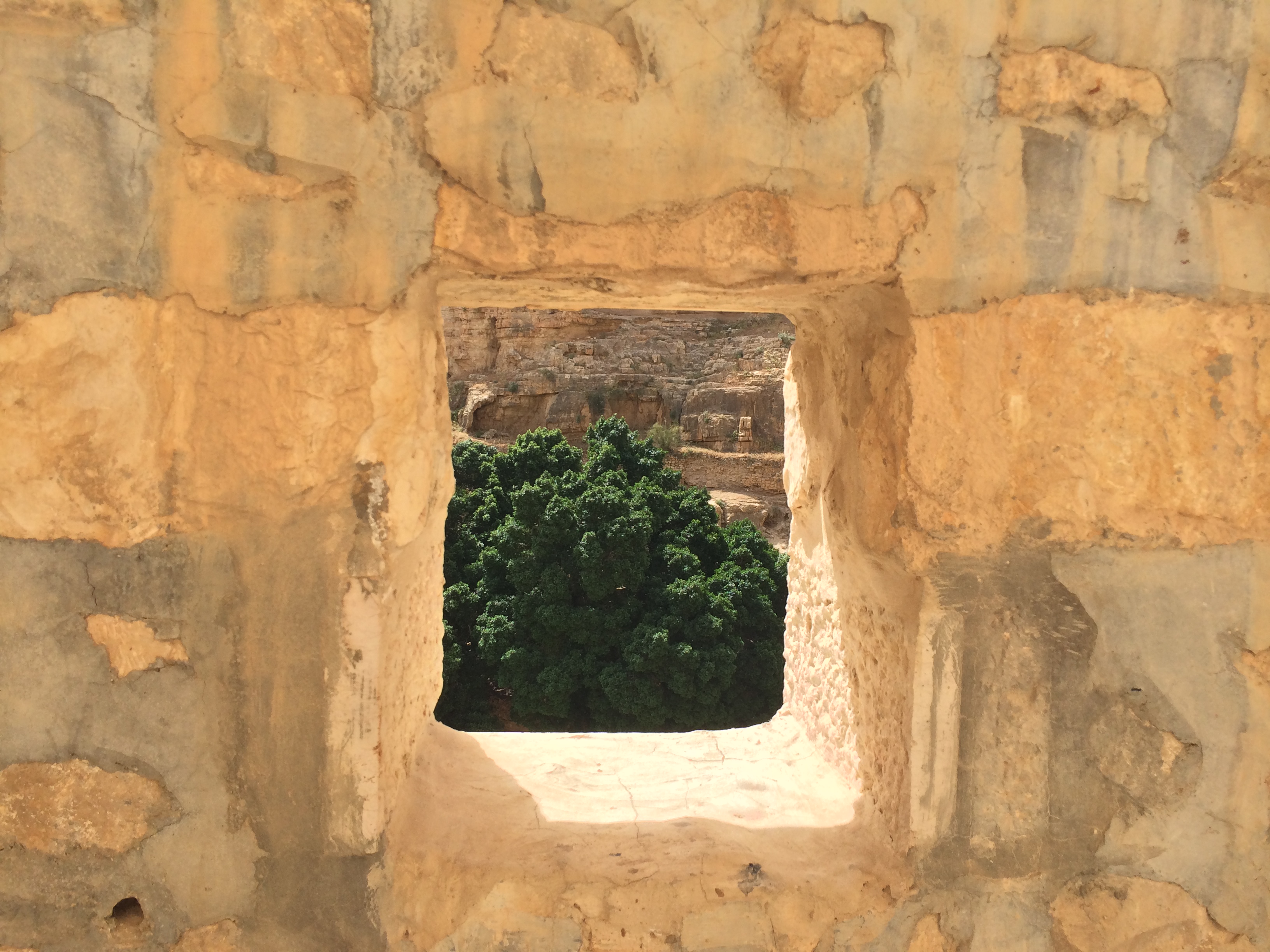
Looking out a window from inside the monastery

IMG_1494IMG_1496

We had to crawl through this little door to get into the monastery. As we were leaving, this group was trying to get in.  They did give us berth to leave. Good thing, because it was quite a huge group.

IMG_1502 IMG_1503
IMG_1497IMG_1519

Beautiful views along the way as we were walking toward Jericho

IMG_1521IMG_1528

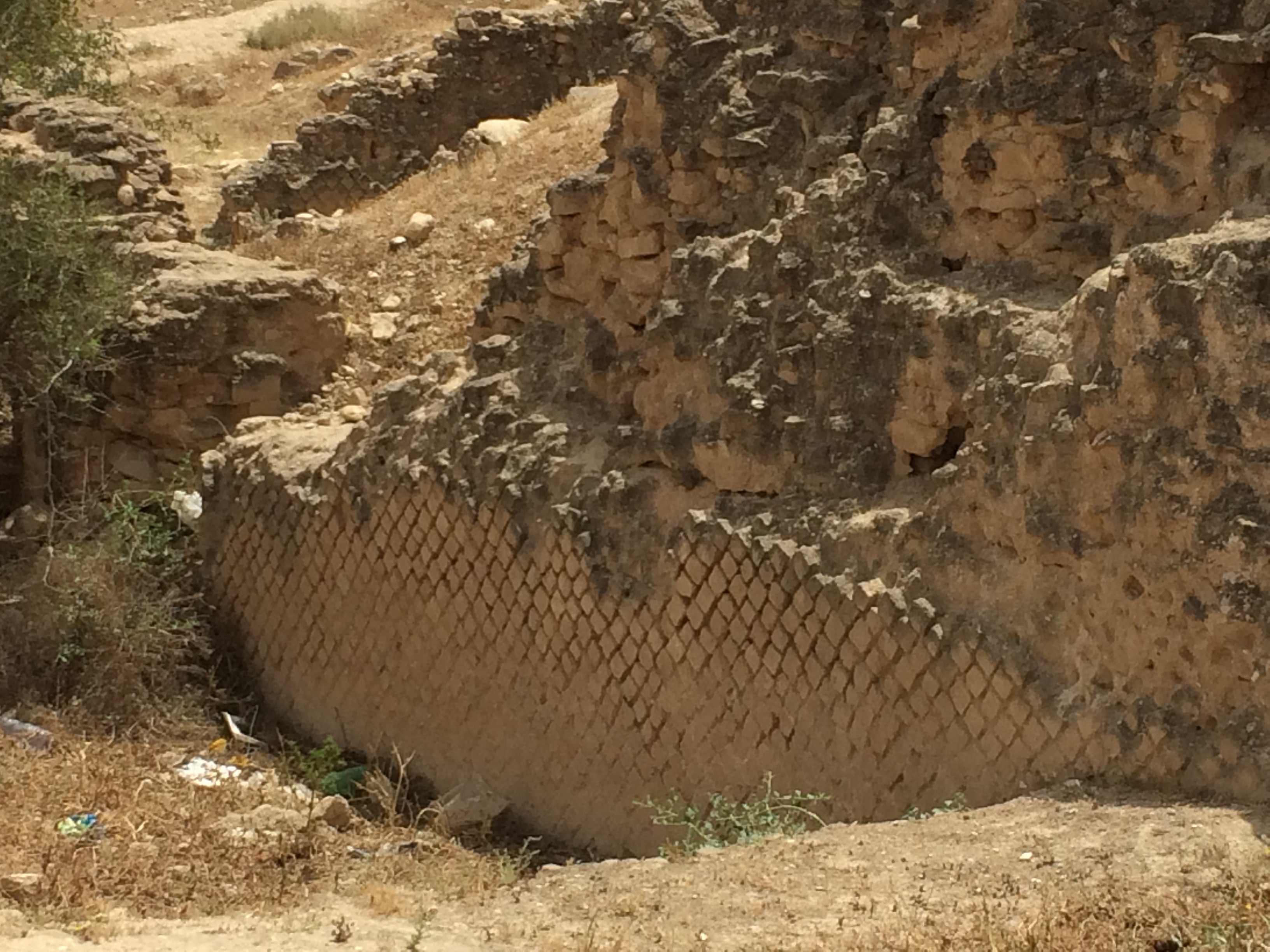
The remains of one of Herod’s palaces

IMG_1527
IMG_1525IMG_1524

Both groups, the Brits and the Francos, were here because of a shared passion for Palestine. It is really good to know that so many people are taking the initiative to try to spread awareness of the reality of the occupation. Israel is a country of remarkable accomplishments and has much to be admired, but  its 48 year old occupation and domination of some 5 million Palestinians is a downward drag. Until it reckons with this, it will never be secure and it is quickly gaining the status in the world of a pariah state. Yes, there are some Palestinian terrorists.  When you consider that a 14 year old in Gaza has experienced 3 full-scale, devastating, infrastructure-obliterating,  inescapable wars, is it any wonder? In spite of this, the overwhelming majority of Palestinians simply want the freedom to live normal lives and support and educate their families.

To Hebron Rehabilitation Committee with Love

I had promised earlier to talk a little more about the work I was doing at HRC. Several months ago, I had answered an online ad seeking an intern to do legal research. After a Skype interview with Nicole, a lawyer from the legal department, I committed to work for them for a month. My initial assignment was to research venues within Europe and possibly the U.S. to bring claims on behalf of Palestinians in Hebron whose human rights were violated. Prior to my arrival, Nicole let me know that the focus of my work would change a bit a to bringing claims in the U.S. There were two primary areas I was asked to research: challenging the tax exempt status of organizations which fund the settlers on the basis that the settlers are committing so many illegal acts against the Palestinian residents.

I’ve talked in previous posts about the horrendous situation in Hebron in which the main street for commerce, Shuhada Street, has been shut down to accommodate just 500 or so illegal Jewish settlers who are trying to reclaim the old city of Hebron. I’ve posted some pictures of the Palestinians shops with doors welded shut by the Israeli authorities. I’ve talked about the devastation to the economy of Hebron and the displacement of 100s of Palestinian families. This was all a result of the terrorist attack by  Baruch Goldstein, a Jewish extremist at the Ibrahimi Mosque in 1994, in which he sprayed machine gun fire in the mosque, killing 29 Muslim worshippers. Israel’s response? Rather than protecting the residents of Hebron, they cut off Shuhada Street, the main commercial area of the old city to create a sanctuary for the radical Israeli settlers, and if that was not enough, they divided the Mosque so that one half is now a Jewish synagogue. Mind you, this mosque has been there as an Islamic Mosque, in a city that has been predominantly Muslim for more than 800 years. But, such is justice under Israeli occupation.

HRC is one of the organizations that has tried to make a difference in this imbalanced equation, fighting for the rights of the Palestinians citizens in the face of a brutal, US-financed occupation. Their primary objective has been restoring buildings in the old city for the use of Palestinians and by doing so, helping to restore the economy  which has been so devastated by Israel’s sequestration of the area. They are funded by many sources, the government of Norway being a major donor. They have done a remarkable job at restoring many buildings in this amazing old city, by many accounts, the oldest city in the world. So they are doing the double duty of preserving antiquities and preserving living and working space for the indigenous population.

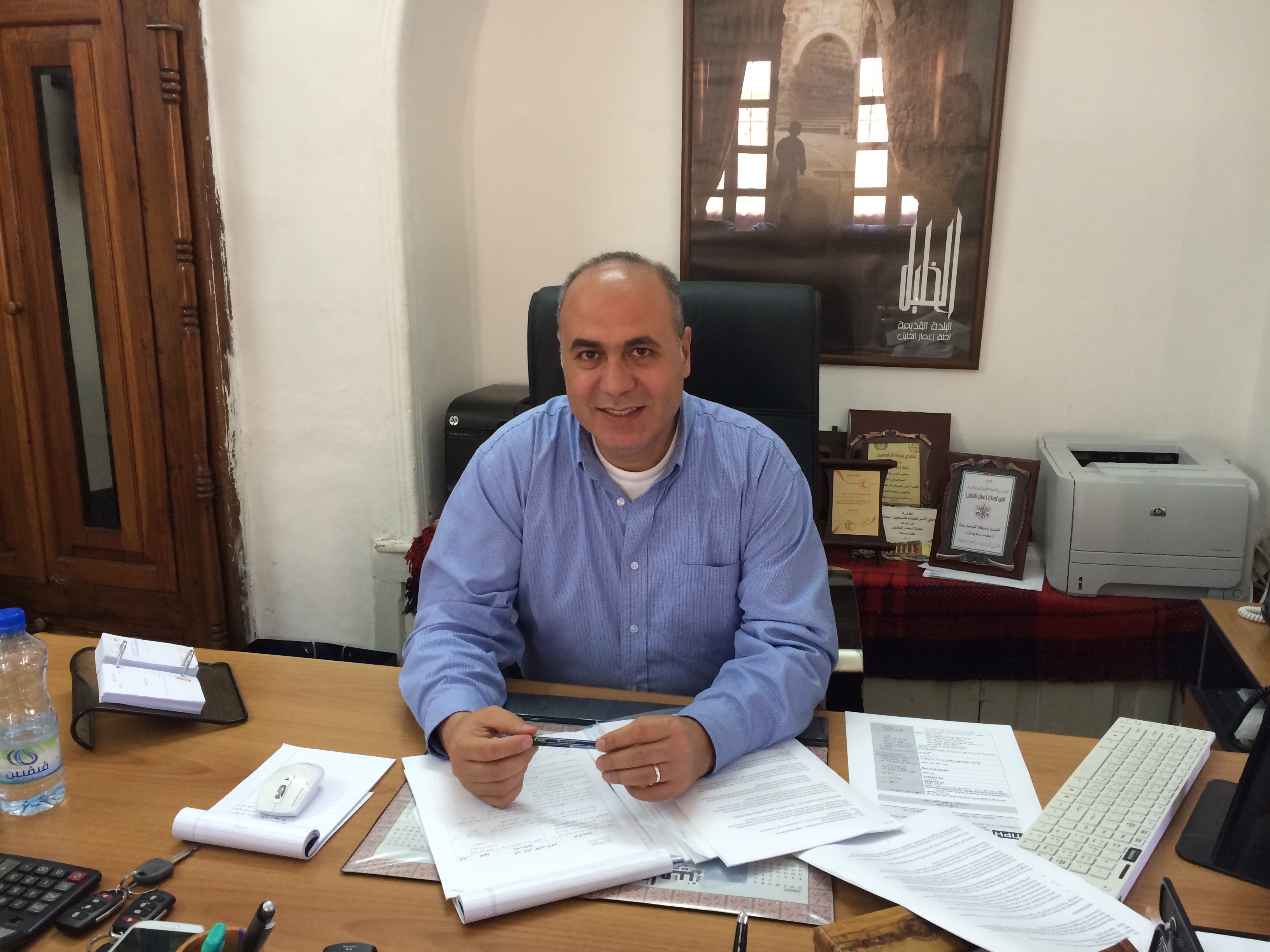
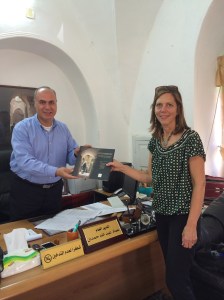
On Sunday, I came into Hebron to drop off my work: two memos on the two different areas of research. Nothing was really scheduled to this end, so I was expecting no more than to just print them out and hand them to someone in the main office who would pass it on to the general director, Emad Hamdan. As it turned out,   Emad was there and was eager to hear about my work. We had a brief meeting, and he expressed great appreciation. The general vibe I had gotten throughout my month there was general incredulity that I, a professional with an office in the US, would take time off to come and do volunteer work in Palestine. I met this with my own incredulity that this could be perceived as such a sacrifice. I felt and feel so very honored to have been able to work in this beautiful place amongst these dedicated, resilient people who are working every day, years on end against such incredible odds. By comparison, what I had done is such a tiny drop in the bucket.

IMG_1428

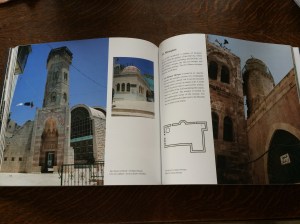
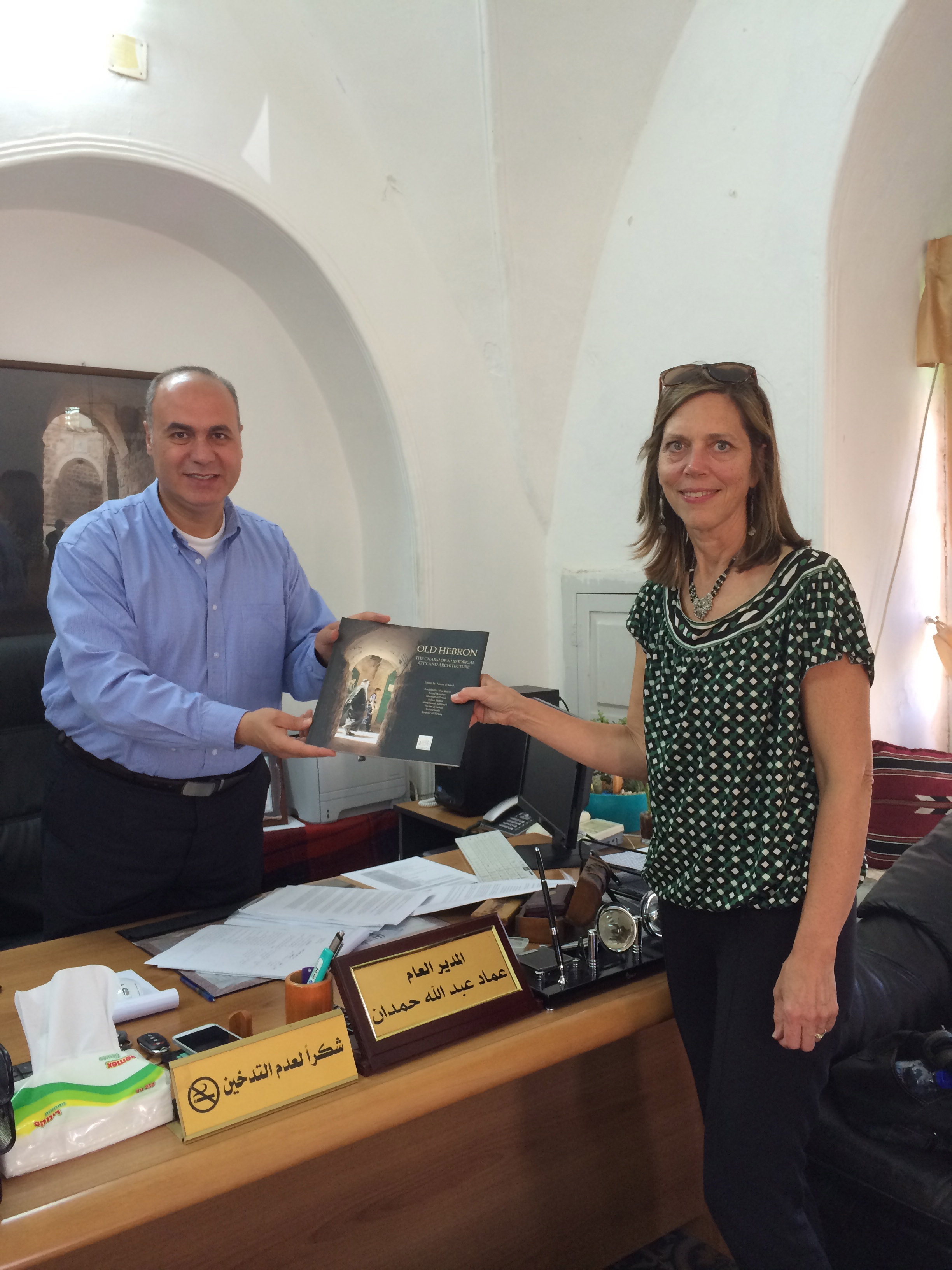
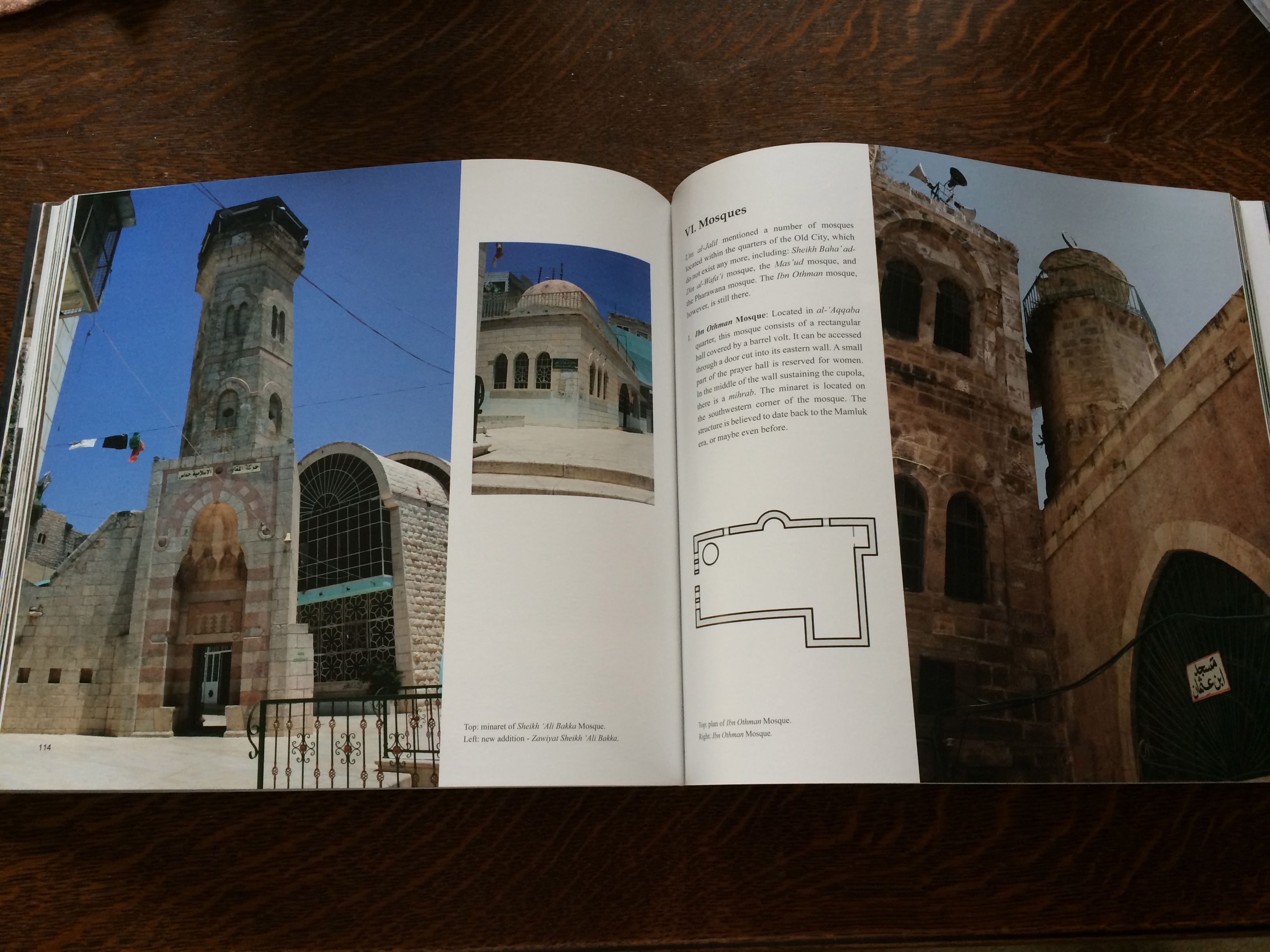
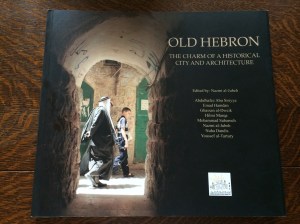
Emad presented me with a beautiful book that HRC had commissioned called “Old Hebron: the Charm of a Historical City and Architecture” which will preserve my memories of this charmed and beleaguered place and grace my coffee table for years to come.
IMG_1431

IMG_1532 IMG_1533

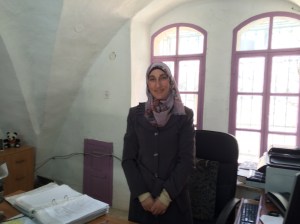
I also want to express my warm wishes to some of my HRC cohorts. Unfortunately I did not get a picture of Tawfiq Jashan, the permanent, local staff attorney.
IMG_1417

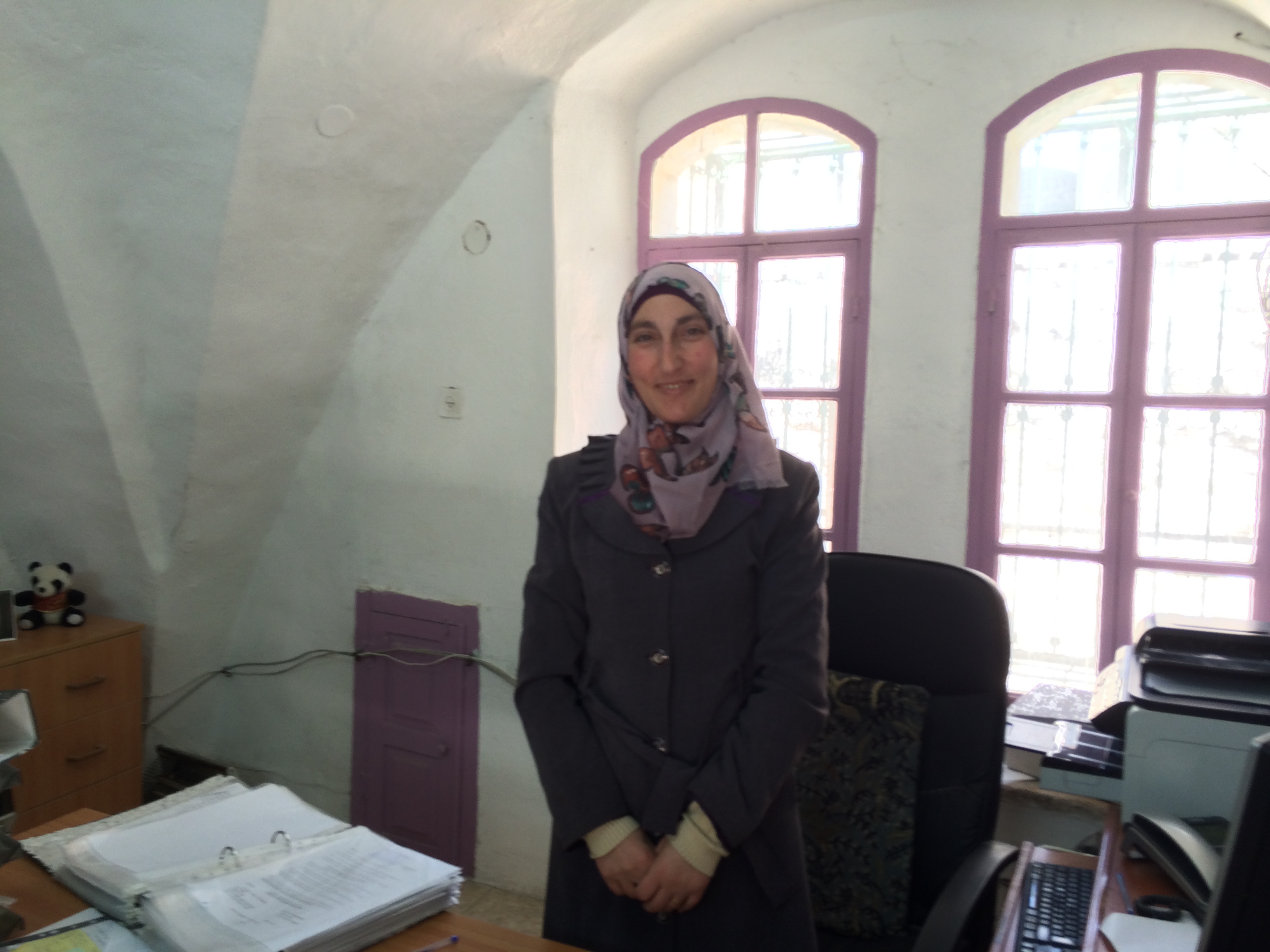
However, here is his secretary Lama who graciously brought me wonderful Turkish coffee on many cold mornings.

I had previously mentioned Sami, (Zbnek Wojowski), the general coordinator guy. Sami is from the Czech Republic and and has been there for seven, going on eight years. He has made himself rather indispensable. He is one of the few fluently English-Arabic, bilingual staff at HRC, in addition to knowing all of the inner workings of the organization. He translated for my initial meeting with Tawfiq during which Tawfiq praised Sami effusively, noting that he  was sure that Sami would someday be the president of the Czech Republic. When I mentioned this later to s0me of the others, they  laughed about how Tawfiq likes to butter people up, but the message regarding Sami’s value to the organization was clear.
IMG_0688

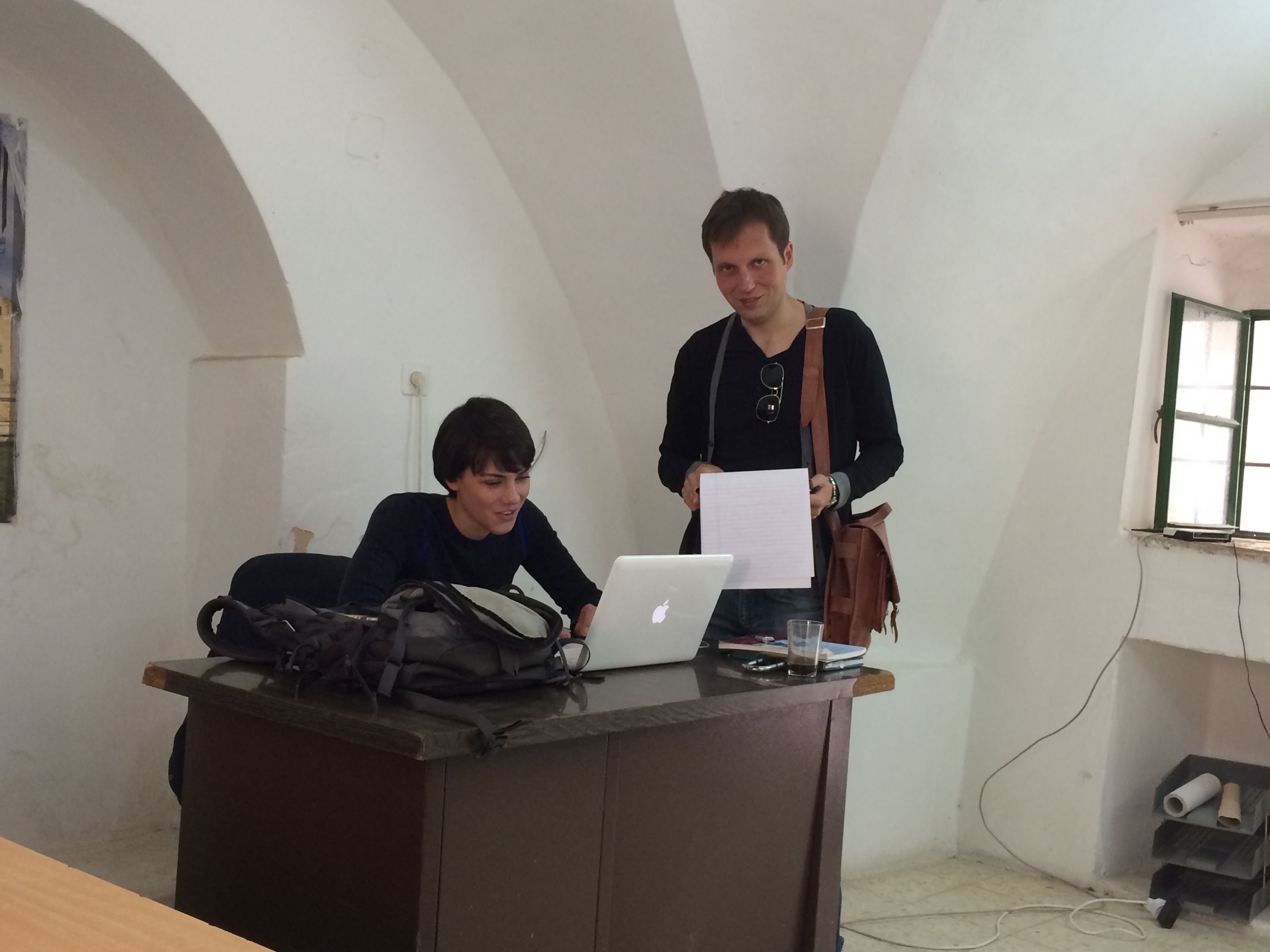
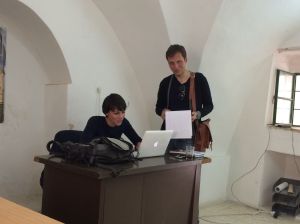
So, here is a picture of Sami, with my office mate Samantha. Samantha is from Canada and is in the legal department doing a volunteer stint helping out on some reports about the local conditions. She provided some good laughs and respite from some heady work.

And finally, Nicole Trudeau is the lawyer from the US who hired me via a Skype interview. I didn’t see a lot of Nicole during my month, as she is out in the field and doesn’t usually work at the HRC buildings.
IMG_0722

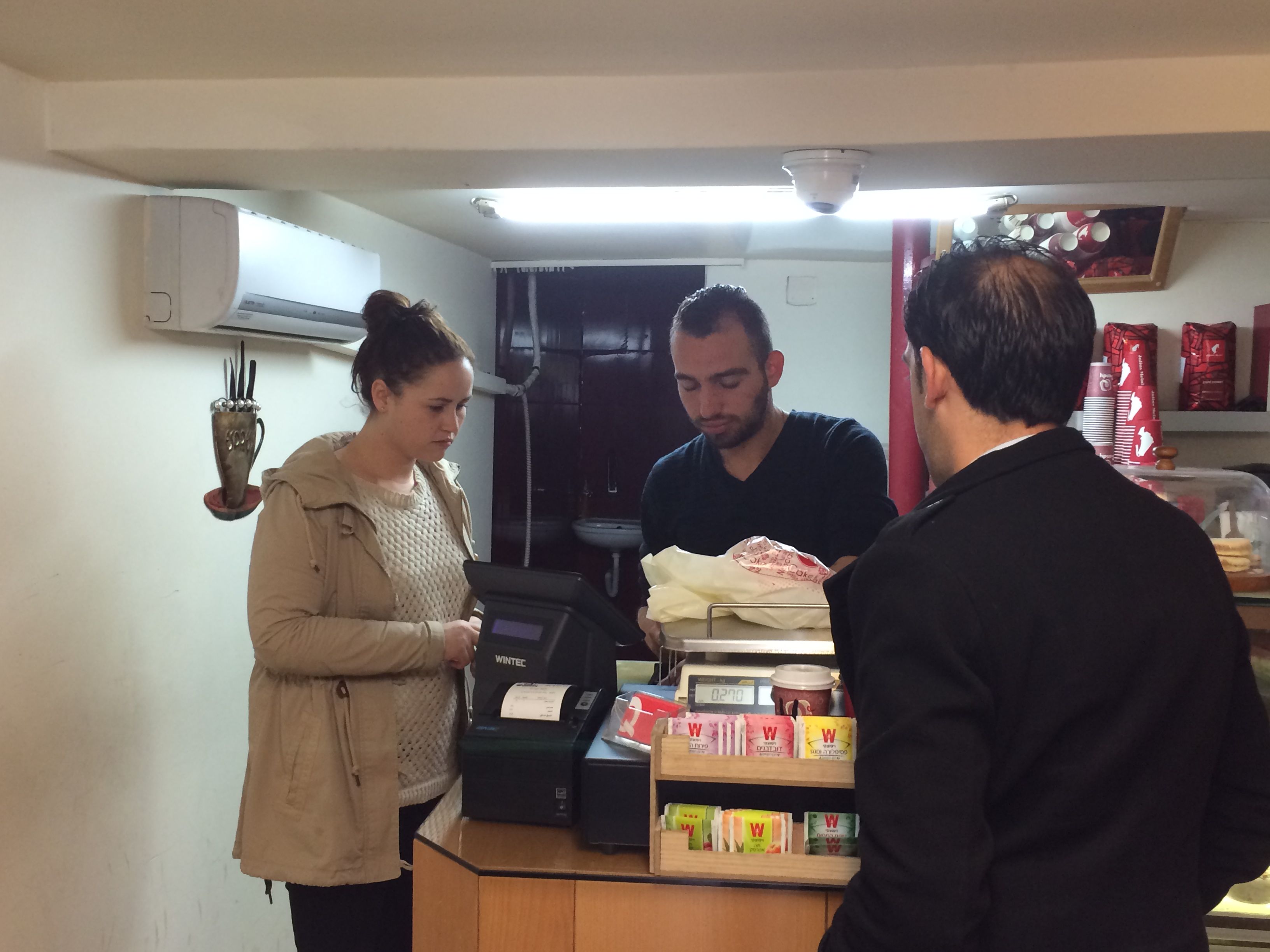
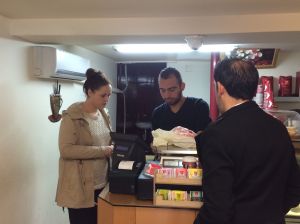
This is a pic of our initial meeting at one of her favorite hangout places, Q Candy (along with Samantha – they are roommates, btw) which is a kilo or so from the Old City and serves great coffee in any style imaginable for a fraction of what Starbucks charges. Nicole is another attorney who had a left behind a lucrative career as a litigation attorney in Rhode Island to work for a fraction of the pay at HRC.  There is something about Palestine that really captivates the soul of many of us internationals.
IMG_1434

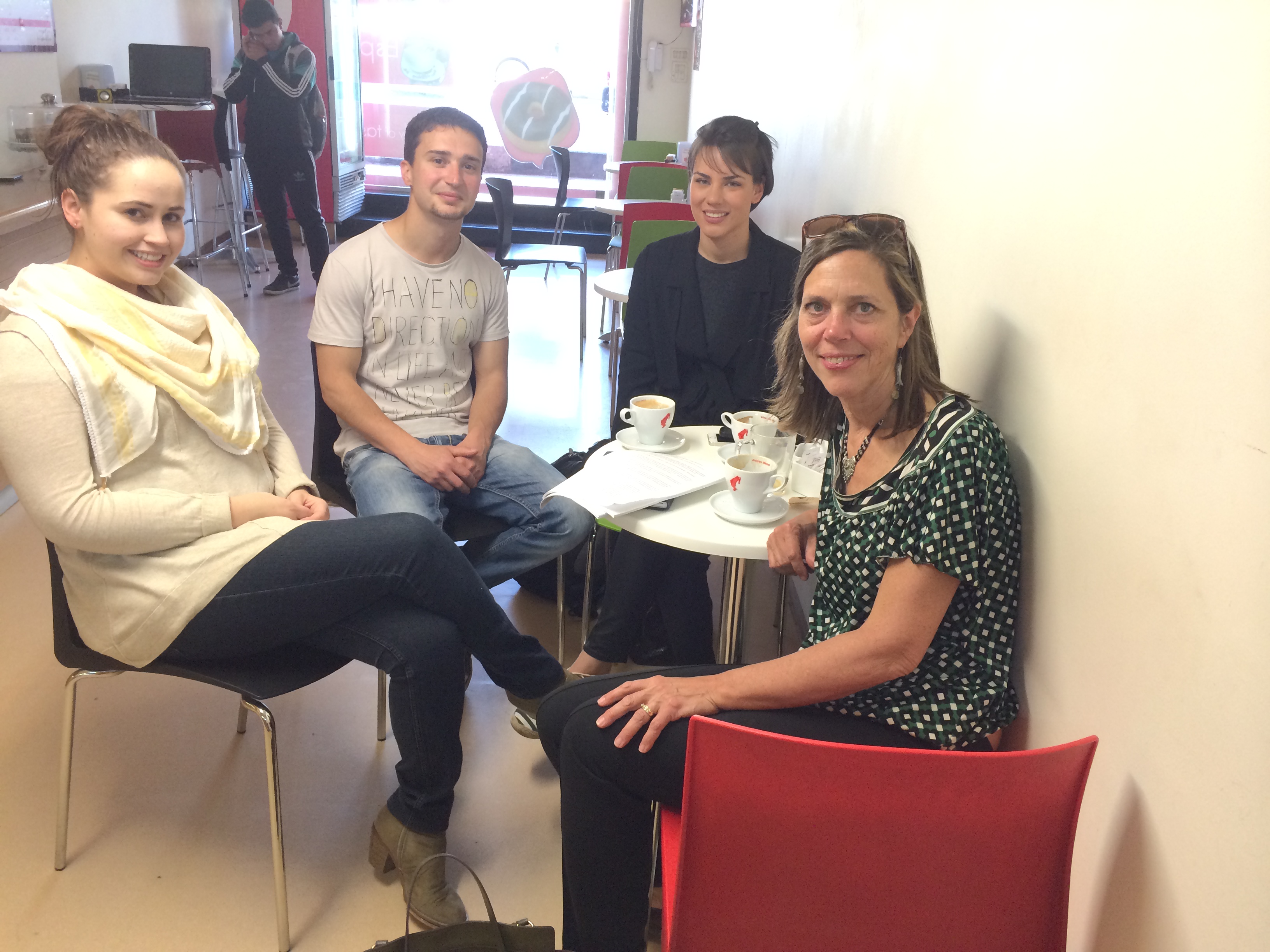
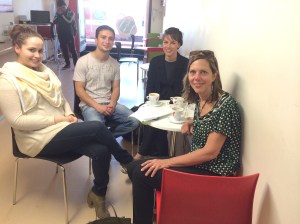
And then another picture of our final meeting on Sunday for farewells. The young gent is Stephen, also a lawyer doing volunteer work. He is from Bulgaria.

So, in closing, I just want to share some more pictures highlighting the beauty of the old city of Hebron which HRC is so diligently working on to preserve for its indigenous, Palestinian residents.  (Keep in mind that you can click on pictures to enlarge them for better viewing.)

P1120314 IMG_0859

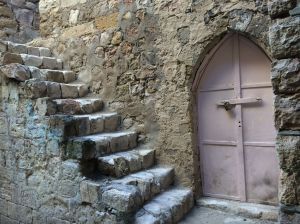
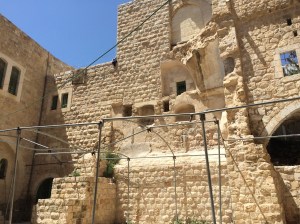
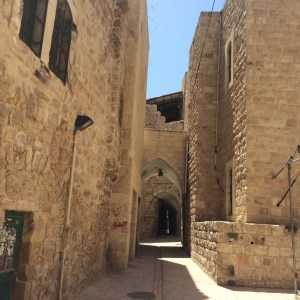
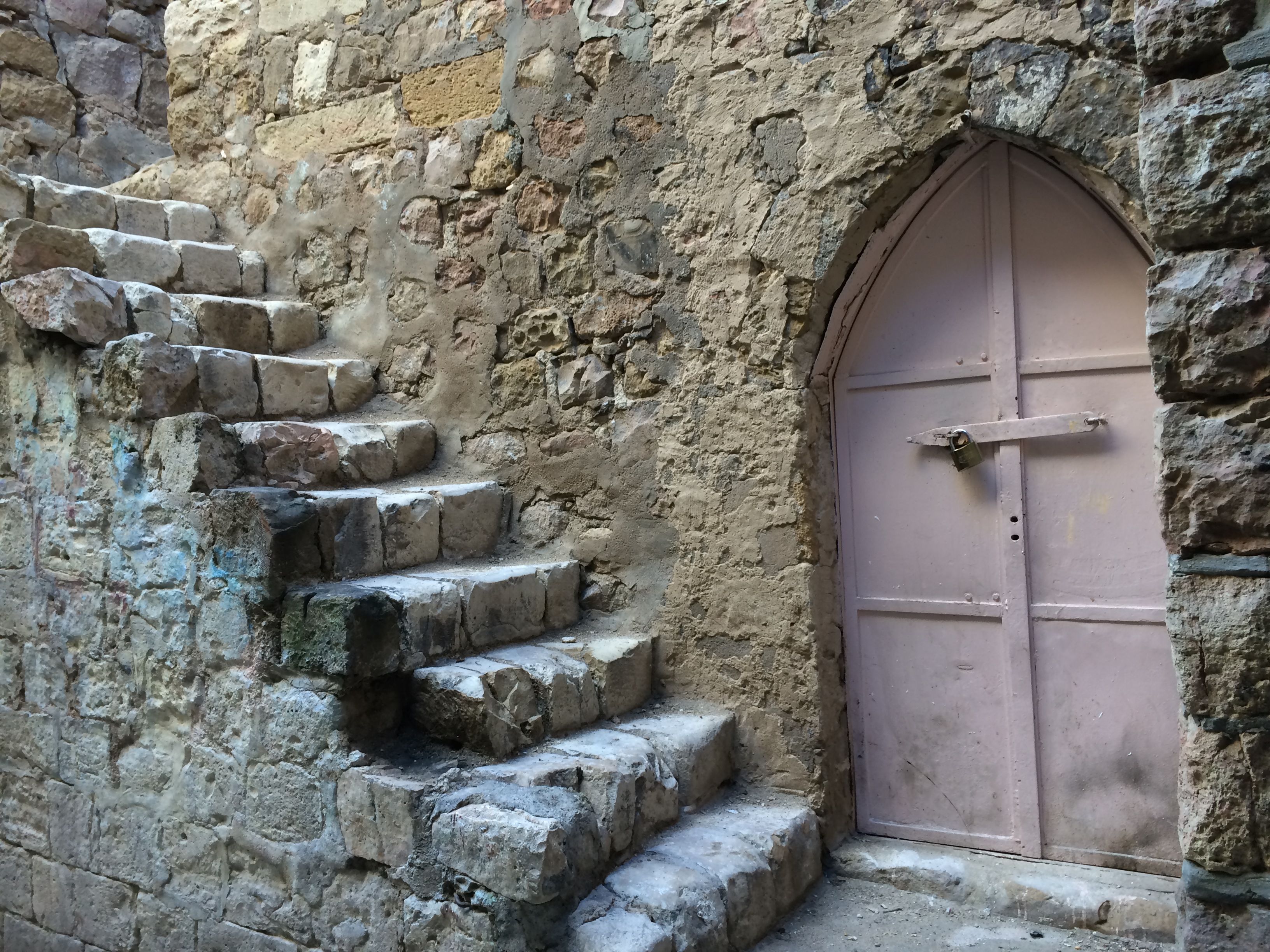
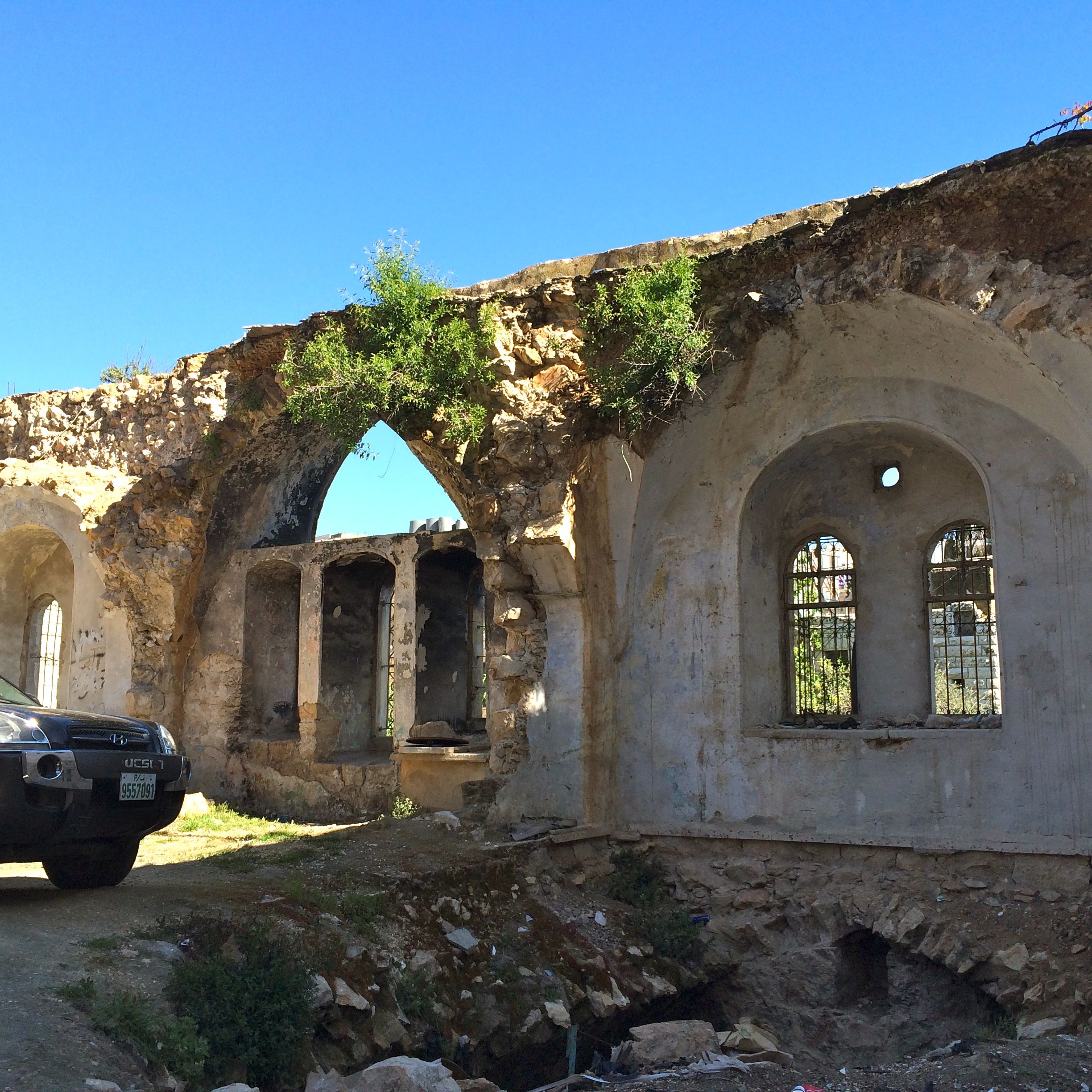
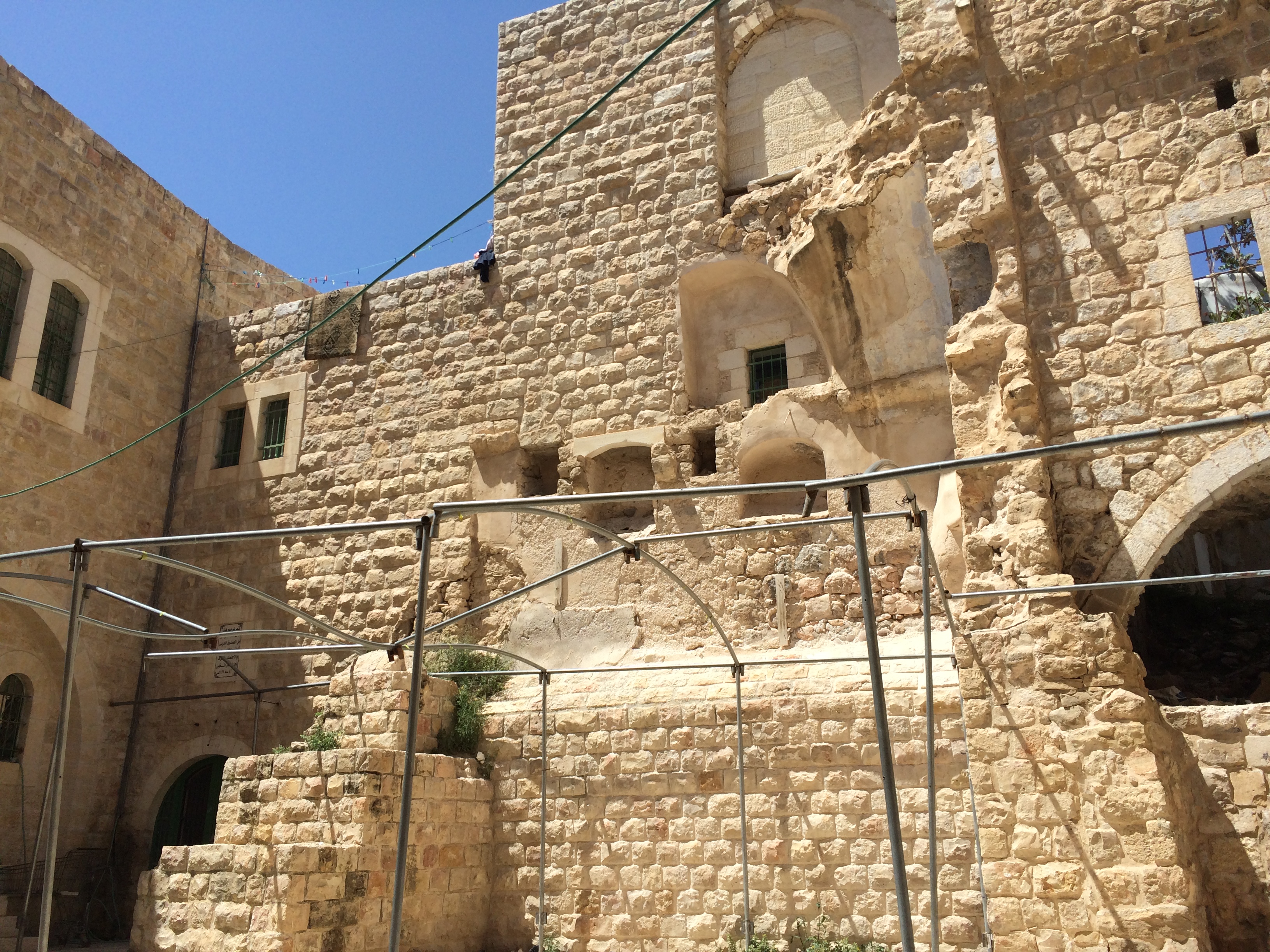
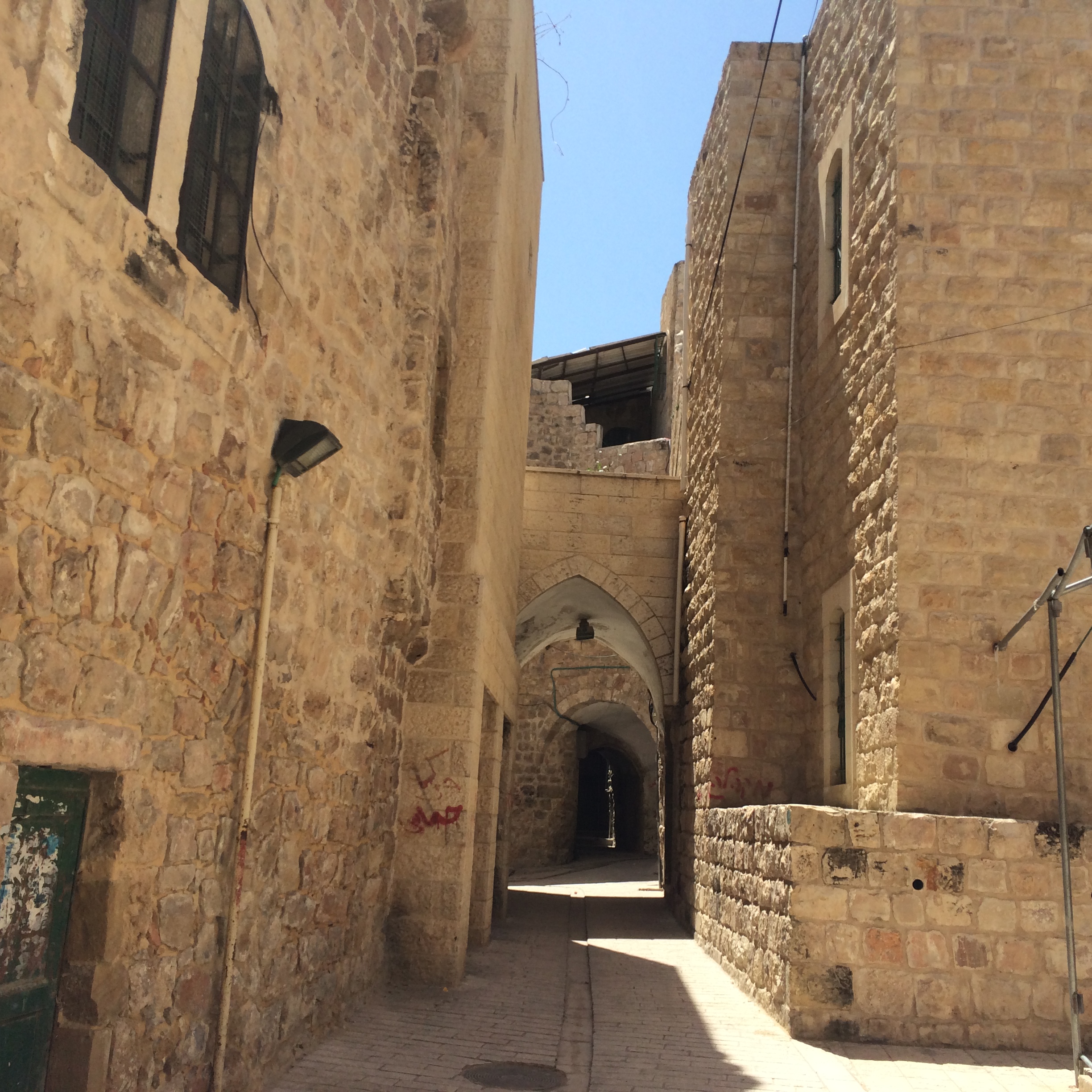
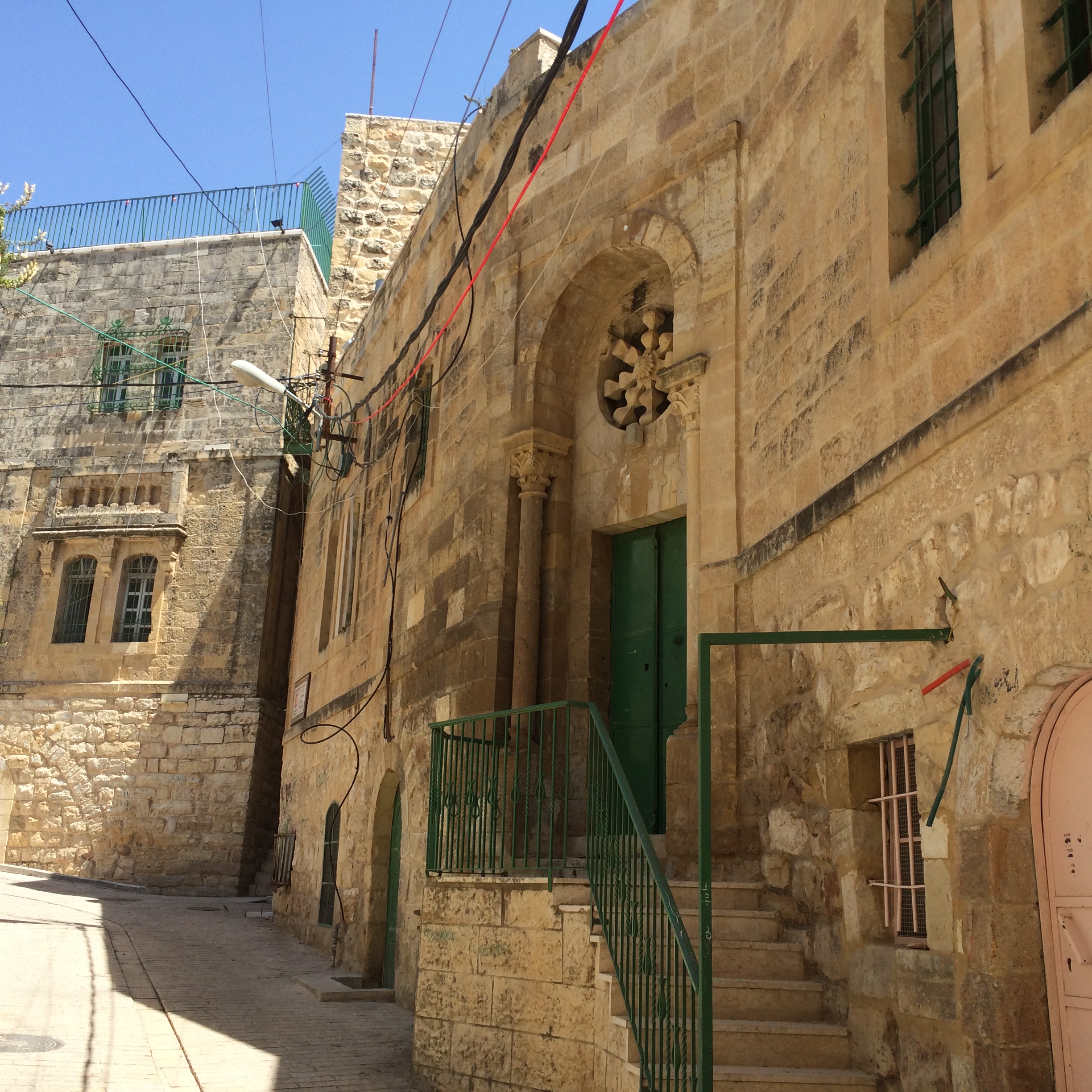
These are examples of the narrow streets, and passageways and little staircases leading up to homes one sees throughout the old city.P1120320 IMG_1063
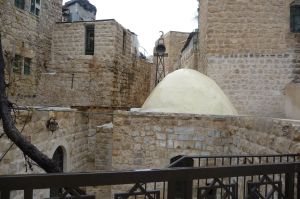
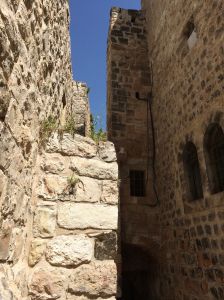
Looking upwards at a couple of buildings
IMG_1414 IMG_1415

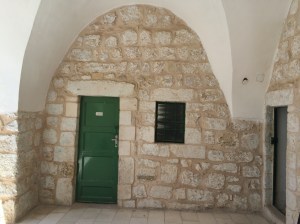
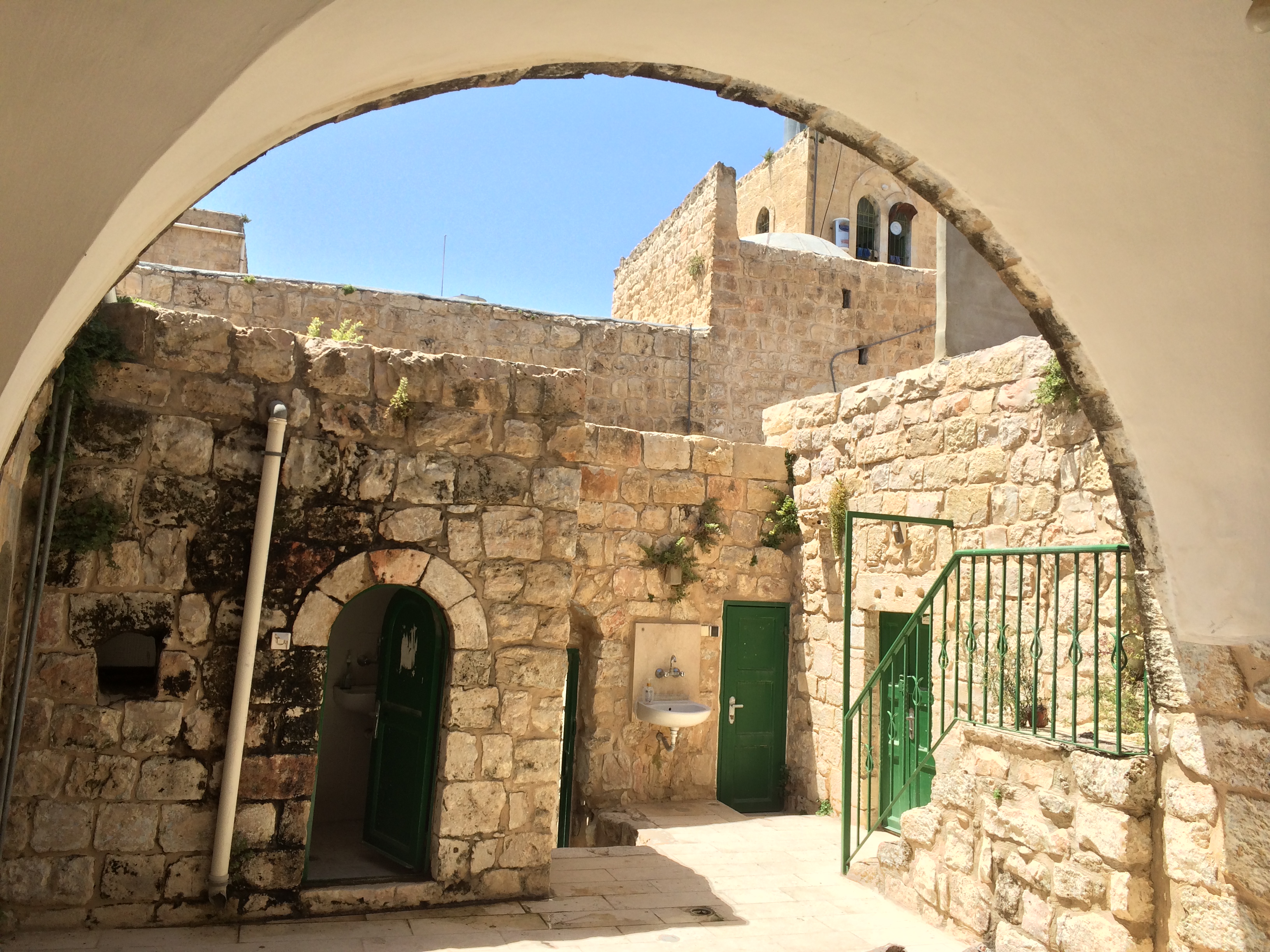
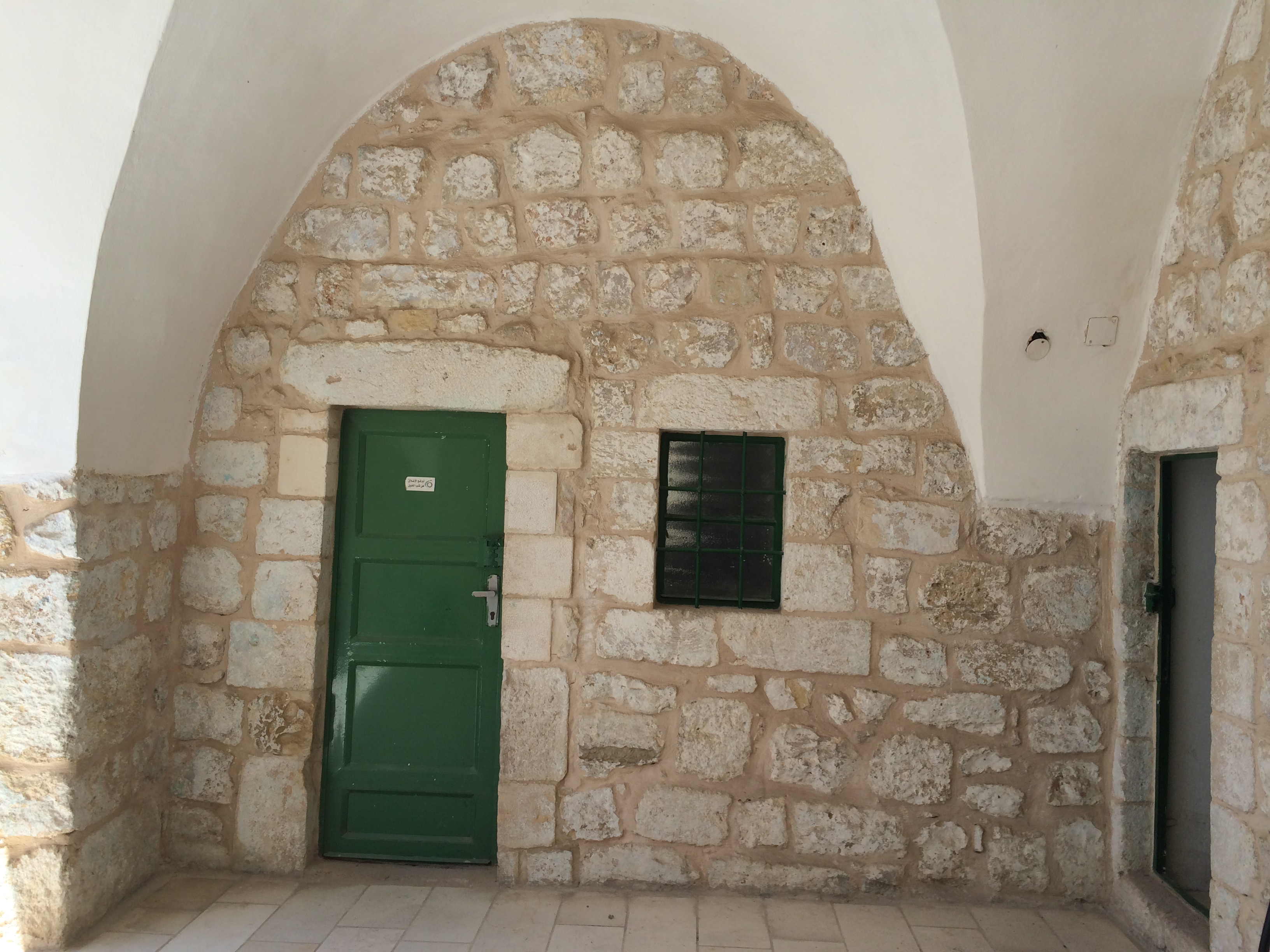
These two are from the breezeway of the legal unit. I spent a good amount of time here  catching sun on some of the cool days wen the stone of the office retained the cold from the previous night.

IMG_0847

An example of a building that has been left to deteriorate.IMG_1418 IMG_1419 IMG_1420 IMG_1424  IMG_1426

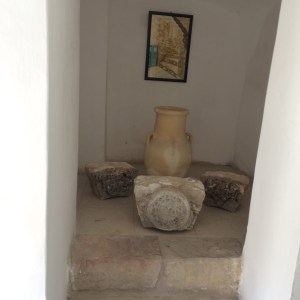
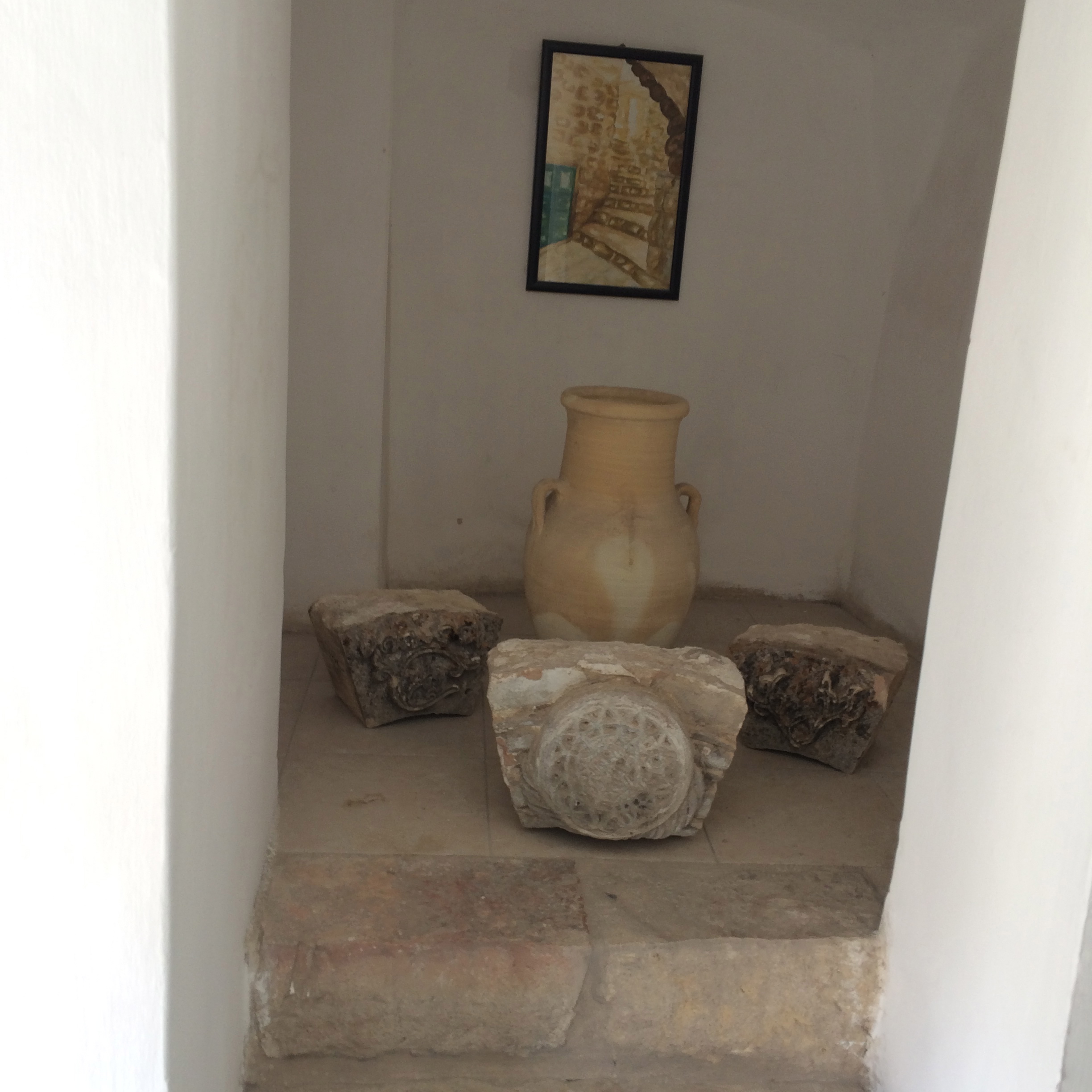
Some artifacts in a cubby in the main HRC office.
SANCTUARY

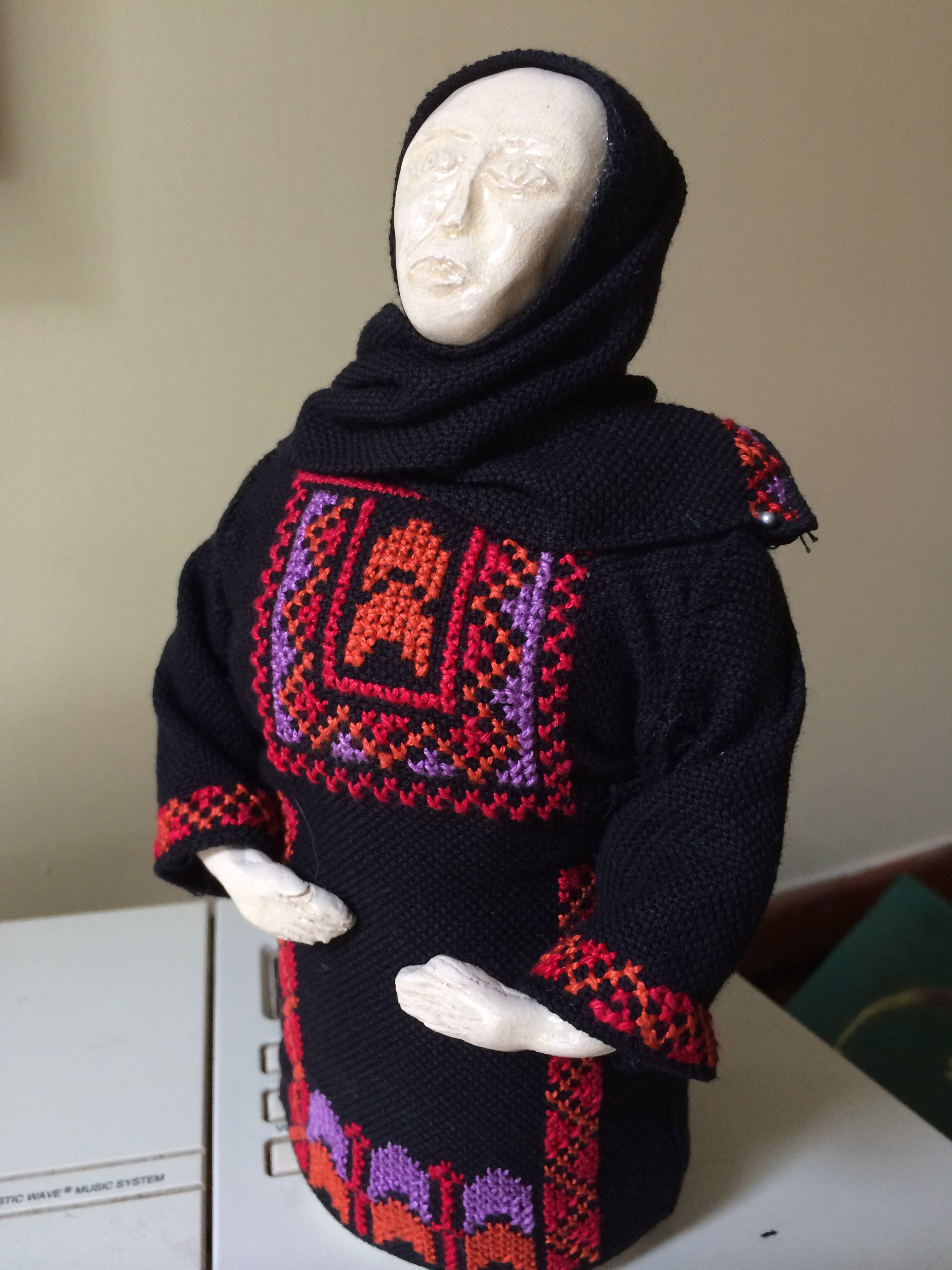
As expected, my month flew by. The last couple of days were a whirlwind of trying to fit everything in. I had made arrangements to meet with Mitri Raheb’s wife, Najwa at Dar al Kalima Univeristy where she works. Alas, our wires crossed and she was just leaving for a dentist appointment as I was arriving. So she was able to give me a lift back into town, but I never did get to see the university. Dar al Kalima is just one of the many things that Mitri has spear-headed for the benefit of the people of Bethlehem, both Christian and Muslim. The Diyar Consortium is another. http://www.diyar.ps/ It is located right next to Christmas Lutheran Church. The center itself is beautiful and includes a guest house and coffee shop. I failed to get pictures.  Among the its many functions is a children’s summer program, an elderly care program and a really wonderful craft center where beautiful crafts made by community members are sold. I bought this lovely little figurine.
IMG_1531

She’s a handmade clay figurine with a the traditional dress worn by older Palestinian women adorned with the classic cross-stitched embroidery. I  had actually had my eye on it last year, but didn’t think I’d have the space to bring her back safely. Fortunately, she waited for me and I was able to bring her home this time.

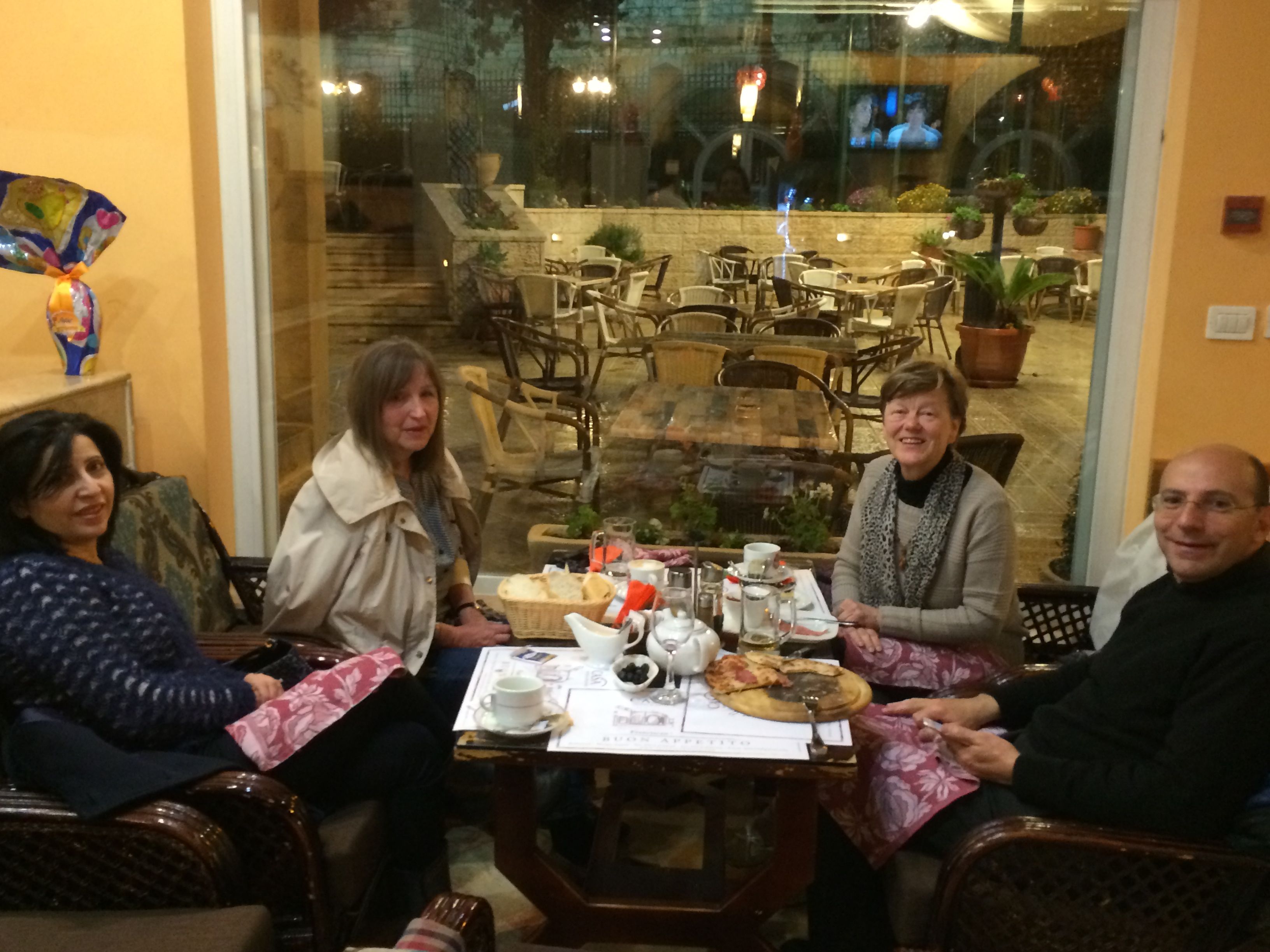
In addition to a meeting I had with Mitri a week or so into the trip, he had invited me to dinner along with his wife and two delightful ladies from Finland. This was from a couple of weeks ago, but fits with the the topic here.

IMG_0812

Here we are after having enjoyed dinner at Nativity Square.

If you want to read about the Palestinian plight from a Christian perspective, Mitri’s book, Faith in the Face of Empire is a must read.  It’s very accessible and succinctly lays the background of the struggle and what Palestinians continue to endure under occupation. http://www.amazon.com/Faith-Face-Empire-through-Palestinian/dp/1626980659/ref=sr_1_1/190-3651443-6976260?s=books&ie=UTF8&qid=1430316286&sr=1-1&keywords=faith+in+the+face+of+empire

But the main reason I mentioned the failed meeting with Najwa is because I had planned to spend my last full day (Sunday) in Hebron and was not planning to go to church. She mentioned, however, that I had told Mitri I would be there. Not that I would have been particularly missed had I not gone, but I just felt it wasn’t right to miss my last Sunday there. So, I went and had a brief goodbye with Mitri prior to the service as I didn’t have time to dawdle afterwards. The service was wonderful. Some parts were in English. His sermon was not, but he gave a brief synopsis in English afterwards. I had picked up bits enough to know that he was talking about the Armenian genocide which was being commemorated that weekend and he had tied in other genocides as well, including Hiroshima and Nagasaki and of course the Holocaust – heavy stuff and a reminder of how brutal mankind can be.

I’ve posted pictures of Christmas Church in an earlier blog entry so won’t repeat them here, but this is a shot that I took that morning. The writing on the windows is in German since the church was originally built by Germans. I love all of them, but this one in particular: Bread of Life.

IMG_1398

I then rushed off to Hebron to say goodbye which deserves its own post.

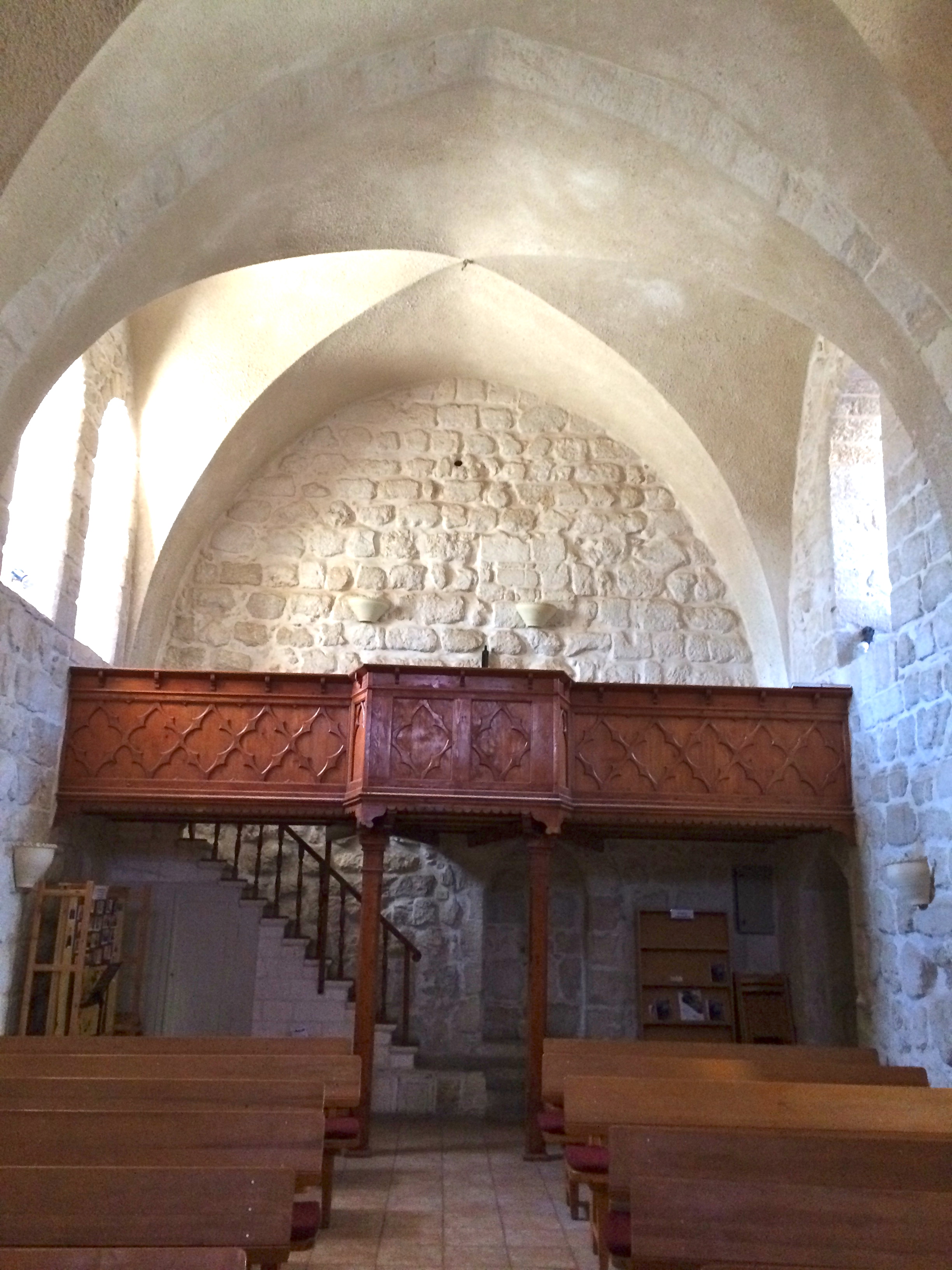
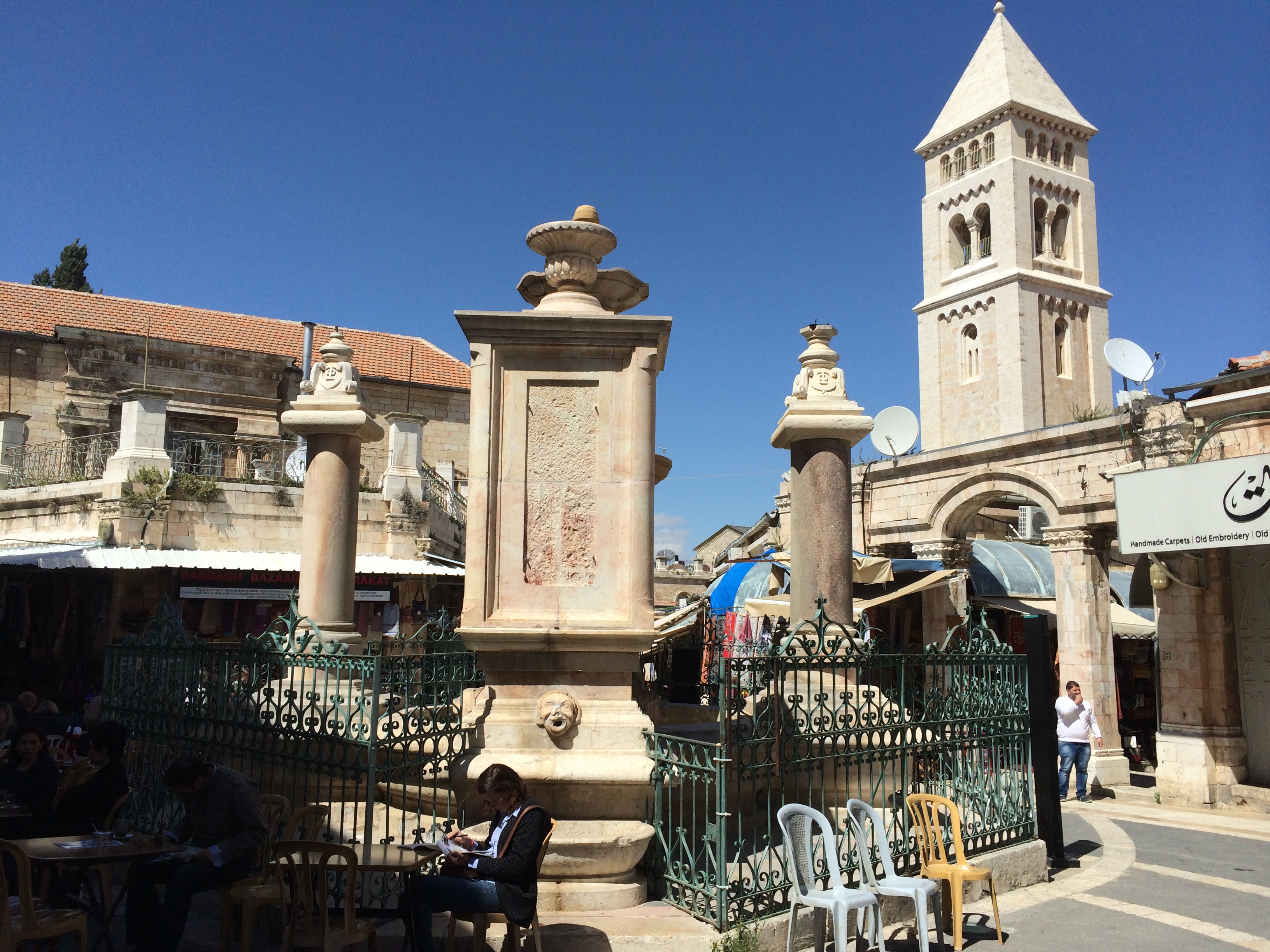
Before I go there, however, I want to mention how comforting and welcoming I find both Christmas Lutheran Church and Lutheran Church of the Redeemer in Jerusalem . Both cities, Bethlehem and Jerusalem are lovely and old, but bustling and chaotic. Both churches provide a  beautiful respite from the noise and the chaos. When I was in Jerusalem the day before, I wandered into the church. I snuck into the chapel which is a smaller worship area. The caretaker saw me and welcomed me.

IMG_1336 IMG_1337

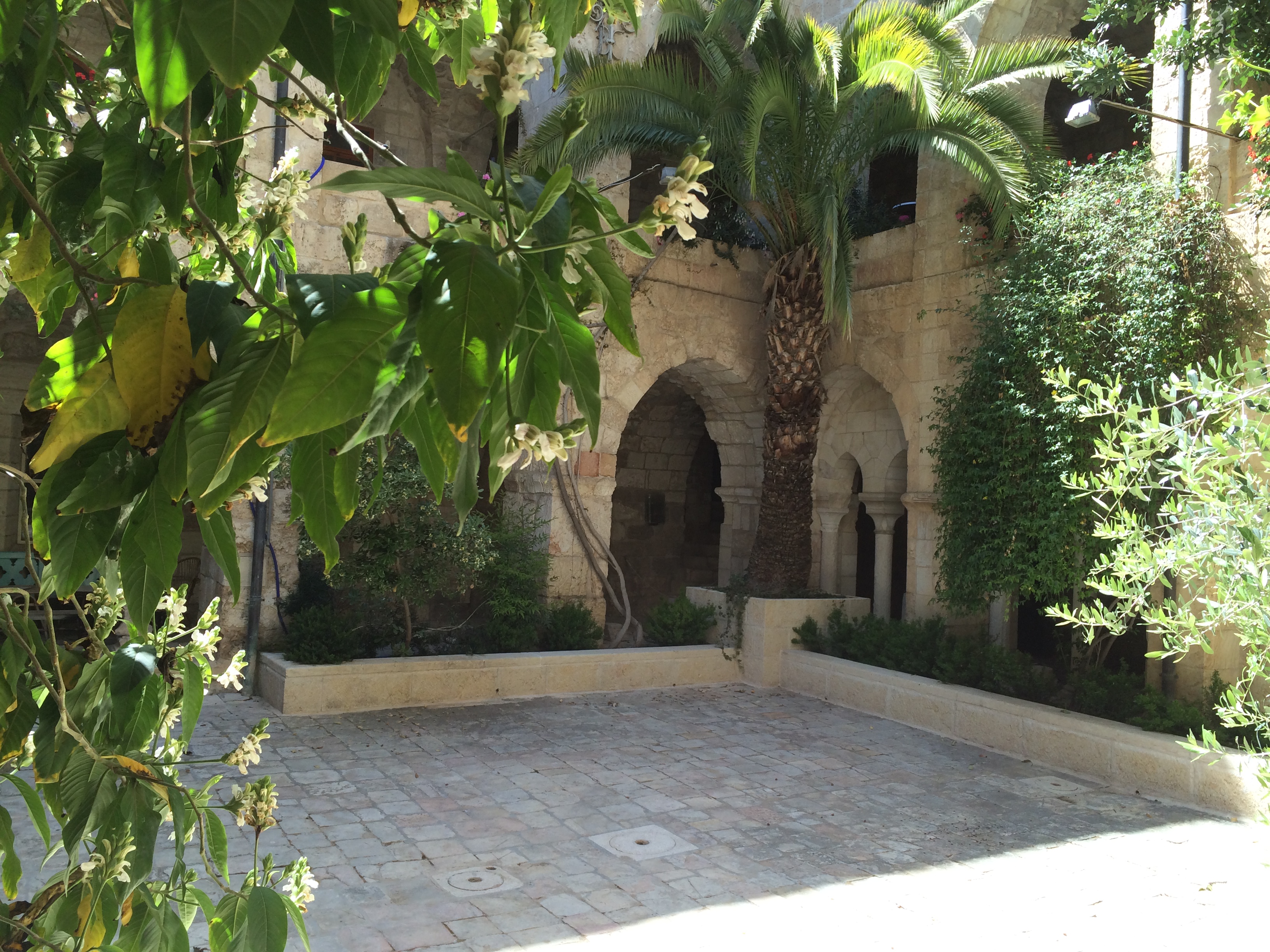
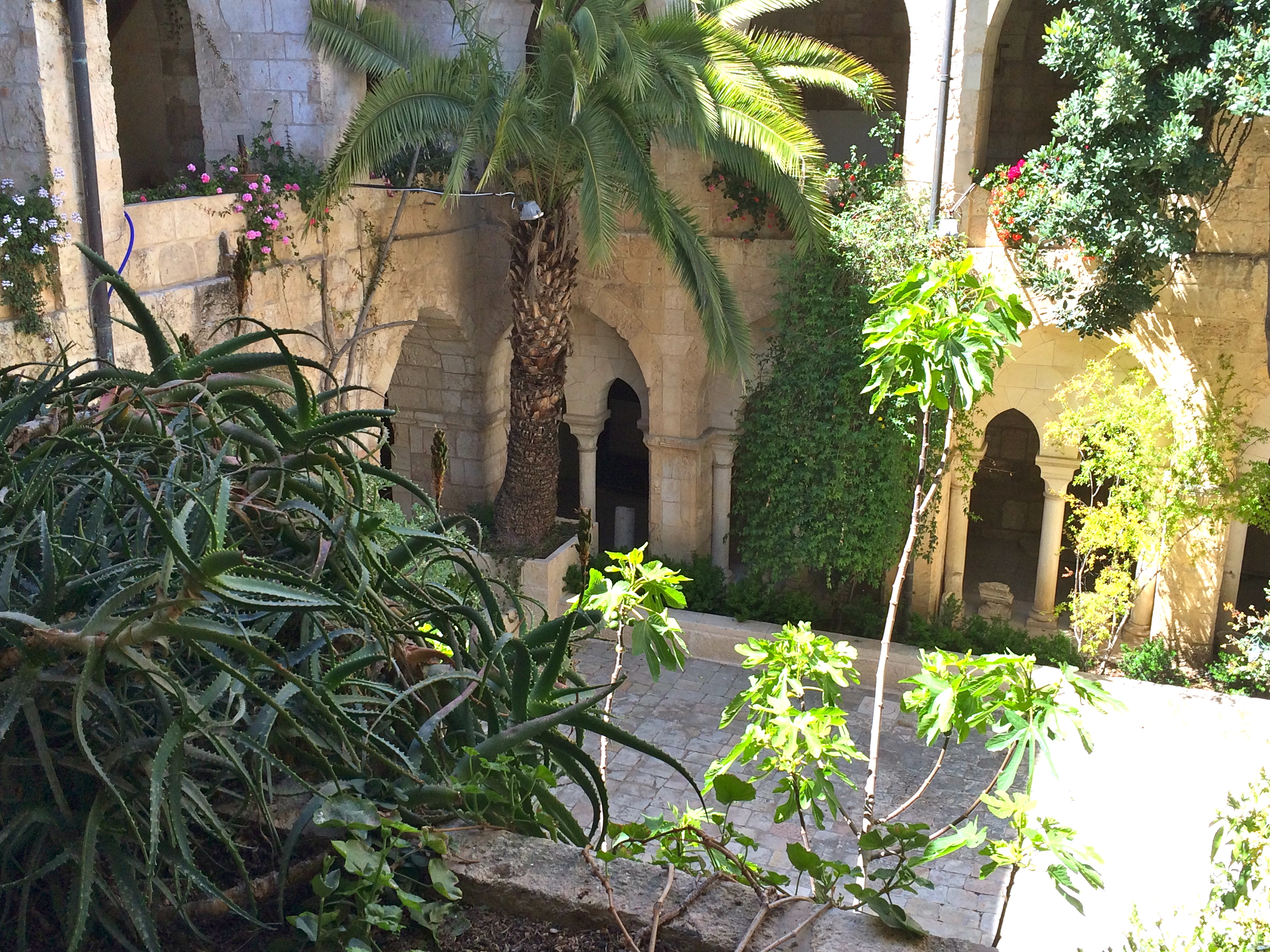
And the church also has this inner wonderful cloister-like area. I found a deep and great appreciation for the word sanctuary from this trip.

IMG_1331  IMG_1334

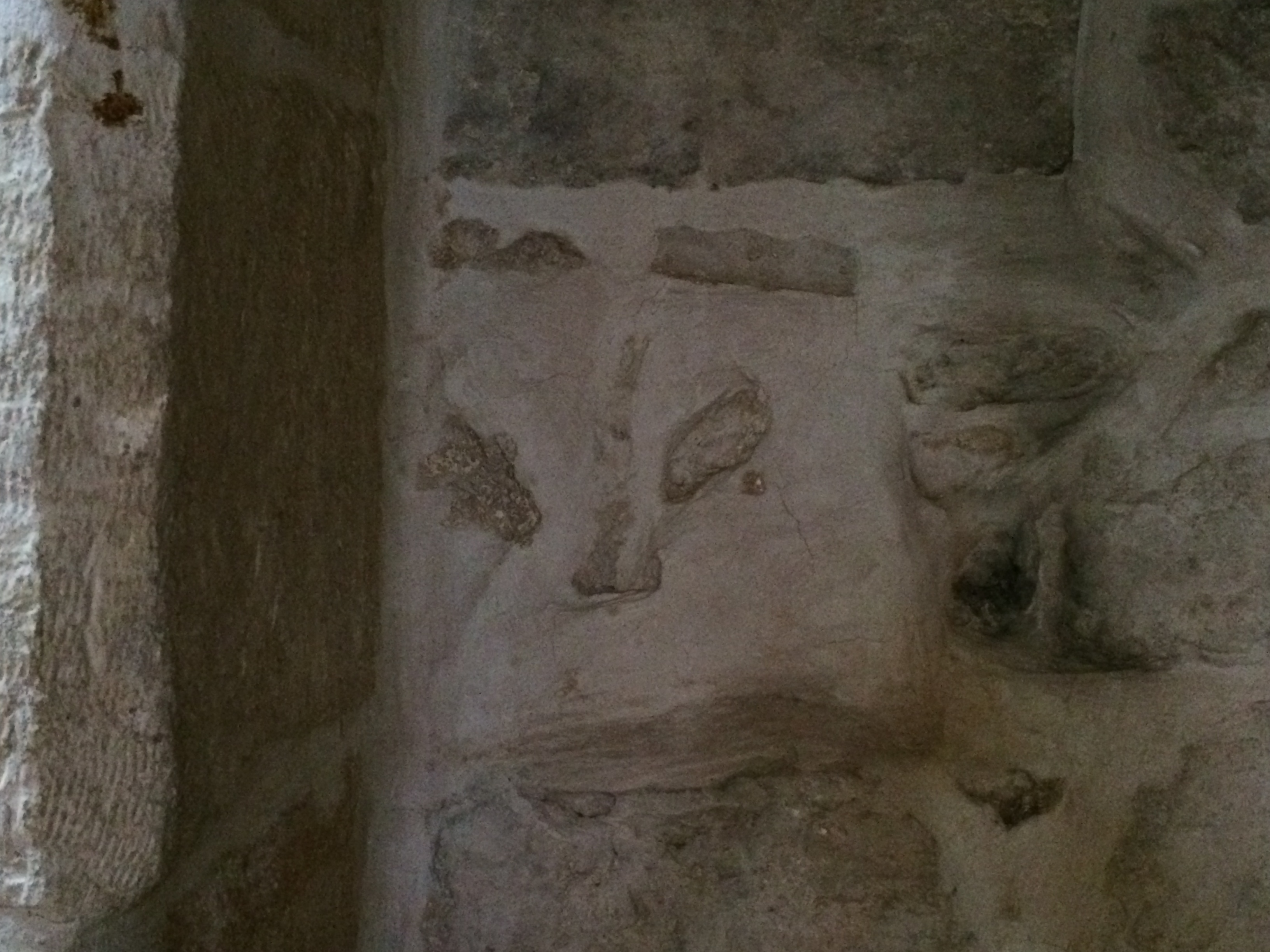
This little detail was in a cubby. I was struck by the unintentional face in the stone.

IMG_1338

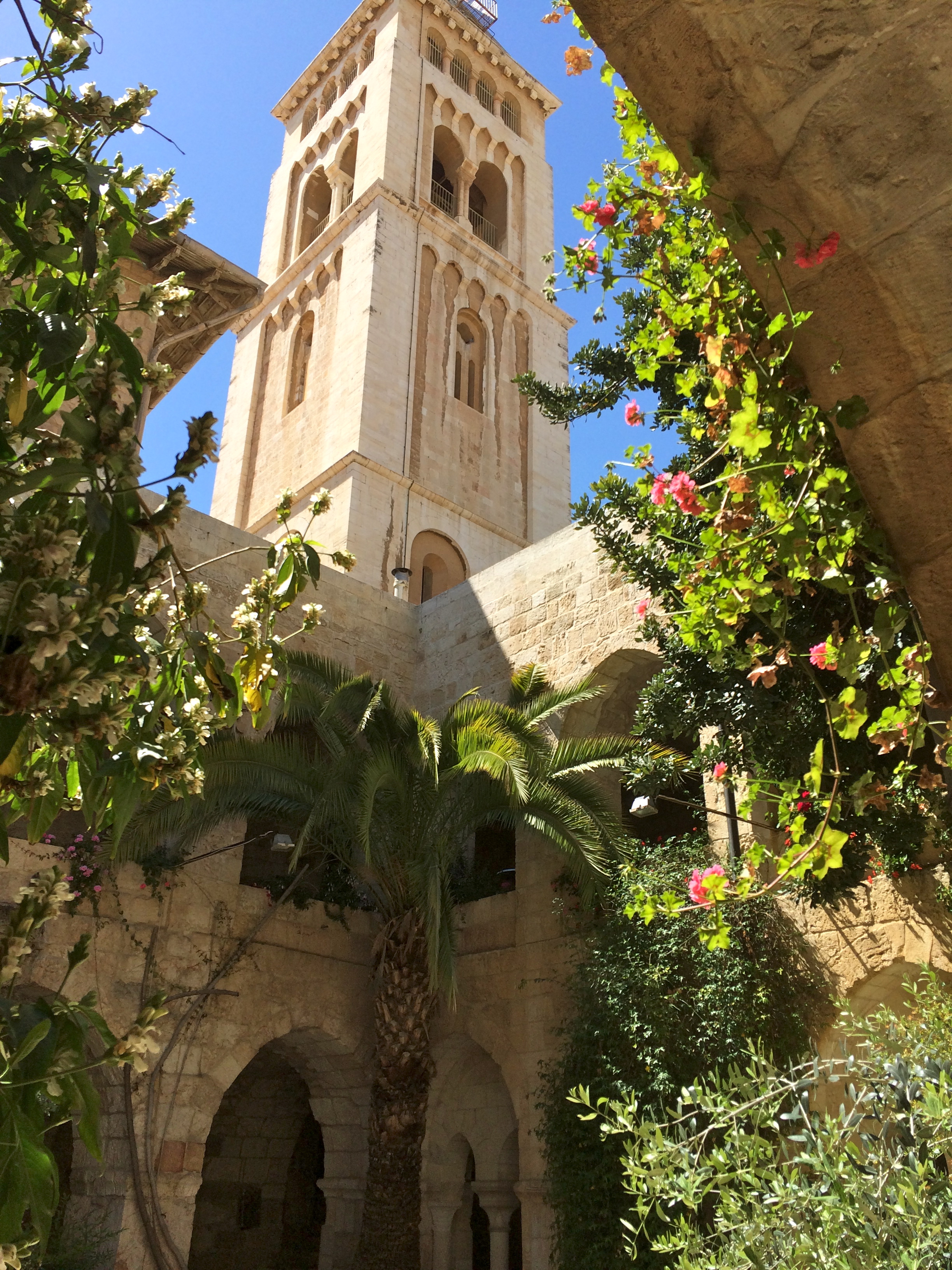
And some views from the church from outside. My only regret was that I didn’t get to try out the organ. As wonderful as the caretaker was, he wouldn’t give me leave to that – this was the providence of the organist!

IMG_1333 IMG_1340